

The Larkin trade gives the Canadiens their second-line center. On Sunday night, Kent Hughes sent Michael Hage, Kirby Dach, Samuel Montembeault and four draft picks to the Detroit Red Wings for captain Dylan Larkin and two picks. For two straight summers, the biggest question in Montreal was who would play behind Nick Suzuki. The answer is a 30-year-old with an Olympic gold medal and a contract that runs through 2030-31.
Here is the deal in one line. Detroit gets Hage’s rights, Dach, Montembeault, a first-round pick in 2027, a second-round pick in 2027, a fourth-round pick in 2028 and a first-round pick in 2029. Montreal gets Larkin plus Detroit’s second-round pick in 2028 and third-round pick in 2027. Both first-round picks are protected in the top 10. The price is high either way. Our read: it is worth paying. Our full breakdown of the trade has the contract and the timeline. This piece is about what it changes on the ice and who comes out ahead.
The Hole at Second Center Is Finally Filled
For two summers, the Canadiens had one problem everyone could name: nobody to play second-line center. Hage was often presented as the answer. That was never a fair job description for a 20-year-old who has not yet established himself in the NHL. Even if he becomes that player, he would not have been ready to carry the role the day he arrived, and expecting him to do it would have been unfair to him.
Larkin does not need time. He has been Detroit’s number one center for years, and he arrives with 818 NHL games, 278 goals, 371 assists and 649 points. Behind Suzuki he moves from the top job to the second job, and that is exactly how a strong second center is built: a player who could lead a line on most teams, playing against the other team’s weaker matchup.
When Larkin changed his mind about leaving Detroit matters far less than the result. It could have been two months ago, two weeks ago or two hours before the deal. The Canadiens took the biggest hole in their lineup and filled it with the best solution available. A weakness became a strength.
Why Larkin Checks Every Box on Our List
Before the trade, the profile we wanted was clear. Larkin matches almost every line of it.
| What We Wanted | Dylan Larkin |
|---|---|
| Shoots left | Larkin shoots left, which gives Montreal a different look in the middle of the ice |
| Faceoffs | 52.8 percent for his career, 53.4 percent this season |
| Production | About 28 goals, 37 assists and 65 points per 82 games over his career |
| Power play | 86 power-play goals and 179 power-play points in his career, a natural bumper |
| Skating | Elite speed for a center, he can drive play through the neutral zone |
| Workload | Played 20:11 a night last season, top 8% among NHL forwards, and 19:33 over his career |
Career numbers from the NHL data through Sunday, November 22.
The power play deserves its own paragraph. The bumper is the player in the middle of the formation, below the circles, who takes the pass from the flank, tips shots and cleans up rebounds. Lane Hutson runs the show from the point, and Cole Caufield and Juraj Slafkovský stretch the penalty kill from the sides. Larkin’s shot and his size make him a good fit in that middle spot. Our read: with Suzuki on one unit and Larkin on the other, Montreal can finally put two real power plays on the ice.
His reason for leaving Detroit is also part of the story. Larkin wanted a team with a real chance to win. In February he won Olympic gold with Team USA in Italy, and our read is that the experience showed him what he was missing. Detroit could not give him a path to a championship, and Montreal can. Now he plays for a building full of fans who wanted him here.
What Our Numbers Say About Larkin
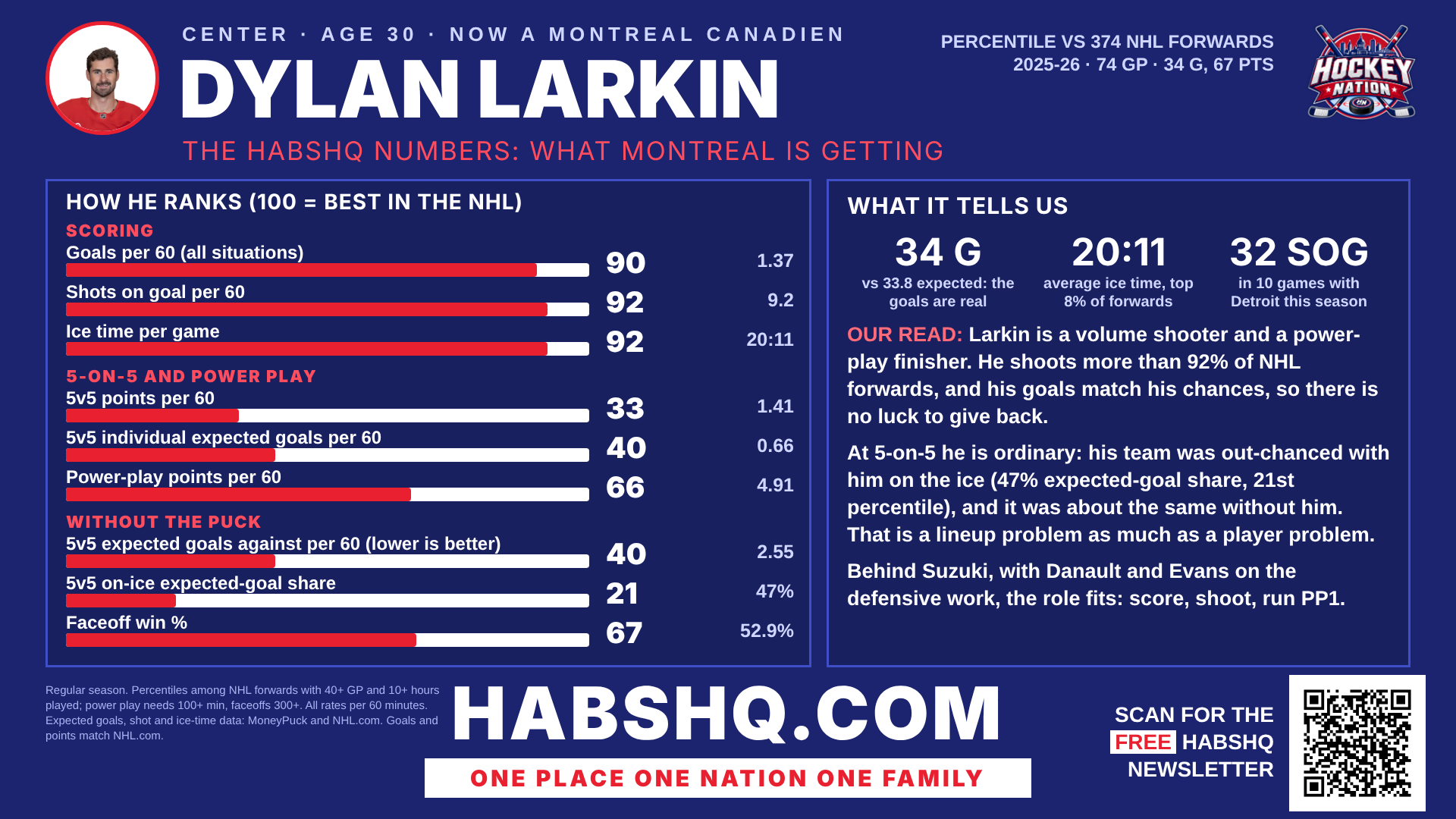
We ran Larkin against the 374 NHL forwards who played at least 40 games and 10 hours last season. The first result is the one Canadiens fans want to hear: he scores because he shoots. He fired the puck more per 60 minutes than 92% of forwards and scored on 34 goals when the quality of his chances said 33.8. His goals are earned, not lucky, so there is no reason to expect a drop. He also carried 20:11 a night, in the top 8% of forwards.
The power play adds to it. He scored 13 of his goals with the man advantage last season, and his 4.91 points per 60 there ranks 66th percentile. He is a finisher on the first unit, not the creator who runs it, and that fits next to Suzuki and Demidov.
The 5-on-5 picture is more honest and less flattering. Detroit was out-chanced with him on the ice, at a 47% expected-goal share (21st percentile), and the team was almost identical without him. His 5-on-5 points per 60 rank 33rd percentile, and the expected goals against while he is out there rank 40th. Our read: this is as much about the lineup around him as about Larkin, but it tells us what the coaching staff has to do. Larkin should score and shoot, while Danault and Evans take the harder defensive minutes.
One more number to watch: in his first 10 games of this season with Detroit he took 32 shots on goal and posted 2 goals and 6 points, with a 60% expected-goal share across all situations. It is a small sample, but the shooting volume is the same.
Percentiles among NHL forwards, 2025-26 regular season. Expected goals and rates from MoneyPuck; goals, points and ice time match the NHL data.
Suzuki, Larkin, Danault and Evans: Four Centers Few Teams Can Match
Look at the middle of the lineup now: Suzuki, Larkin, Phillip Danault and Jake Evans. Very few NHL teams can line up four centers like that. Opponents cannot hide their best line against a weak one, because there is no weak one. When one center is injured or in a slump, the next man steps up without the whole structure shifting.
It also gives Martin St-Louis choices. A coach with two top-end centers can change the combinations during a game without breaking up the top six. One night it could be Suzuki with Ivan Demidov on his wing and Caufield with Larkin. The next night it could be the reverse. That flexibility is what separates a team that is good in the regular season from a team that can adjust in a playoff series.
Who Wins From the Larkin Trade
The Canadiens
Montreal improves its lineup without giving up a player who was driving its results. Dach was a bottom-six forward, Montembeault had slipped behind the young goalies and Hage is still a prospect. In return the Canadiens get a center who plays big minutes in all situations, and they keep their core intact. Our read: when a team is trying to win now, first-round picks are the currency, and spending them on a proven player in his prime is how contenders get built.
Dylan Larkin
His long saga with Detroit is over. He wanted a team that can win the Stanley Cup, and he got it. He steps into a lineup where he no longer has to be the only offensive engine, which should make his game easier. His average numbers are very good rather than spectacular, and in Montreal very good is all that is asked.
Ivan Demidov
Ivan Demidov is still working his way back from his foot injury, but when he returns he will have a real center to play with. Nothing against Alex Newhook, Oliver Kapanen or Evans, who have all done the job. Larkin is another level. Demidov also has options: he can play with Larkin, and because Montreal now has two excellent centers, he could line up with Suzuki at some point too.
Owen Beck
This trade opens the door for Owen Beck. He has played ten games this season for 2 goals and 2 assists, averaging 8:49 a night, and what we saw in recent weeks suggests he can play in the NHL. Dach was averaging 11:42 and held spots on the third line, the second power play and the second penalty kill. Those minutes are available now, and with Dach and Hage gone the competition thins out. Our read: Beck can turn a trial into a long-term place on this team.
Martin St-Louis
Having a first and second center like Suzuki and Larkin gives the coach better options every night. He can mix combinations and keep the top six strong. Larkin also brings experience and leadership to the room, and a coach always benefits from that. Our read: the biggest change will show up on special teams, where two excellent power-play units are now possible.
Michael Hage Is the Loser, and It Is Hard to Watch
Michael Hage comes out of this as the player with the hardest story. His father, Alain, who died in 2023, was a lifelong Canadiens fan, and Michael grew up wearing the colors his family loved. Being drafted by Montreal meant something beyond hockey to him and to his family, and now he is leaving that team before ever playing a full season for it.
There is a hockey side to this too. Hage decided to go back to Michigan for a third college season. That is a legitimate choice for a young player, but it also meant his rights were still in play when Detroit asked for them. We will never know how he feels about that decision today, and it would be wrong to guess. What we can say is that he is a talented prospect who will get a real chance in Detroit. Detroit made him the centerpiece of its return, which tells you how highly he is rated.
Dach and Montembeault: The Road Ends in Montreal
For Dach, this is the end of an up-and-down stay. He played 2 games in 2023-24, 57 in 2024-25 and 37 in 2025-26, and this season he has 2 goals and 6 assists in 22 games. Injuries kept him from finding a rhythm, and when he played the production never matched the talent. He leaves Montreal with the same question that followed him from Chicago: can he stay healthy long enough to show what he can do?
Montembeault is different. He was well liked by his teammates and he was the starter when the Canadiens needed one. But with Jacob Fowler and Jakub Dobeš now ahead of him, there was no place for him in Montreal. In Detroit he gets a chance to play in the NHL again, and he deserves it.
The Price Is High, and the Chance Is Real
This is one of the biggest trades in recent Canadiens history. The outcome is that Montreal saw a chance to improve right now, accepted that the price is steep, and paid it to land a center like Dylan Larkin. A trade like this does not guarantee a Stanley Cup. It gives the team a better chance to win one, and for a roster this young and this cheap, that is exactly when you push.
Next Up
The Canadiens play the Los Angeles Kings tonight, Monday, November 23, at 7:30 PM ET (7:30 AM Tuesday, November 24, Vietnam time). We will have the lines, the first look at the new center group and a full recap.
Sources: NHL.com (player data, Red Wings and Canadiens news, Olympic coverage), the official transaction graphic, TSN (Hage profile), Hockey News, MoneyPuck (expected goals).
Get the HABSHQ Newsletter in Your Inbox
Every Monday, the HABSHQ newsletter brings you the full Canadiens, Rocket, Lions and prospects report, our takes, the stats of the week and the preview of the week ahead, straight to your inbox. It is free.

Get the Habs week in your inbox
Free weekly newsletter from HABSHQ.
More from HABSHQ



Watch the analysis
Coach Frenchy breaks down every Canadiens game live on the Hockey Nation Live Show, with the lines, the numbers and the plays that mattered.
Watch on YouTubeAbout Coach Frenchy
Coach Frenchy (Pierre) hosts the Hockey Nation Live Show, the daily live Canadiens and NHL commentary show on YouTube. HABSHQ is where he brings the lines, the numbers and the prospects together in one place.
Leave a Reply