

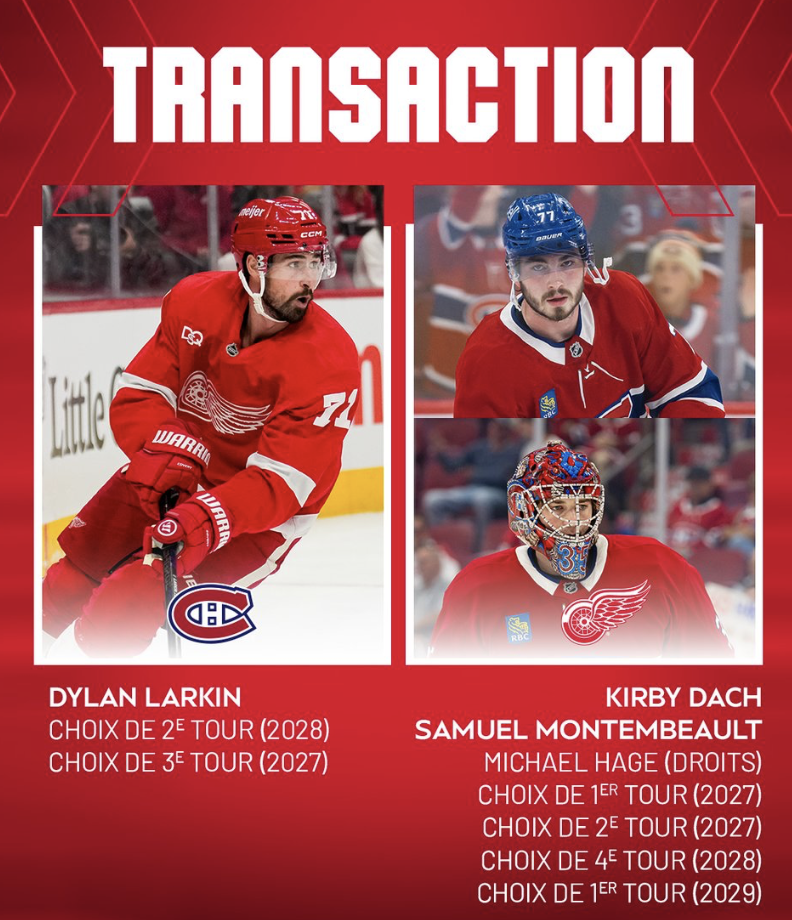
The Canadiens finally have the second-line center they have been chasing since June. Late Sunday night (Nov. 22), Montreal acquired Dylan Larkin from the Detroit Red Wings in the biggest trade of Kent Hughes’ tenure. The price is just as big: prospect Michael Hage, two players from the current roster, and four draft picks.
Montreal is 14-6-4 with 32 points, third in the Atlantic, and the team plays the Los Angeles Kings tonight at the Bell Centre (7:30 PM ET, which is 7:30 AM Tuesday Vietnam time). This trade changes the middle of the lineup, the goalie depth chart and the future of the prospect pool at the same time.
What Montreal Gave Up and What It Got Back
| Montreal receives | Montreal sends to Detroit |
|---|---|
| Dylan Larkin (C) | Michael Hage (rights) |
| 2028 second-round pick | Kirby Dach (F) |
| 2027 third-round pick | Samuel Montembeault (G) |
| 2027 first-round pick | |
| 2029 first-round pick | |
| 2027 second-round pick | |
| 2028 fourth-round pick |
The list comes from the official transaction graphic. Both first-round picks are protected in the top 10.
Count it plainly: Montreal sends out three players and four picks, and brings in one player and two picks. Two first-round picks and a second go out. A second and a third come back. Hughes paid in quantity and in quality, and he paid with the one asset he refused to move for years.
Why Larkin Fits the Hole in the Lineup
Larkin is a 30-year-old center who has hit 65 points six times in 818 NHL games (278 goals, 649 points), including each of the last five seasons. He is a proven number-two center who takes real minutes. This season he averaged 21:41 a game in Detroit, more than Suzuki (20:47) and well above Newhook (16:24), who has shared the second-center job on our side.
Larkin was drafted 15th overall in 2014 out of the University of Michigan and is a native of Waterford, Michigan. He has scored 30 goals in five straight seasons in Detroit, including a career-high 34 last season. He is also a two-way center who has shown the willingness and the ability to take tough matchups against the other team’s best players. That is the profile Montreal wanted behind Suzuki.
That is the point of this trade. Montreal had one true number-one center and a lot of good support players asked to play above their level. The second-center spot has gone back and forth between Newhook and Evans all season, and the other forwards have filled other roles. None of them is a player who can drive a line by himself against the other team’s best defensive pair.
Our read: Larkin goes to the second-line center spot, which lets Newhook and Evans settle into depth roles where they fit better, and it gives St-Louis a real choice when he wants to separate Suzuki from his wingers or put two high-end centers on the ice together late in games. That is our read, and reports from Montreal describe the same plan: second center behind Suzuki. The coach has not announced lines.
The Power Play Might Be the First Thing He Fixes
The Canadiens’ power play was 31st in the league at 12.5% when we last checked on Nov. 17. The team has talked all month about slow puck movement and predictable plays. Larkin has 86 power-play goals and 179 power-play points in his career, and this season three of his six points came with the man advantage even though Detroit was struggling.
He does not need to run the unit. The quarterback is a defenseman’s position, and that job belongs to Hutson. Larkin can play the bumper, the middle spot in the formation, where he takes passes, shoots from the slot and screens the goalie. Hutson runs the puck, Caufield and Slafkovský need a third scoring threat, and a veteran center with that power-play record gives the unit another threat to defend. Whether that works depends on how fast Larkin joins the unit, because he has not played in a game since Oct. 26. Reports say that once he does play, he will probably work with the first power-play unit.
The Price: Michael Hage
Hage is a 20-year-old center, drafted 21st overall in 2024 by the Canadiens after Montreal traded up for him. He is at Michigan this year with 5 goals and 21 assists in 13 games, which is 26 points and 2.0 points per game. Last season he had 52 points in 39 games. These are not normal numbers for a college player. They are the numbers of a gifted playmaker, although scouts see him as a middle-six NHL forward, either a third-line center or a second-line wing.
That is why this hurts. The Canadiens only get one such player, and in the months before this deal he was widely described as the player Hughes did not want to move. He changed his answer for Larkin, which tells us how he sees the team: not a rebuild, not a patient project, a roster that made it to the Eastern Conference Final last spring and wants a real chance this season.
The risk is simple. A 30-year-old with a contract through 2030-31 at an $8.7 million cap hit will decline before Hage, who is 20, reaches his peak. If Larkin gives Montreal three or four strong years next to Suzuki, Caufield and Hutson, the trade works. If Hage becomes a top-line center on a much cheaper deal, we will look at this in 2029 and ask a different question.
What Detroit Gets in Hage
Hage is a skilled forward who makes creative plays with the puck. He sees the ice at a high level and can run a power play because of his vision and his shot. He is a strong skater who plays with pace and drives play at even strength with controlled entries. He is not the hardest forward to play against, but he has been getting to the net more to create offense. He had a strong World Juniors for Team Canada a year ago and a big sophomore year at Michigan before this season. Our read: he will likely get a better opportunity in Detroit than he would have had behind Suzuki and Larkin in Montreal.
The Contract Window Gets Clearer
There is a second reason Hughes was willing to pay. Larkin’s $8.7 million cap hit runs through 2030-31, which lines him up with Suzuki (2030), Caufield (2031) and Slafkovský (2031). By our count those four forwards cost just over $32 million a year against the cap. Add the team-friendly contracts of Hutson and Demidov, and the Canadiens keep room to add more talent next summer. That tells us how Hughes sees the window: a long one, with the core signed to the same years.
It also changes how we look at the two first-round picks. They were always going to be trade capital for a deal like this, and Montembeault had been a trade candidate since the summer. The one piece that really hurts is Hage. Everything else came out of a surplus.
Montembeault Leaves, and the Goalie Picture Gets Clearer
This trade is the end of a story that started with an injury. Montembeault was hurt in early October, and the Canadiens called up Jacob Fowler to fill the spot. Fowler took the net and never gave it back, and from there the rest is history. Montembeault has not played a game this season. He played 25 games last year with a .872 save percentage and 3.43 goals-against average, and by the time he was healthy the starting job belonged to someone else. The trade removes the logjam that had been the story since training camp.
The current pair is Jacob Fowler (15 games, 10 wins, .918, 2.31) and Jakub Dobeš (9 games, 4 wins, .864, 3.60). Fowler is the starter, and the gap between the two is wide. Dobeš is now the backup without competition, and the team has no safety net if one of them is hurt for a long time. We will watch how often Fowler starts the second game of a back-to-back, because that is where the third goalie would have helped.
What Leaves With Dach
Kirby Dach has 2 goals and 6 assists in 22 games this season and plays 11:42 a night. He has played on the wing this season, not at center, on a third line with Newhook. He is a big forward with talent, but he has not found a regular role and injuries have limited him. His departure opens a wing spot in the bottom six. Beck, Berard and Florian Xhekaj are among the forwards St-Louis has used in recent games, so our read is that one of them gets the chance. The question for St-Louis is whether the bottom six keeps its size and energy without him.
Larkin Was Open to Montreal for Two Months, and Nobody Knew
Larkin asked for a trade in June, and for months the Canadiens were not on his list as it was reported. The truth came out after the deal: Larkin had been open to a trade to Montreal for more than two months, but the Canadiens chose to keep that quiet because they felt the extra noise could hurt the chances of getting a deal done, and Larkin’s camp agreed. He lifted a full no-movement clause to make it happen. Talks became more serious on Friday (Nov. 20), and that is when the Canadiens gave in on including Hage. Our read: the wait was about the price, and Hage was the piece that finally moved it.
The situation in Detroit had also turned ugly. For weeks the speculation never stopped, and Detroit assistant general manager Kris Draper was often seen at Canadiens games. Then on Oct. 28 Larkin was missing from Detroit’s practice. The next day it was clear his time with the Red Wings was over: Larkin felt he had given the team enough time to find a deal and left as a way to apply pressure. He did not play after Oct. 26, and the Red Wings suspended him and took $1 million in pay. His agent, Pat Brisson, said (translated by us): “Dylan is fed up with this situation. We believe he has been very professional and cooperated throughout this process.” Detroit’s interim general manager, Shawn Horcoff, was not impressed. He said (translated by us): “I am ready to wait as long as it takes to make sure that what we get in return benefits the Red Wings as a whole.” Detroit is 8-12-3 with 19 points, seventh in the Atlantic, and has won two of its last ten.
The Detroit side of the story explains why it ended this way. Larkin’s request became public in early June after Detroit missed the playoffs for a tenth straight season and after he had publicly clashed with then-general manager Steve Yzerman a year earlier. In July Yzerman moved out of his role, and Detroit named Horcoff interim general manager in September. The Red Wings stripped Larkin of the captaincy in September. He reported to camp, missed the first two games with an upper-body injury, and was booed on opening night. In his first game back he was booed again, until he scored, added an assist and was named first star of a 5-3 win over Ottawa. He is also the only player left from Detroit’s last playoff team, in 2016.
Fans in Montreal chanted for him in Detroit on Oct. 10, and he has now chosen Montreal. The question is whether a player who forced his way out of one dressing room arrives ready to lead in another. He has made the playoffs only once in Detroit (2016), and Montreal is a team that was in the conference final six months ago. We will find out in the first few games, because he has been away from the ice for almost a month.
Next Up
- Tonight: Kings at Canadiens, Monday Nov. 23, 7:30 PM ET (7:30 AM Tuesday Vietnam time). Larkin is expected to arrive in Montreal today, but it is unlikely he plays tonight, since he has not played since Oct. 26. His debut date has not been confirmed.
- Next: at Colorado, Wednesday Nov. 25, 9:30 PM ET (9:30 AM Thursday Vietnam time), then at Vegas on Saturday Nov. 28.
- Still to come: Kent Hughes is expected to speak to the media tomorrow. We will update this article with his explanation of the price and the plan for Larkin. A second, minor trade involving draft picks has also been reported but not yet announced.
Sources: NHL.com player and standings data and trade report, official transaction graphic, The Hockey Writers, Yahoo Sports, TSN (Pierre LeBrun’s report on Larkin’s openness to Montreal), Yardbarker, The Athletic, Radio-Canada Sports (RDS).
Get the HABSHQ Newsletter in Your Inbox
Every Monday, the HABSHQ newsletter brings you the full Canadiens, Rocket, Lions and prospects report, our takes, the stats of the week and the preview of the week ahead, straight to your inbox. It is free.

Get the Habs week in your inbox
Free weekly newsletter from HABSHQ.
More from HABSHQ


Watch the analysis
Coach Frenchy breaks down every Canadiens game live on the Hockey Nation Live Show, with the lines, the numbers and the plays that mattered.
Watch on YouTubeAbout Coach Frenchy
Coach Frenchy (Pierre) hosts the Hockey Nation Live Show, the daily live Canadiens and NHL commentary show on YouTube. HABSHQ is where he brings the lines, the numbers and the prospects together in one place.
Leave a Reply