
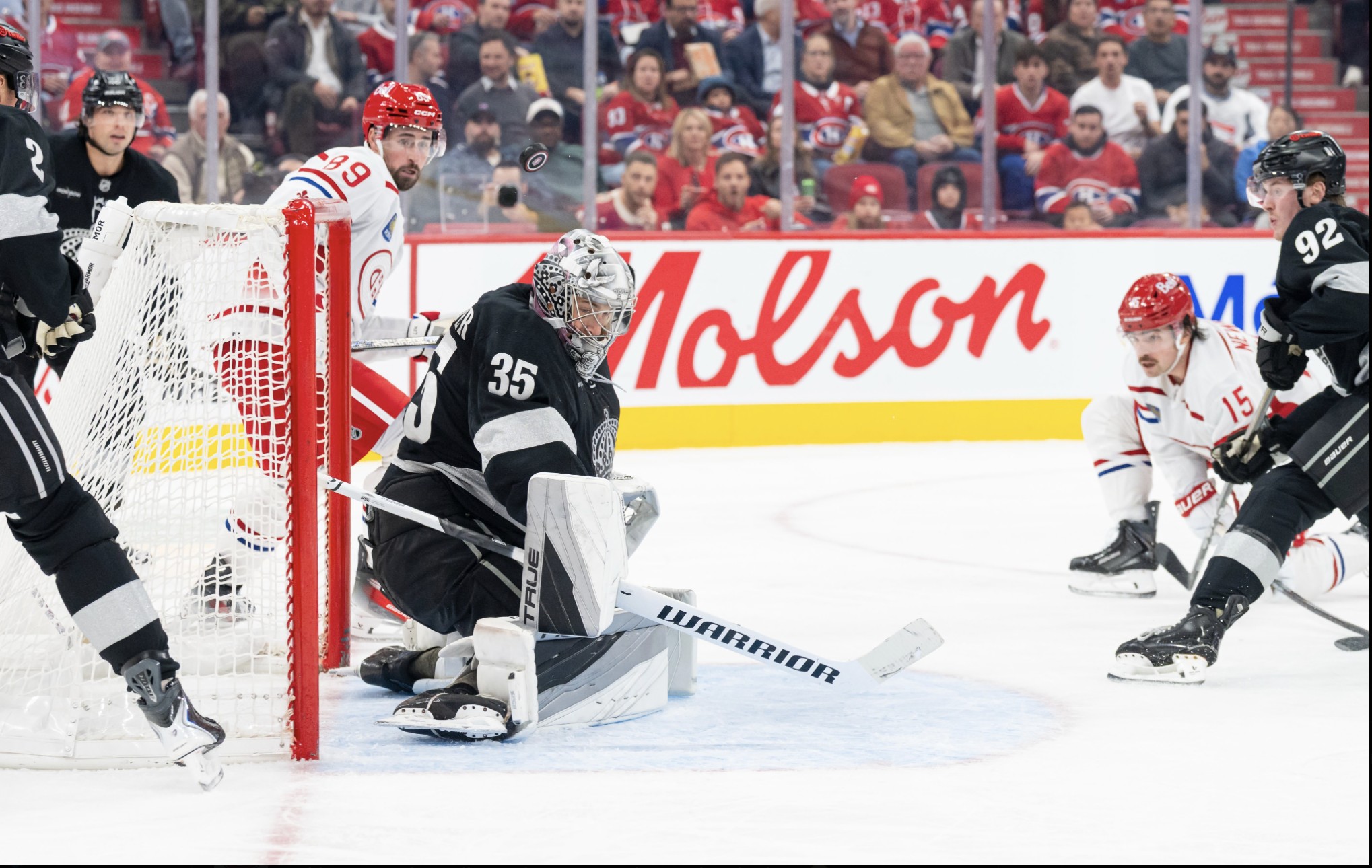
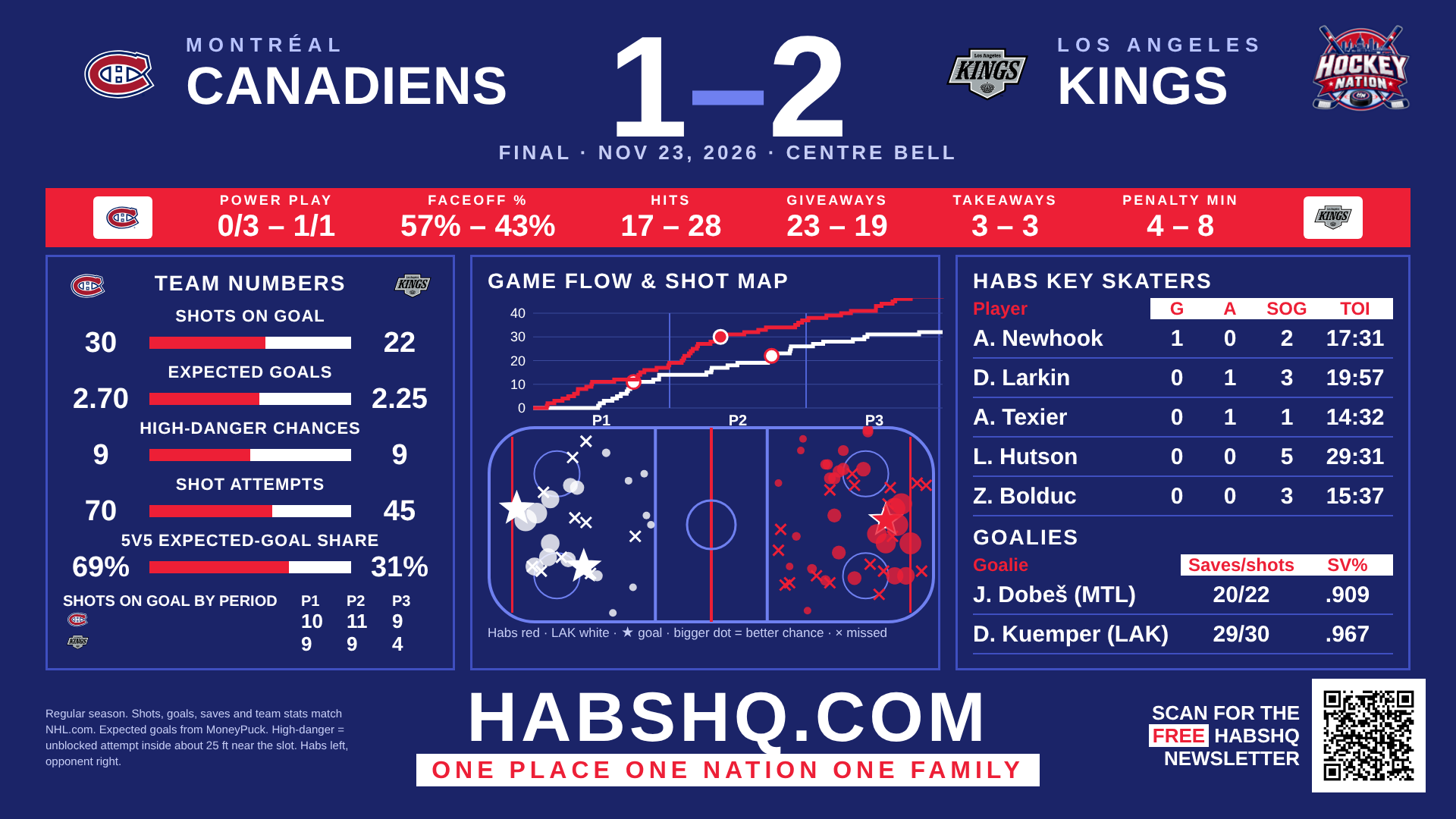
The Canadiens had the puck, the shots and most of the chances against the Los Angeles Kings on Monday night at the Bell Centre, and they still lost 2-1. Montreal outshot Los Angeles 30-22, but Darcy Kuemper stopped 29 of 30 shots (.967) and the Canadiens went 0-for-3 on the power play. It was Dylan Larkin’s Canadiens debut, and he finished with an assist, three shots and 19:57 of ice time.
The loss leaves Montreal at 14-7-4 with 32 points, and it is the fourth straight home game without a win (0-3-1). Los Angeles, 8-12-2, got a power-play goal from Alex Laferriere and a winner from Trevor Moore. Jakub Dobeš stopped 20 of 22 shots (.909) for the Canadiens. The next game is Wednesday at Colorado.
How the Goals Happened
The Kings scored first, on their only power play of the night. Owen Beck took a slashing minor at 13:46 of the first period, and Laferriere scored 57 seconds later, at 14:43, with a between-the-legs shot from beside the crease. Quinton Byfield and Artemi Panarin had the assists. It was Panarin’s first game back after missing four.
Montreal tied it at 7:28 of the second period. Kevin Fiala gave the puck away at 7:16, and 12 seconds later Alex Newhook snapped a shot in from the slot. Alexandre Texier and Larkin had the assists, which gave Larkin his first point as a Canadien.
Moore scored the winner at 14:57 of the second period, and the shifts before it matter. Dobeš gave the puck away behind his own net at 14:22, Moore put a shot on goal at 14:25, and Caufield turned the puck over in the Canadiens’ end at 14:30. The Kings kept the puck alive in the zone and Moore finished it with a snap shot from about 37 feet. Erik Haula and Joel Armia had the assists.
Our read, from watching the game: the winner was a team mistake with two names on it. Adam Engström takes the blame for the defensive breakdown on the play, and Dobeš gave up a bad goal on a shot he has to stop. The turnovers started the sequence, but the finish is where the game was lost. Dobeš was solid on the rest of his night, and in a one-goal game that is the shot that decides it.
Two other Kings goals did not count, and both times Martin St-Louis’s challenge decided it. Moore had a first-period goal taken off the board for offside, and a Mats Zuccarello goal in the second period was disallowed for goaltender interference on Dobeš. Without those two challenges, this is a very different game.
Montreal Controlled 5-on-5 and Still Lost
At five-on-five the Canadiens out-attempted Los Angeles 61-32 and put 28 shots on net to the Kings’ 14. By our own count of close-range shots from the middle of the ice, Montreal had nine to the Kings’ five. MoneyPuck’s expected goals say the same thing: 2.70 to 2.25 over the full game, and 2.59 to 1.19 at five-on-five.
Martin St-Louis saw the same game, and he was not satisfied with the attack: “Few teams play this style, but we got a lot of time in the offensive zone and we had 70 (69 exactly) shot attempts, which is still high. But our attack in general is average right now,” the coach said, after the Canadiens spent almost five more minutes than the Kings in the offensive zone. (Translated from French by HABSHQ.)
So why the loss? Kuemper. Against 2.70 expected goals he allowed one, which is about 1.7 goals better than an average goalie on those shots. That is the whole gap in this game. Dobeš stopped 20 of 22 against 2.25 expected goals, a fair night and not the problem. He was also tested shorthanded, where he stopped all four shots he faced.
There is a caution in the numbers too. The Canadiens gave the puck away 23 times to the Kings’ 19, and both Kings goals that counted followed Montreal turnovers: a takeaway by Laferriere four seconds before his goal, and the Dobeš and Caufield giveaways before Moore’s. Territory is a good sign. Sloppy exits are what keep a one-goal game from becoming a win.
The Power Play Wasted Three Chances
Montreal went 0-for-3 and generated almost nothing. In the two full power plays, after Corey Perry’s tripping minor in the first period and Drew Doughty’s hooking minor in the third, the Canadiens had two shot attempts and one shot on goal in four minutes. The Kings, shorthanded, put four shots on Dobeš in the same stretch.
The third chance came with Dobeš pulled and Adrian Kempe in the box for hooking at 19:00 of the third period, a 6-on-4 for the last minute. Montreal produced six attempts and none reached Kuemper: five were blocked and one missed. The season power play is now 13.7%, 31st in the league.
Larkin was on the first unit with Suzuki, Caufield, Slafkovský and Hutson, in the spot Bolduc held before. One game does not say whether the move works. The unit’s problem is getting pucks to the net, and a new player on the half wall does not fix that by himself.
Larkin’s Debut: Useful Early, Not Decisive
Larkin played 19:57 with Texier and Newhook, not with Slafkovský as projected before the game. That trio shared the ice for most of the night, with Larkin and Newhook together for about 15 minutes and Larkin and Texier for about 12. Slafkovský played on the first line with Suzuki and Caufield instead.
Larkin won 10 of 17 faceoffs (58.8%), had three shots and picked up the assist on Newhook’s goal. He was on the ice for both the tying goal and Moore’s winner. MoneyPuck gave him a game score of 0.91, a positive night, and expected goals ran 0.64 to 0.46 in Montreal’s favor while he was on the ice. For a player who had not played since Oct. 26, that is a reasonable first night. The test is what the second line does over the next ten games.
Larkin liked what he saw from the team: “It was a disjointed game. That said, I am delighted with what I saw from our team. The puck possession, the way our defensemen were involved, it was really enjoyable. If we had taken advantage of a few chances around the net, the result would have been different. I know the guys are not happy about the loss, but I am eager to see what the future holds for us.” (Translated from French by HABSHQ.)
St-Louis was pleased with his new center and said he is holding back on the details for now: “I liked his game, he is in control offensively and defensively. I tried not to give him too much information. He will keep fitting in on the details of faceoffs, the power play and the penalty kill.” (Translated from French by HABSHQ.)
Kuemper, Panarin and the Kings
Los Angeles did not need much. Kuemper made 29 saves and Panarin, back after four missed games, played 19:46 and picked up an assist on the power-play goal. Byfield played 20:10 and had an assist. The Kings win a game where they were outshot and out-attempted because their goalie was the best player on the ice and their power play scored on its only chance. They are now 8-12-2.
The Canadiens knew they were facing a team that sat back. “You have to give them credit: they defend really well. They stayed in their positions the whole game,” captain Nick Suzuki said. (Translated from French by HABSHQ.)
Home Ice Has Become a Problem
The Kings loss is not an isolated night at the Bell Centre. Since March 28 of last season, regular season and playoffs combined, Montreal is 9-13-3 at home, which is 21 points out of a possible 50, or a points percentage of .420. A team that plays like that at home is not protecting its own building, and for a club that wants to climb the Atlantic Division, that is the first number to fix.
The split is simple. The Canadiens score 2.44 goals per game at home and allow 3.36, a gap of almost a full goal every night. The special teams explain a big part of it: the power play is at 16.0% and the penalty kill is at 75.5%. Monday was a small version of the same story. The power play went 0-for-3, and the penalty kill gave up the only goal it faced.
The shooting percentage over that stretch is 9.1%, which tells us the offense is not broken because the shots are not going in. It is closer to what happened against Los Angeles: Montreal created the chances, put up 30 shots and 61 five-on-five attempts to the Kings’ 32, and ran into a hot goalie. Our read is that the home problem is a goals-against and special-teams problem first, and that the five-on-five game, which was good on Monday, is not what is costing the team points. St-Louis has to fix the turnovers in his own end and the penalty kill before the building gets any louder for the wrong reasons.
What Has to Change on Wednesday
The Canadiens have three things to fix, and they have been the same three for weeks. First, the power play has to produce shots, not blocked attempts. Second, the third defense pair had the worst night: Arber Xhekaj and Adam Engström had MoneyPuck game scores of -2.11 and -2.07, the two lowest on the team, in about 13 and 14 minutes. Third, the giveaways in the defensive zone have to stop, because Montreal is good enough at five-on-five to win these games without extra help.
On the other side, Dobson (2.47) and Hutson (2.28) had the best game scores, and Hutson played 29:31 with five shots. That is a lot of minutes for one defenseman in a game Montreal was controlling. Our read: if the coaching staff is going to lean on Hutson that heavily, the third pair has to be someone it can trust.
Next Up
The Canadiens play at Colorado on Wednesday, Nov. 25 (9:30 p.m. ET), at Vegas on Saturday, Nov. 28 (4:00 p.m. ET), and at Utah on Monday, Nov. 30 (9:30 p.m. ET). All times are Eastern.
Sources: NHL.com (play-by-play, shift charts, boxscore and standings), MoneyPuck (expected goals and game scores), RDS (postgame report).
Get the HABSHQ Newsletter in Your Inbox
Every Monday, the HABSHQ newsletter brings you the full Canadiens, Rocket, Lions and prospects report, our takes, the stats of the week and the preview of the week ahead, straight to your inbox. It is free.

Get the Habs week in your inbox
Free weekly newsletter from HABSHQ.
More from HABSHQ


Watch the analysis
Coach Frenchy breaks down every Canadiens game live on the Hockey Nation Live Show, with the lines, the numbers and the plays that mattered.
Watch on YouTubeAbout Coach Frenchy
Coach Frenchy (Pierre) hosts the Hockey Nation Live Show, the daily live Canadiens and NHL commentary show on YouTube. HABSHQ is where he brings the lines, the numbers and the prospects together in one place.
Leave a Reply