

In this Habs Tuesday Report, the Canadiens are 4-3-1 after eight games, and the season already reads like two different chapters. The first four games went 1-2-1 with 4.75 goals against a night. The last four went 3-1-0 and the special teams turned around. Some problems did not move at all: the penalties, the blown leads and the goaltending question.
The tracker: first 4 vs last 4
The shots flipped from a deficit to a clear advantage, yet the goals did not follow. Source: official NHL game data.
| Category | First 4 games | Last 4 games |
|---|---|---|
| Record | 1-2-1 | 3-1-0 |
| Goals for / against per game | 3.50 / 4.75 | 2.75 / 2.75 |
| Shots on goal per game (for / against) | 25.5 / 27.8 | 32.8 / 24.0 |
| Share of shots on goal | 48% | 58% |
| Power play | 1 for 13 (7.7%) | 3 for 14 (21.4%) |
| Penalty kill | 5 goals against on 17 (70.6%) | 1 goal against on 17 (94.1%) |
| Times shorthanded | 17 | 17 |
| Giveaways per game | 14.8 | 12.8 |
| Save % of the starting goalies | .852 | .885 |
Shot attempts tell the same story, counting shots on goal, missed shots and blocked shots. In all situations the Canadiens had 227 attempts for and 215 against in the first four games (51.4%), and 267 for and 201 against in the last four (57.1%). At 5-on-5 it is 168 for and 155 against (52.0%) in the first four, then 197 for and 140 against (58.5%) in the last four. That is 49.2 attempts a game at 5-on-5 for the Canadiens, with only 35.0 against. The numbers are counted from the NHL play-by-play data, so they can differ slightly from other sites.
Special teams: night and day
After four games the Canadiens were at 7.7% on the power play and 70.6% on the penalty kill. Over the last four games the power play is at 21.4% and the penalty kill at 94.1%, which is night and day compared with the start of the season.
The samples are small, with 13 and 14 power plays and 17 penalty kills in each stretch. For the full eight games the power play is 4 for 27 (14.8%, 25th in the NHL) and the penalty kill is 82.4% (12th).
Look at who is producing on the power play. Zachary Bolduc has two of the four power-play goals (against Carolina and the second Buffalo game), and Lane Hutson and Nick Suzuki have one each. Three of the four came in the last four games.
On the penalty kill, the improvement lines up with the changes on the back end. Guhle is back, Carrier has gone from 4 blocked shots to 10 in four games, and the team gave up one power-play goal on 17 chances. A coach will take that every night, but 17 chances in four games is still a lot of work for the penalty killers.
What has not changed
The Canadiens were shorthanded 17 times in the first four games and 17 times in the last four. That is 4.25 a game, the most in the NHL (the league average is about 3.25), so a better penalty kill is covering for a problem that has not gone away.
The penalties are the first thing I would fix. The Canadiens have taken about 40 minor penalties in eight games, 5.00 a game against a league average near 3.6, and they rank last in the NHL. By my count the offences are tripping (8), roughing (8), holding (7) and interference (6), plus two too-many-men calls. Tripping, holding and interference are what a team takes when it is a step late. Roughing and too many men are discipline. None of those need a skill change, only attention to detail.
The penalties are spread around the lineup. Josh Anderson has taken 5, Noah Dobson 4, and Caufield, Texier, Matheson, Dach, Slafkovský, Carrier and Hutson 3 each. Because it is not one or two players, this is a team habit, and the staff will need to address it as a group.
Now the leads. Montreal has led at some point in 7 of 8 games and has only one win in regulation, the opener in Toronto. Three times they led by two goals and did not close: against Nashville at the Bell Centre and twice against Buffalo. Against Nashville they went from 2-0 to 2-2 by the end of the second period and then gave up three more in the third, two of them into an empty net. Against Buffalo they led 3-1 twice and were tied 3-3 both times, and those games ended in a shootout win and an overtime win. Three of the last four games needed extra time. In the third period of those eight games the Canadiens have scored 6 goals and allowed 11, a goal differential of -5, and 3 of the goals against were into an empty net.
When you lead, the game plan changes: you manage the puck, get it deep, change lines and make the other team go 200 feet. Over eight games the leads have disappeared in the third period, and the video should show whether the team is managing the puck the way it should.
Goaltending: Dobeš and Fowler
The team save percentage is .855, 30th in the NHL, and it includes empty-net goals. Jakub Dobeš is at .842 (96 saves on 114 shots) in four starts and is 1-2-1. Jacob Fowler is at .900 (81 saves on 90 shots) in four starts and is 3-1. Fowler started three of the last four games.
Dobeš’s four starts show the problem. He allowed 18 goals in 4 starts, 4.50 a game, and 3 of the 4 starts had 5 or more goals against. He had one quality start. The team scored 4.00 goals a game in his starts, so he was not abandoned. Against the power play he stopped 14 of 18 shots (.778), well below the league average of .850, and at even strength he stopped .856 against a league average near .901.
Fowler has been steadier. He is 3-1 with a .900 save percentage, and his best start was the 30-save shutout in Detroit, a game the Canadiens won in the shootout. His other starts were 15 of 18 against Nashville, before two empty-net goals, 13 of 16 in the first Buffalo game and 23 of 26 in the second.
The point for a goalie coach is simple. A goalie does not need to steal games, but he needs the one save that keeps the team ahead. Over eight games that has been missing from the net, and that has a lot to do with the lost leads.
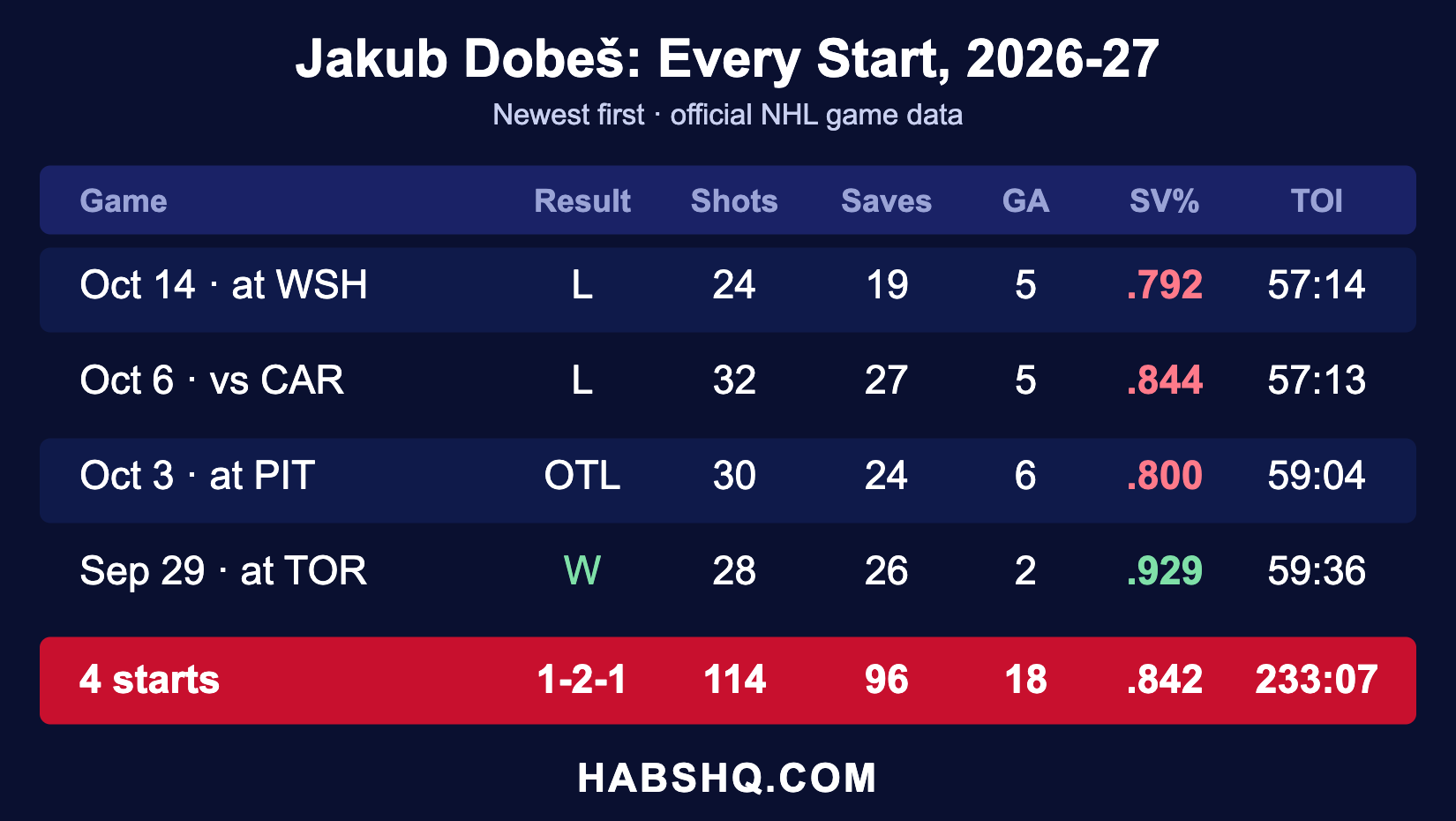
The game log shows one good night out of four: 26 saves on 28 shots in Toronto (.929). In the three starts since, he allowed 5, 6 and 5 goals, with save percentages of .800, .844 and .792.
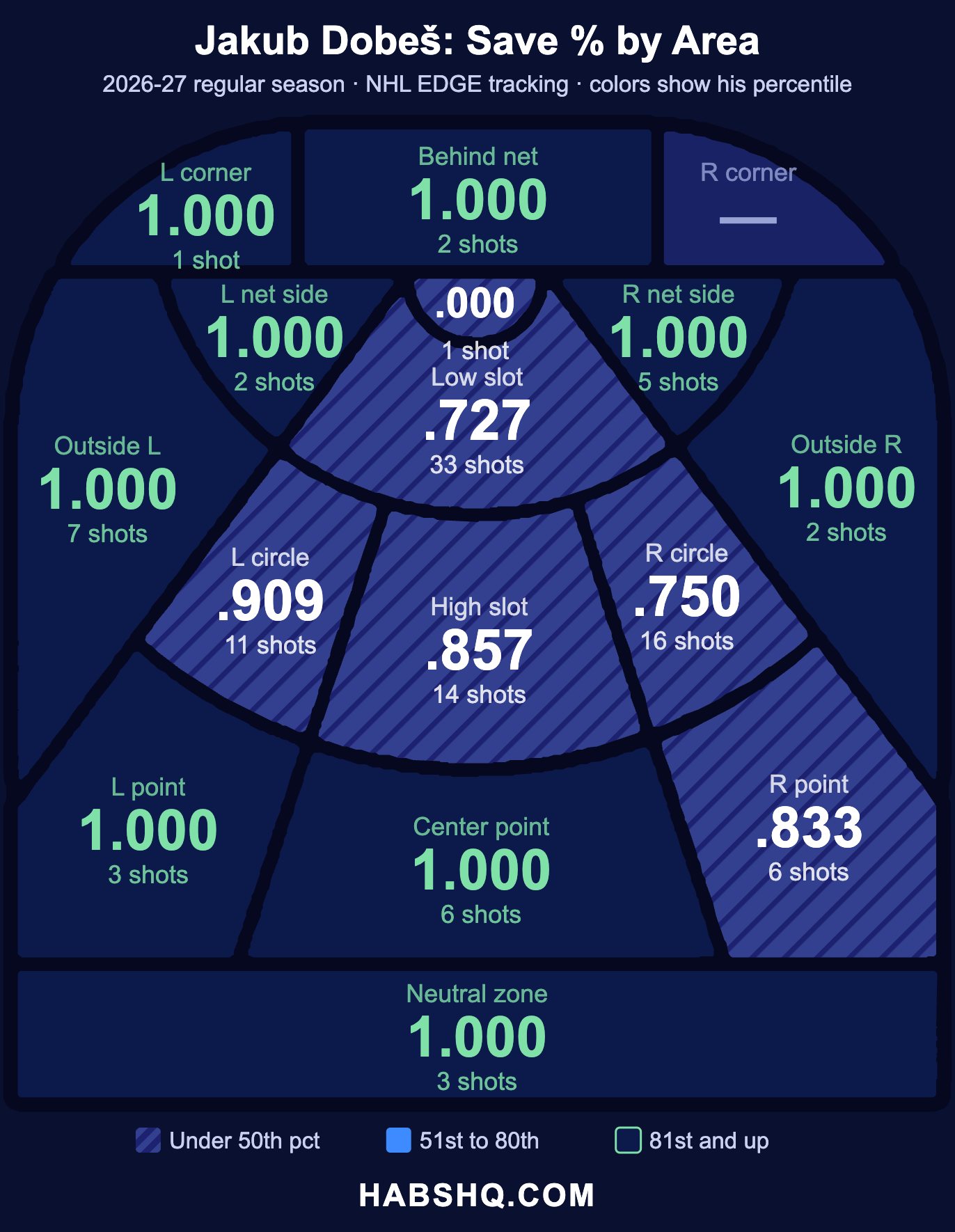
The save map shows where it goes wrong. The low slot is the most dangerous area on the ice, and he has faced 33 shots there with a .727 save percentage, the lowest of any area with a real sample. He is also at .750 on 16 shots from the right circle and .857 on 14 shots from the high slot. On the other areas, such as the corners, the outside lanes and the points, he has stopped every shot, but those are low-danger chances. Rebound control and the first save on shots from the middle of the ice are what a goalie coach would work on first.
Departures and arrivals: Matheson out, Guhle in
Mike Matheson played 23:01 in Detroit, got hurt in that game and has not played since. Kaiden Guhle was back in the lineup for the same game, one of seven defensemen the Canadiens used, and played 15:33 that night and 22 to 25 minutes in each of the next three games. Matheson’s own start was as uneven as the team’s: through his first four games he had 2 hits, 8 blocked shots and a -3 rating, and then the injury took a top-four defenceman out of the lineup. Guhle has stabilized the defence. He has 10 hits in four games, more physical than before, and the penalty kill improved while he was in the lineup.
Guhle’s partner Alexandre Carrier went from 4 blocked shots in the first four games to 10 in the last four, and from 17:36 to 20:48 a night. Arber Xhekaj has also played very well over the last three games.
One warning came from the last game. Guhle and Carrier were on the ice together for 15:05 against Buffalo and finished with a 0% expected-goals share (xGoals%, MoneyPuck), which means every quality chance in those minutes went to the Sabres. It is one game, and this pair has been good on the whole, but a coach goes to the video on a number like that to see whether the chances came from gaps in the neutral zone or from breakdowns around the net.
The lines: new combinations, a fourth line to fix
Over the last four games the Canadiens have used Kreider with Newhook and Anderson, and a Franco line of Texier, Danault and Bolduc. The top forwards stepped up too: Slafkovský went from 1 point to 4, Caufield from 2 points to 4 (3 goals), and Suzuki, Slafkovský and Caufield went from 32 shots to 42 together, although Suzuki’s points fell from 7 to 3.
The line numbers from MoneyPuck show the Franco line creating the most. It leads the group in shot attempts (CF%), expected goals (xGF%) and high-danger chances (HDCF%), but its goals are only 50-50, so the results have not caught up with the play. The first line is the best all-around line, with 66.67% of the goals and 68.65% of the expected goals. The second line is winning the goals (60.00%) with fewer chances behind it (52.53% of expected goals).
| Line | Players | CF% | GF% | xGF% | HDCF% |
|---|---|---|---|---|---|
| 1st line | Slafkovský – Suzuki – Caufield | 65.12 | 66.67 | 68.65 | 65.38 |
| 2nd line | Kreider – Newhook – Anderson | 58.33 | 60.00 | 52.53 | 57.89 |
| 3rd line | Texier – Danault – Bolduc | 66.29 | 50.00 | 72.29 | 76.19 |
CF% is the share of shot attempts, GF% the share of goals, xGF% the share of expected goals (shot quality) and HDCF% the share of high-danger chances, while each line is on the ice. Source: MoneyPuck.com.
The Canadiens need something from their fourth line. They are spending $6.45 million in cap dollars on Jake Evans ($2.85 million) and Kirby Dach ($3.6 million) this season, which is a lot for what they have given so far. Evans has provided valuable minutes on the penalty kill, but he has not made an impact otherwise. Dach has one point in eight games, and none of the other fourth-line players, including Florian Xhekaj and Owen Beck, has a point. The unit has no goals this season. Offence will never be the driving force of that line, but the Canadiens need something from it all the same.
What to watch next
San Jose visits the Bell Centre on Tuesday and the Canadiens play in Chicago on Friday. These are the four things I would track:
- Whether the penalty total comes down, since the Canadiens are shorthanded more than any other team.
- Whether they can finish games they lead, especially in the third period.
- Whether Fowler keeps the net and how Dobeš responds when he plays.
- Whether the fourth line scores its first goal.
The bottom line
The first four games and the last four games are two different teams. The shot share, the penalty kill and the blue line are better, and three of the four power-play goals came in the second stretch. What has not changed is the part of the game that decides close results: the Canadiens take more penalties than any other team, they have let leads slip in the third period, and the goaltending has not yet delivered the one save that protects a lead.
That is why 4-3-1 is a fair record. The process looks like a winning team’s more often than the results do, but over 84 games the process only pays off if the penalties come down and the team learns to close out a game. Those two items should lead the video session before anything else. Fix them, and the shot share will start turning into wins; until then, this is a good team that keeps handing games back.
Tonight: Sharks at the Canadiens
The Canadiens host the San Jose Sharks tonight at the Bell Centre, with puck drop at 7:00 PM ET. Jacob Fowler gets the start in goal, and the forward lines and defence pairs are the same as in Saturday’s win over Buffalo. The one change is on the power play: Zachary Bolduc moves up to the first unit in place of Chris Kreider, who drops to the second unit. Bolduc has two of the team’s four power-play goals, so the move follows the production. Florian Xhekaj, Ivan Demidov, Mike Matheson and Samuel Montembeault are all out.
San Jose is 4-4-1 and is on the second night of a back-to-back after losing 3-1 in Toronto on Monday. Macklin Celebrini leads the Sharks with 11 points in seven games, and their penalty kill is at 77.4%, so a power play that has finally started to produce gets a good test. The Sharks are allowing 3.44 goals a game, which should give the Canadiens’ improved shot share a chance to turn into goals. The team has lost its last two games against San Jose, but the real test tonight is the same as in the rest of this article: stay out of the penalty box and close the third period.
Get the Habs week in your inbox
Free weekly newsletter from HABSHQ.
Leave a Reply