

Martin St-Louis likes the way his team has been playing. He just cannot take much comfort in it. After Friday’s practice, the Canadiens head coach said his group has played excellent hockey over the past four games, and that the standings do not show it. Montreal (3-3-1, seven points) won two of those four games, and both wins needed a shootout.
The Canadiens host the Buffalo Sabres on Saturday night. Here is what St-Louis and his players had to say about where this team stands, what the numbers say, and what still has to change.
Playing Well Is Not Enough Anymore
St-Louis was honest about the gap between the performances and the results. He said the team could have a better record without playing this well, and that would feel better in the short term but would be worse in the long term. He wants the process to stay right.
He also made it clear that the process is no longer the whole goal. The Canadiens are on the right path, he said, but they “cannot be satisfied with just playing well.” They need the points too.
That is a change in tone from the early years of the rebuild, when stacking wins was far less important. This season the urgency is higher. Montreal reached the conference final last spring and wants to be one of the league’s good teams again, not just a team that is moving in the right direction.
Josh Anderson, who has four goals in seven games and shares the team lead with Suzuki, said the group has grown over the past few years and now has to focus on the small details and build winning habits. In his words, everybody has to be at their best every day, and the team has to play as a unit of five to collect as many points as possible.
The Numbers Back Up the Process
St-Louis is not just talking. The advanced numbers support his view of the games. The Canadiens rank fifth in the NHL in shot-attempt share (Corsi) at 55.6 percent, and seventh in expected-goals share at 54.2 percent. They are also seventh in offensive-zone time (42.5 percent) and ninth in the league for the least time spent in their own zone (39.8 percent).
The first line is a good example. The trio of Slafkovsky, Suzuki and Caufield ranks seventh among all offensive lines in the NHL in expected-goals share (69 percent), among lines with at least 38 minutes together. In 43.7 minutes over six games, that line has created 2.9 expected goals and allowed only 1.3. The one soft spot is defence: it gives up 1.79 expected goals per 60 minutes, more than most of the lines ranked ahead of it.
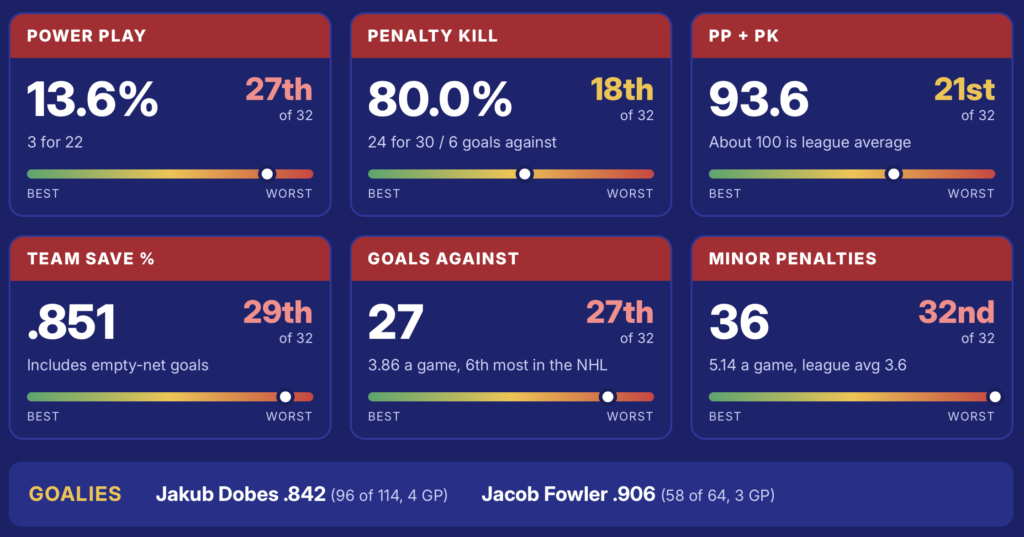
So the process is real. The problem is what happens with the chances and what happens when the game gets stopped. The team save percentage is .851, 29th in the league (that includes empty-net goals). Jakub Dobes is at .842 (96 saves on 114 shots in four games) and Jacob Fowler is at .906 (58 on 64 in three games). The Canadiens have allowed 27 goals in seven games, 3.86 per game, the sixth most in the NHL.
The Penalty Problem
What bothers St-Louis most right now is discipline. The numbers back him up. According to official NHL statistics, the Canadiens have taken 36 minor penalties in seven games. Only Philadelphia has taken more, and the Flyers have played nine games. That works out to 5.1 minors per game, the highest rate in the league, compared with a league average of 3.6. The team also averages 12.3 penalty minutes per game, sixth in the NHL.
St-Louis said the numbers do not match what he sees. In his view, Montreal is one of the teams that spends the most time with the puck in the offensive zone and the least time defending, so the team is in control of the game. “Why are we taking so many penalties? I don’t know,” he said. He added that he will not blame the referees.
His solution is not to play soft. The team will keep its edge, but it needs to be smarter about where it puts itself. Fewer positions where the referee can make the call, and fewer decisions that feel like rolling the dice.
The cost is easy to find. In the 5-2 loss to Nashville on October 8, a tripping penalty at 18:00 of the second period, with Montreal leading 2-1, led to the power-play goal that tied the game 1:28 later. In the third period, another tripping call at 15:45 was followed by the game-winning goal 59 seconds after it. The penalty kill is at 80 percent (24 for 30), 18th in the league, so the team has been getting by, but giving the opponent that many chances is a risky way to play.
The Power Play and the First Line
The man advantage is the other big problem. After finishing at 23.1 percent in the regular season last year, the Canadiens are at 13.6 percent (3 for 22), which ranks 27th in the league. Add the penalty kill and the combined number is 93.6, 21st in the NHL, where about 100 is the league average. Only one of the three power-play goals came on a standard 5-on-4: Zachary Bolduc scored it in Carolina. Lane Hutson scored on a 5-on-3 against Buffalo, and Suzuki scored with the goalie pulled in Washington.
That last goal is Suzuki’s only point on the power play this season. He has no assist and no goal on a regular 5-on-4. Caufield and Slafkovsky have one power-play point each, both assists, and Chris Kreider has none. Hutson leads the group with two. Suzuki, Caufield and Slafkovsky have each played about 25 minutes on the power play so far.
St-Louis connected that to the play of the first line. The trio, with Nick Suzuki and Cole Caufield, is producing, but not in the way it is capable of. “What the first line is missing is a bit of swagger,” he said. For players of that level, he explained, confidence often starts with the power play. If they produce with the man advantage, they feel better offensively at 5-on-5.
He is not worried. St-Louis said he is confident it will come, and he loves the commitment the line shows over 200 feet. The offence is in there, he said, and the players want it, but they are not taking shortcuts to get it.
The raw production is not bad. Suzuki leads the team with nine points (four goals, five assists) in seven games. Caufield has three goals and four points, and he said there is no reason to panic. He likes how much time the team spends in the offensive zone and agrees the group can create a few more scoring chances, but he believes the puck will go in more often. “I’m not really worried about that,” he said, even if he knows results matter.
Juraj Slafkovsky has three points in seven games, with one goal on 22 shots. The shot volume is there, but the finish has not followed yet. He did not practice on Friday after taking two hits in Washington, so his status for Saturday is something to watch. For more on his slow start and the situation on the second line, read our earlier look at Slafkovsky and the hole left by Demidov.
What Comes Next
Saturday’s game against Buffalo is a chance to turn the good process into a win in regulation. The Canadiens beat the Sabres 4-3 in a shootout on Tuesday at the Bell Centre. The puck drops at 7:00 p.m. ET, and the team then hosts San Jose on Tuesday before leaving for Chicago on Friday. You can follow the lines on our Lineup Tonight page, and the latest injury news is on the Injury Report. For a bigger picture of the coach’s approach this season, see our Martin St-Louis, Year 5 article.
Get the Habs week in your inbox
Free weekly newsletter from HABSHQ.
Leave a Reply