
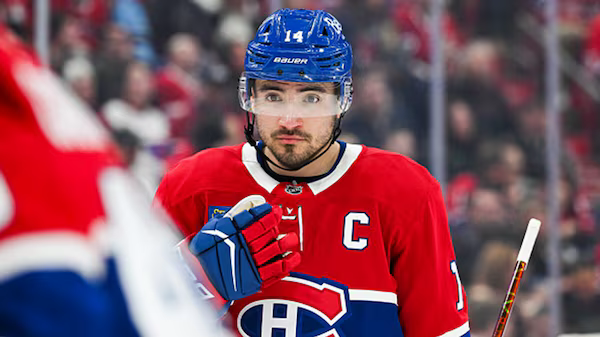
Nobody wanted to write about the Canadiens without Nick Suzuki, but here we are. Nick Suzuki, the captain and the No. 1 center, is out with an upper-body injury, and the club is projecting two to four weeks. For a player who has not missed a game since he arrived in Montreal in 2019, that is a strange sight. Suzuki has played 546 regular-season games, every single one of them, and the streak ends now.
Let me say it plainly, the way I would say it in a dressing room: this hurts the team, but it can end up helping the player. Either way, Martin St-Louis now has to rebuild his first line on the fly, and the next four weeks will tell us a lot about this group.
We covered the injury report itself in our first article, Suzuki Out 2-4 Weeks: Canadiens Lose Their Engine. This one is about what it means on the ice.
Why This Break Can Help Suzuki
Look at the workload. Last season alone Suzuki played 82 regular-season games, 19 playoff games and 6 more at the Olympics. That is 107 games in one season, and he still finished with 101 points in the NHL. After 546 straight games, nobody has a body that is 100 percent every night. Every player carries something: a sore shoulder, a groin, a back, a wrist that does not feel right. You play through it because you are the captain and the team needs you.
A forced break gives the body time to heal completely. If he comes back at full strength, he returns better and stronger for the rest of the season and for the playoffs. That is the silver lining, and it is also why I do not want anyone rushing him back.
The Timeline Is Everything
The hope is two weeks. Four weeks is the worst case we should be planning for. If it goes past that, it becomes very hard on this team. The schedule gives the Canadiens 14 games in the next four weeks, so two weeks means about seven games without him, and four weeks means the full 14.
| Date | Opponent | Home / Away |
|---|---|---|
| Fri Oct 23 | Chicago Blackhawks | Away |
| Sun Oct 25 | Winnipeg Jets | Away |
| Tue Oct 27 | St. Louis Blues | Away |
| Thu Oct 29 | Dallas Stars | Away |
| Sat Oct 31 | Pittsburgh Penguins | Home |
| Tue Nov 3 | Winnipeg Jets | Home |
| Thu Nov 5 | Utah Mammoth | Home |
| Sat Nov 7 | Toronto Maple Leafs | Away |
| Tue Nov 10 | Minnesota Wild | Home |
| Thu Nov 12 | Boston Bruins | Away |
| Sat Nov 14 | Colorado Avalanche | Home |
| Mon Nov 16 | New York Rangers | Away |
| Wed Nov 18 | New Jersey Devils | Away |
| Thu Nov 19 | Carolina Hurricanes | Away |
Six of the first seven games are against Western Conference teams, and the first four of them are on the road, against teams Montreal does not see often. The real checks come in the second half of the stretch: Toronto, Minnesota, Boston, Colorado and Carolina.
Canadiens Without Nick Suzuki: The One Injury They Could Not Afford
Every team has a player it can survive losing. For Montreal, Suzuki is not that player. He leads the team with 12 points in 9 games (5 goals, 7 assists), three more than Lane Hutson, and he plays 21:48 a night, more than any other forward. He is the center who takes the key faceoffs, plays against the other team’s best line, runs the power play from the middle of the ice and gives the wingers a safe outlet in the defensive zone. Center is the hardest position in hockey because you cover all 200 feet, and Suzuki does it at the top level.
Here is the real problem: the Canadiens were already thin down the middle. They never had a true No. 2 center, and now they are playing without their No. 1. Alex Newhook has 4 points and is a minus-5. Phillip Danault has 2 points. Jake Evans has none. We are not replacing one center; we are asking a group that was short at the second-line spot to cover two jobs.
The timing makes it worse. Ivan Demidov was still wearing his protective boot this week and his return is not close, so Montreal is now without two of its four best forwards at the same time. We covered his original injury and what it meant for the lineup earlier this month.
Martin St-Louis does not want the room to look at it that way. “Of course Suzy is a big piece, but I think what always helps us keep going is team play,” the head coach said. “Team play has a lot more power than going through just one individual. So that is what we are building on.”
As a coach, I agree with the principle. Structure and five-man play carry you through a bad month. But a system still needs a center to run it, because the center is the player who supports the puck carrier, wins the draws and connects the defensemen to the wingers. The collective game is the plan; now somebody has to be the glue in the middle of it.
Kapanen Between Caufield and Slafkovský
St-Louis’s answer is Oliver Kapanen, who now centers the first line between Juraj Slafkovský and Cole Caufield. Let’s be honest about where Kapanen is. He scored 22 goals last season, but his last goal came on March 28, and that is 19 games ago when you count the 7 playoff games and his 2 games this season. He is averaging just 11:05 of ice time, and now he will play 17 or 18 minutes against top defense pairs and the checkers who go after the best line.
The challenge is big, but the thinking is clear. Caufield already has 6 goals and 32 shots in 9 games. He needs a center who wins puck battles, supports low in the defensive zone so the wingers can break out quickly, and gets the puck to him in the scoring areas. Slafkovský (2 goals, 5 assists, 24 shots) drives the line with his size and puck protection. Kapanen’s job is not to be Suzuki. His job is simpler: win his wall battles, get to the net, and let the two wingers finish.
Kapanen gets a real opportunity here, and he knows it. He centered Caufield and Slafkovský in Thursday’s practice, he is back at his natural position, and he acknowledged that this is a good chance to improve his place on the team. Slafkovský played a lot with him last year and has spoken well of him, which helps. But let’s be realistic: nobody should expect Kapanen to copy the production of the team’s top scorer and most-used forward. The goal is to keep the line dangerous, not to clone Suzuki.
Caufield sees it the same way. “It is a huge loss,” he said. “Nobody can really replace Suzy and we are aware of it. As a team, everybody is going to have to raise their game. I think Kappy is a smart player, you can put him almost anywhere in the lineup, and I hope we find a way to create things together, but everybody has to step up.”
Slafkovský’s message was the same: it is sad to lose the captain, but now is the time to raise our game and play for him while he is out. That is the correct mindset. It will not be easy, but this group believes it can find success without Suzuki.
The Power Play Has to Be Redrawn
Here is the part that is easy to forget. Suzuki was a power-play piece, not just a five-on-five center. By ice time, the first unit has been Suzuki, Caufield, Slafkovský, Kreider and Hutson, each between about 2:50 and 3:55 a night. Take Suzuki out and the whole structure changes.
St-Louis has already made his move. He is keeping the new Caufield, Kapanen and Slafkovský trio together on the first unit, and instead of the old four-forwards-and-one-defenseman look, he is giving them two defensemen: Lane Hutson and Noah Dobson. On the second unit, Adam Engström was working the point in practice, with Mike Matheson close to a return.
There are good things about that look. Two defensemen means two passing and shooting options from the blue line, and Hutson is one of the best puck distributors on the team. Kapanen gets to play the middle of the formation as a passer and support player, so Caufield and Slafkovský can concentrate on getting open and finishing. The risk is the net-front and rebound battles: with one forward fewer in the dirty areas, the unit needs to win second chances with shot volume and traffic.
And the Canadiens cannot afford a weaker power play. They are 4-for-29, a 13.8 percent success rate that ranks 27th in the league. Dobson has been playing only about a minute a game on the man advantage, so this is a big step up for him. Owen Beck was also recalled from Laval to give the team an extra forward on the four-game trip.
Leadership and Accountability
Do not underestimate what Suzuki’s absence means in the dressing room. Lately you could feel the players wanting to raise the level of accountability with each other and demand more of themselves. That is healthy, but the environment around it has to stay healthy too. Losing, for a few weeks, the player who does the most to keep the room together makes this moment more delicate.
St-Louis addressed it directly. “When you have accountability, it does not mean you point fingers,” he said. “But if you are going to take those actions, you had better judge yourself first and look in the mirror. I think we have that. We are not a group that points fingers. We are a group that takes responsibility, that is honest and that looks in the mirror.”
He added that the team’s spirit does not depend only on its main leader. “I know Suzy is our captain, but we have a lot of leaders in this group, and our culture is going to help us get through this. Of course you lose a big piece, but I think we will be able to keep going.”
That is what a coach should say, and I believe him. But a good locker room is tested exactly in these weeks, when the best player is out, the results are mixed and the pressure rises. If the leaders keep talking to each other honestly instead of pointing fingers, this stretch can make the group stronger.
Fix What Was Not Working Before the Injury
Two things are easy to forget in all this. First, nobody takes Suzuki’s spot, and nobody should try to. But if the Canadiens clean up what they were not doing well when he was healthy, that alone can win them games without their captain. Three areas stand out: goaltending, special teams and, above all, discipline.
Goaltending first. Montreal’s team save percentage is about .857, second-worst in the league, and the team is giving up 3.78 goals a game, fourth-most. Jakub Dobeš is at .847 with a 4.47 goals-against average in 5 games, and Jacob Fowler is at .900 in 4. With the offense about to lose its engine, this team cannot afford to give up three or four goals a night. If the goalies get back to .905 or better, close games start to go the other way. The defense can help by cutting down the second chances and clearing the front of the net, but the saves have to come first. We covered the goalie situation in Three Goalies Again: Kent Hughes’ Familiar Problem.
Special teams are the second piece. The power play is 4-for-29, a 13.8 percent success rate that ranks 27th, and the penalty kill is at 78.4 percent, 19th in the league, with 8 power-play goals against. A team with that profile has no cushion. When your power play does not score and your penalty kill gives one back, you lose the special-teams battle almost every night.
And that brings us to discipline, which for me is the biggest one. The Canadiens have taken 46 minor penalties in 9 games, the fourth-most in the NHL, and they have been shorthanded 37 times, about 4.1 times a night. That is nearly seven minutes of penalty killing every game. Think about what that does to a lineup missing two of its top four forwards: the players who kill penalties burn energy, the top lines sit on the bench while the other team gets the puck, and the game gets away from you in the third period. A penalty taken because you were a step late is a skill problem, but a lazy stick penalty or a retaliation in the offensive zone is a decision problem, and decision problems are the easiest ones to fix. It costs no talent. It only costs focus. The blown 3-1 lead against San Jose showed what a couple of penalties can do, and we looked at the problem earlier in Good Hockey Isn’t Enough: St-Louis Wants Results and Fewer Penalties and Why Can’t the Canadiens Protect a Lead?
That is the opportunity in this stretch. The Canadiens cannot replace what Suzuki does. They can control the things that were already hurting them: stop the saves from leaking, tighten the special teams and stay out of the box. Do those three things and the loss of the captain becomes survivable.
Tonight in Chicago: A Must-Win Game
The trip starts tonight, and this is the game the Canadiens must win. Chicago is 3-6 and is the team Montreal can beat on this four-game road swing. A win starts the trip the right way, and it protects the Canadiens from walking into the three hard games that follow with no points in the bank.
I am not saying it will be easy. Connor Bedard is back in the Blackhawks lineup, and he has 3 points in his 3 games this season (1 goal, 2 assists). Chicago also plays better at home, where it is 3-2, than on the road, where it is 0-4. The Blackhawks will be fighting for their own season, and the building will help them. But that is exactly why it is a must-win: you win the games you are supposed to win, even when they are not pretty.
After Chicago the road gets harder. Winnipeg on Sunday is 4-3-3, St. Louis on Tuesday is 5-4-1 and has not lost at home in regulation (3-0-1), and Dallas on Thursday is 6-3-1 with 13 points. None of those three is an easy team to beat. If Montreal leaves Chicago with two points, the rest of the trip becomes a bonus. If it does not, every game after becomes a must-win.
We expect Jacob Fowler in the net tonight. He has a .900 save percentage and a 2.16 goals-against average in 4 games, and the team needs the best version of him with the offense short a center. Puck drop at the United Center is 8:00 PM ET. For the final lines, defense pairs and the latest news, check our Canadiens Lineup Tonight and Canadiens Injury Report pages, which we update as soon as the team confirms them, along with our game preview.
The Playoffs Are Still in Sight
Right now Montreal is 4-3-2 with 10 points in 9 games, seventh in the Atlantic (here are the full NHL standings). Nobody knows exactly how many games Suzuki will miss, so the key is to stay around .500 until he is back. Seven wins in 14 games would be a fine result. Our Canadiens Stats of the Week page tracks the numbers. This is the biggest challenge of the St-Louis era.
A slow stretch is not a death sentence. The 2018-19 St. Louis Blues were last in the entire league in early January and finished the season lifting the Stanley Cup. Last year Buffalo was seventh in the Atlantic, 27th in the league, in early December, and ended up winning the division with 109 points. Fourteen games is one-sixth of an 84-game season, and nobody wins or loses the year in October and November.
My Take
The most important thing is that Suzuki recovers totally. I hope the injury is not too big and that he is back at the early end of the two-to-four-week window. It is also an opportunity: we finally get to see how this team plays without its captain and which players grow when the minutes open up.
The other part of my take is that winning without the captain starts with fixing what was already broken: the saves, the special teams and the penalties. Those are in the team’s control, and they matter as much as who plays center.
I am surprised to see Kapanen on the first line, but I understand the decision. Two lines are doing well, and St-Louis wants to limit the changes so the other lines stay together. My question is how long Kapanen stays there if things turn bad.
My coaching answer: give him a handful of games and judge the process, not the goals. Are Caufield and Slafkovský getting more scoring chances and more time in the offensive zone with him on the ice? Is he getting the puck out of our end cleanly? If the line is being out-chanced game after game, you change it, even if the scoreboard has not punished you yet.
Sources: NHL.com (stats, standings and schedule); RDS and Radio-Canada (injury report, quotes and practice notes).
Get the Habs week in your inbox
Free weekly newsletter from HABSHQ.
Leave a Reply