
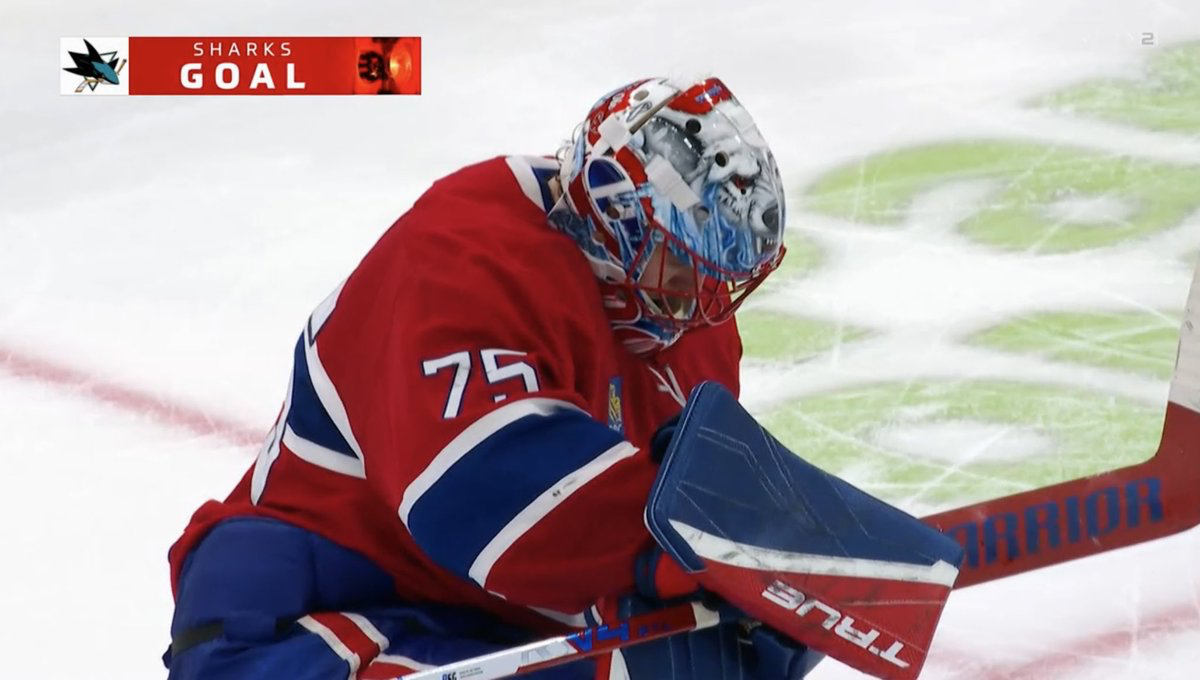
For most of this game, the Canadiens looked like the better team. They scored three straight goals after Macklin Celebrini opened the scoring, led 2-1 from 1:49 of the second period and 3-1 from 14:03, and held a lead for almost 24 minutes. Then the game turned on four plays: two turnovers and two bad penalties. At 2:13 of overtime, Celebrini scored on the power play and the San Jose Sharks won 4-3.
Montreal takes one point and sits at 4-3-2 (10 points) after nine games. San Jose is 5-4-1 (11 points). The most important number is this one: it is the fourth time this season the Canadiens have blown a two-goal lead.
The Game in Numbers
| Canadiens | Sharks | |
|---|---|---|
| Final | 3 | 4 (OT) |
| Shots on goal | 34 | 30 |
| Shot attempts, all situations | 77 | 51 |
| Shot attempts, 5-on-5 (regulation) | 72 | 45 |
| Power play | 0-for-2 | 2-for-3 |
| Minor penalties | 6 | 5 |
| Goaltending | Dobeš 26 saves on 30 shots (.867) | Nedeljkovic 31 saves on 34 shots (.912) |
Read that table carefully. Montreal had more shots, more attempts and more of the five-on-five game. The Canadiens did not lose this game at even strength. They lost it with the puck in the wrong places and in the penalty box.
Four Plays That Changed the Game
1. The first goal (1-0, 13:49 of the first). A Jake Evans pass was intercepted by Celebrini, who went in on a breakaway and scored. The goal was unassisted, five-on-five. Against a player of his caliber, a pass the opponent can read is a breakaway. This is a puck-management mistake, and it gave San Jose its first lead.
2. The turnover that made it 3-2 (5:36 of the third). Lane Hutson lost the puck at the blue line on the Sharks’ side of the ice. That opened a 2-on-1 the other way, and Michael Misa finished it. With a two-goal lead, a defenseman at the offensive blue line has one job: keep the puck in, or get it deep and keep the play in front of him. Lose it there, and you give up the most dangerous rush in hockey. It happens, but it is the mistake that started the comeback.
3. Xhekaj’s penalty (3-3, 11:09 of the third). Arber Xhekaj took unsportsmanlike conduct and roughing, a four-minute package. San Jose’s Kesselring went off for roughing, which offset one of the minors, but the unsportsmanlike call left Montreal short-handed. Tyler Toffoli scored on that power play, with Celebrini and Trouba on the assists. This was a one-goal game with the Canadiens trying to close it out. The penalty gave the other team the ice.
4. Dobeš’s penalty (4-3, 2:13 of overtime). Jakub Dobeš was called for interference at 1:53. In 3-on-3 overtime, a minor gives the other team a 4-on-3, and at that level of space it is almost a goal by default. Celebrini scored twenty seconds later. The penalty was avoidable and undisciplined. A goalie in overtime is supposed to be the safest player on the ice, and Montreal had already earned a point. That penalty cost them the second one.
What Martin St-Louis Said
The coach saw it the same way. “You have to understand what the game demands. We were up by two,” said Martin St-Louis. “Then when you lead 3-2 and you play like that, this game should be over. You have to realize what you need and what you have to avoid.”
He also pointed to the shot count as proof that the team is playing well enough to win: “Since I’ve been in this job, I find we’re able to fix ourselves. But we’re leaving points on the table, and that’s on us.” He was right on the numbers: Montreal had 77 shot attempts to San Jose’s 51.
The First Line Did Its Job
Montreal did not lose this game because of the first line. Slafkovský, Suzuki and Caufield scored all three goals, added three assists, finished a combined +8 and put 8 shots on goal. They are now playing like the engine of this team, and the recent numbers show it:
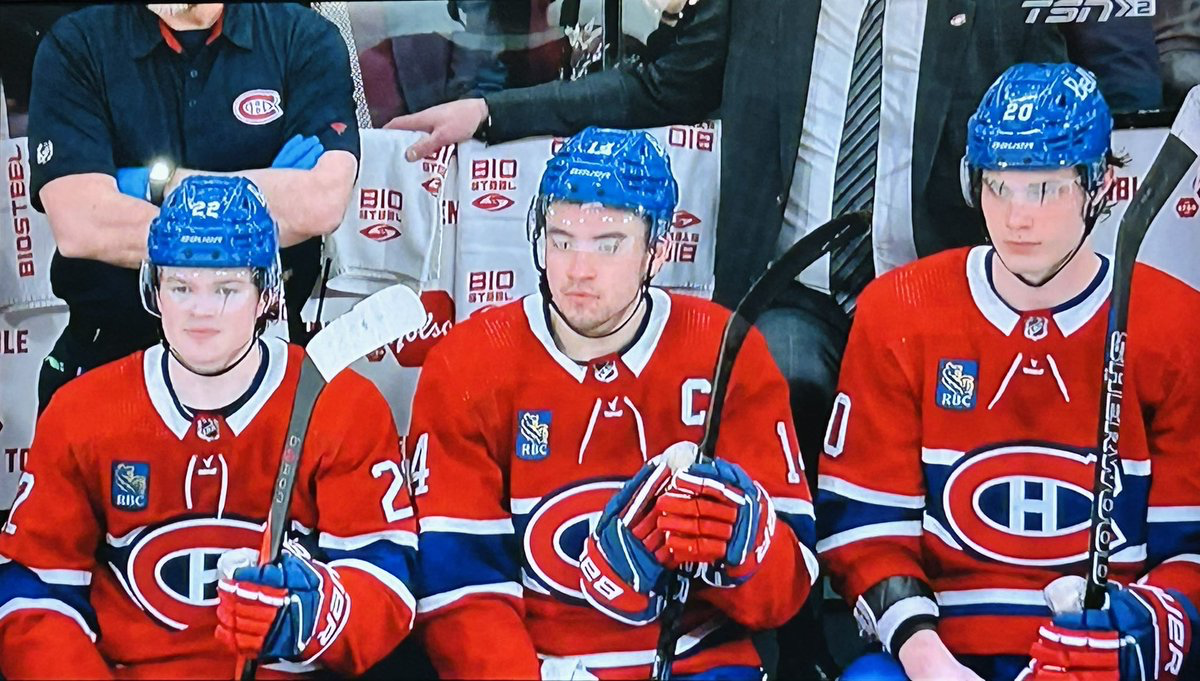
- Caufield has scored in three straight home games (Oct. 13, Oct. 17 and Oct. 20, four goals in total) and had at least two points in each of them.
- Slafkovský has four points in his last two games: two against Buffalo on Saturday and two against San Jose on Tuesday.
- Suzuki has a point in three straight home games and in five of the six home games this season.
- As a line, through nine games the trio has 14 goals and 29 points and is +11.
That is why this loss hurts. When your first line produces like this, the team cannot hand the game back. Tuesday night, two turnovers and two bad penalties did exactly that, and they erased what the first line built.
What the Analytics Say
Expected goals (xG) measure the quality of the shots a team creates and allows. Here is how Montreal’s lines and defensemen did on the ice at all times, with xGF (expected goals for) and xGA (expected goals against) while each player was on the ice (data from Natural Stat Trick):
| Player | TOI | xGF | xGA | Game score |
|---|---|---|---|---|
| Suzuki | 21:03 | 1.24 | 1.09 | 3.86 |
| Caufield | 19:36 | 1.23 | 1.20 | 3.44 |
| Slafkovský | 17:16 | 0.56 | 1.01 | 2.32 |
| Danault | 15:44 | 1.53 | 0.24 | 3.00 |
| Bolduc | 14:55 | 1.42 | 0.29 | 0.92 |
| Texier | 13:10 | 1.10 | 0.05 | 0.97 |
| Kreider | 15:28 | 0.47 | 1.69 | -2.88 |
| Newhook | 16:21 | 0.45 | 1.80 | -3.30 |
| Anderson | 16:13 | 0.47 | 1.93 | -3.77 |
| Hutson | 25:46 | 1.47 | 1.12 | 1.67 |
| Carrier | 22:13 | 1.64 | 1.26 | 1.24 |
| Guhle | 22:51 | 1.20 | 1.21 | -0.19 |
| Dobson | 21:44 | 1.04 | 1.12 | -0.86 |
| Engstrom | 12:56 | 0.77 | 0.84 | -0.40 |
| Xhekaj | 13:14 | 0.77 | 0.88 | -0.67 |
Game score is a single-game rating that combines a player’s goals, assists, shots, blocked shots, penalties and how the team’s chances and goals went while he was on the ice. Around 0 is an average night, above 2 is a strong game and below -2 is a rough one.
Three things stand out:
- The third line dominated the scoring chances. With Texier, Danault and Bolduc on the ice, Montreal created 1.10 to 1.53 expected goals and gave up only 0.05 to 0.29. That is a line that controlled the puck and tilted the ice. Danault’s game score (3.00) was third best on the team behind Suzuki and Caufield.
- The second line was badly out-chanced. Kreider, Newhook and Anderson had the three worst game scores on the team (-2.88, -3.30, -3.77). With them on the ice, Montreal created fewer than half an expected goal (0.45 to 0.47) while San Jose created between 1.69 and 1.93, about four times the danger. Over the last two games (Saturday against Buffalo and Tuesday against San Jose), the three have no points and are a combined -10: -6 on Saturday and -4 on Tuesday.
- The top line scored on its chances. Suzuki and Caufield were close to even in expected goals (1.24 to 1.09 and 1.23 to 1.20), but they finished: three goals and three assists, six points, and a combined +8 with 8 shots on goal. That is good finishing, not dominance, and it is why a lead of 3-1 felt safer than it was.
On defense, Hutson (25:46) and Carrier (22:13) had the best expected-goal numbers, and Hutson’s game score was a positive 1.67 even with the turnover. One mistake does not erase 25 minutes. But it matters when it comes with a two-goal lead and a game on the line.
Goaltending: Dobeš Was Not the Problem at Even Strength
Dobeš stopped 26 of 30 shots (.867). The shots he faced carried 3.58 expected goals against, and he allowed 4, so he was about 0.4 goals worse than expected. That is a near-average night by the numbers. The goals were a breakaway, a 2-on-1 turnover, a power play and an overtime power play. None was a routine shot he failed to stop.
That is why his penalty matters more than his save percentage. His season line is now .847 with a 1-2-2 record. The goaltender has to give the team more than saves in tight games. He has to stay out of the box.
The Third-Period Problem
Over the last seven games, the Canadiens have been outscored 12-2 in third periods. Three of those 12 goals were empty-netters, so the real gap is 9-2, which is still lopsided. Tuesday’s third period added two more against: Misa’s 2-on-1 and Toffoli’s power-play goal.
The pattern is the same every time: the Canadiens lead, then lose the structure and the discipline when the game asks them to manage it. Taking a lead is one skill. Holding it, with the puck decisions at the blue line, the line changes and the penalties we talked about above, is another. Right now it is the one the Canadiens have to fix.
We wrote about this problem in Why Can’t the Canadiens Protect a Lead?. Four times in nine games means it is no longer an accident.
Game Notes
- Hutson’s assists: his assist on Suzuki’s tying goal keeps him in elite company. He has averaged 0.77 assists per game since his 2023-24 debut, fourth among all defensemen over that span (minimum five games), behind Quinn Hughes (0.92), Cale Makar (0.82) and Evan Bouchard (0.79).
- Two No. 1 picks, again: Slafkovský (1G 1A) joined Celebrini as the second first-overall pick to score in this game. It is the eighth game this season in which multiple No. 1 picks scored, and the second in as many days (Auston Matthews and Gavin McKenna for Toronto on Oct. 19).
- Caufield’s home streak: Caufield (1G 1A) recorded multiple points for the third straight home game. Only two Canadiens in the last 30 years have stretched that to four games: Nick Suzuki (2024-25) and Vincent Damphousse (1996-97).
- Celebrini: Two goals and an assist, six shots on goal and 23:07 of ice time. He was the best player on the ice.
What’s Next
Montreal now goes on the road: Friday, Oct. 23 in Chicago (8:00 PM ET), then Winnipeg on Sunday, Oct. 25 and St. Louis on Tuesday, Oct. 27. The to-do list from this game is short and clear: protect the puck at the blue line, keep the second line from being the weak link, and stay out of the penalty box when the game is in your hands.
Sources: advanced stats (expected goals, on-ice chances, game score) from Natural Stat Trick; game data and play-by-play from NHL.com.
Get the Habs week in your inbox
Free weekly newsletter from HABSHQ.
Leave a Reply