
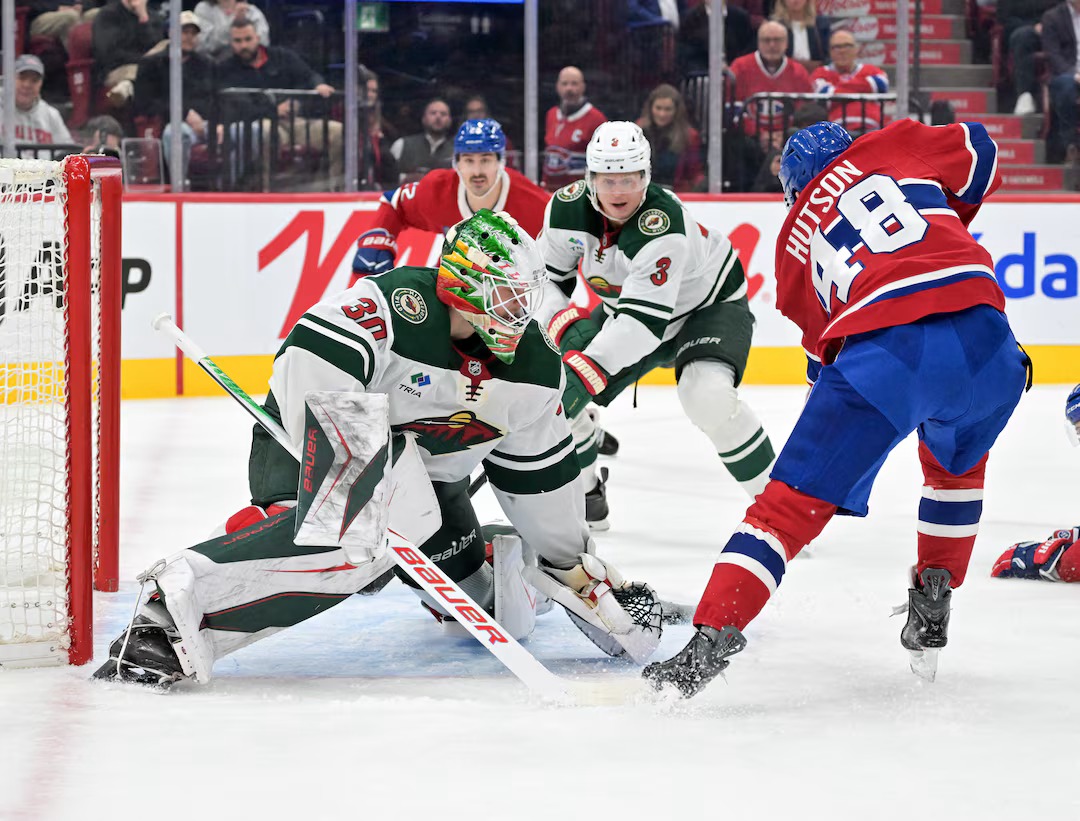
The Canadiens lost 2-1 in overtime to the Minnesota Wild on Tuesday night at the Bell Centre. On paper it was just a lost point. In reality it was one of the best games they have played all season, on the night they honoured Carey Price, and the way they lost says more about where this team is going than most of their wins.
The overtime point also kept a historic run alive. The Canadiens have now gone 11 games in a row without a regulation loss, and only seven streaks by a Canadiens team since 1978-79 have been longer, led by the 21-game run in 1979-80.
Price Night: Almost Four Minutes of Standing Ovation
Price came to Montréal about 24 hours after his induction into the Hockey Hall of Fame in Toronto. Before the game he was added to the Canadiens’ Ring of Honour and his portrait went up in the dressing room alongside the franchise’s other Hall of Famers. The crowd stood and cheered for almost four minutes. Price, who avoided attention during his entire 15-year career, stood there a little uncomfortably and waited for it to end.
He also had a message for the current team. Speaking in Toronto, Price said he loves watching this group because it is exciting and explosive offensively, and from the ice he turned to the Canadiens’ bench and told the players that this is their time now and to enjoy it.
Jacob Fowler was in the net that night. He is less than two weeks from turning 22, which makes him the youngest regular goalie in the league, just as Price was when he broke in during 2007-08. Fowler said he had goose bumps, that he had never been that close to Price before, and that the ovation went on so long the players wondered if the game would ever start. We wrote about how closely Fowler’s path follows Price’s in As Price Enters the Hall, Fowler Follows in His Steps.
The Matchup Plan That Worked
Once the puck dropped, the game was a real playoff-style test. Minnesota has a top line of Kirill Kaprizov, Joel Eriksson Ek and Matt Boldy, plus defenseman Quinn Hughes, and by postgame reports that line had not allowed a five-on-five goal all season. The Canadiens have a similar mix on their own top line: a pure shooter in Cole Caufield, a two-way center in Nick Suzuki and a big, skilled winger in Juraj Slafkovský.
Martin St-Louis gave that line the job of playing against the Wild’s best, together with the defense pair of Kaiden Guhle and Alexandre Carrier. That left Lane Hutson and Noah Dobson to face Minnesota’s depth more often and gave the third and fourth lines a chance to win the minutes underneath. There was a cost: the Suzuki line was not going to get the offensive freedom it normally has. But the plan was sound, and the Canadiens executed it.
St-Louis described the approach in simple coach’s terms. Against a line like that, he said, it is not about winning every shift. You win some by playing carefully, you win some by making them defend, and sometimes the goal is just not to lose a shift. He liked how his group managed it, said the depth behind the top line was good, and called it a great hockey game from both teams. His only disappointment was that his players did not get the two points.
Here is what the five-on-five numbers show, using the official NHL play-by-play and shift data. Neither team scored at even strength except for Minnesota’s Bobby Brink at 2:53 of the third period, so the games within the game were about who controlled the play.
| Five-on-five unit | Time on ice | Shot attempts | Shots on goal | Goals |
|---|---|---|---|---|
| Suzuki line (Caufield, Suzuki, Slafkovský) | 11:18 | 13-6 | 8-3 | 0-0 |
| Suzuki line against the Wild top line | 7:17 | 8-4 | 5-2 | 0-0 |
| Guhle and Carrier | 12:03 | 6-14 | 1-8 | 0-0 |
| Hutson and Dobson | 15:23 | 27-12 | 11-5 | 0-1 |
| All five-on-five | 48:02 | 50-46 | 20-18 | 0-1 |
Source: NHL play-by-play and shift data, Nov. 10 game against Minnesota. Shot attempts, shots on goal and goals are Canadiens first. The Wild top line is Kaprizov, Eriksson Ek and Boldy.
The Suzuki line won its minutes, and when it was on the ice against the Wild top line it had the better of the shots, 5-2, with nothing scored either way. The Wild top line did not produce a five-on-five goal. Guhle and Carrier took the hard minutes and were on the wrong side of the shot attempts, but nothing got through. Hutson and Dobson controlled their time against the depth, and the one even-strength goal against came with them on the ice. Overall the Canadiens finished slightly ahead at five-on-five, 50-46 in attempts and 20-18 in shots on goal, and outshot Minnesota 28-24 in the game. The top line is also producing: Suzuki has 7 goals and 9 assists in his first 12 games of the season, a start that only a few Canadiens centers have matched, including Saku Koivu in 1996-97, Keith Acton, Pete Mahovlich, Jean Béliveau and Henri Richard.
The Referee Situation: One Official, Two Costly Calls
The Canadiens tied the game at 18:22 of the third period, when Suzuki scored on the six-on-five with 1:38 left. Forty-one seconds later, at 19:03, Cole Caufield went to the box for slashing Quinn Hughes. The penalty carried into overtime, Minnesota started on a four-on-three power play, and Kirill Kaprizov scored at 0:21 with assists from Matt Boldy and Hughes.
Here is how the play happened. Caufield put his stick over Hughes’ stick, and at the same moment Hughes lifted his stick. The contact between the two broke Hughes’ stick, and the referee called slashing on Caufield. Postgame coverage noted that the replay did not clearly show contact that would have broken a stick. After the game, many of the conversations were about the quality of the sticks and about the NHL needing to decide how it wants to handle a penalty when a stick breaks.
The earlier call followed the same pattern. At 7:20 of the third period, Josh Anderson was called for hooking Maxim Shabanov on a backcheck. The veteran referee, Kelly Sutherland, was explaining to the Wild players why there was no penalty on the play, and then Justin Kea, the other referee, called it anyway. That irritated the Canadiens’ bench. Both the Anderson and Caufield penalties were called by the referee at the back of the play. The Canadiens killed the Anderson penalty and the Wild did not score on three shots, but it was a clear example of two officials who did not agree on what they saw.
Martin St-Louis did not like the Caufield call, but he stayed measured. He agreed with the reporter’s point that officials often penalize a broken stick even when the player did not cause it, said there is always context in how a stick breaks, and added that officials have a hard job at that speed. What he regretted was that the call decided the game.
In the dressing room the players were more direct. Phillip Danault said the two referees did not look like they were on the same page, that the call was ambiguous, and that it was costly. Alexandre Carrier said it is frustrating, that officials make mistakes like anyone else, and especially frustrating when the official farther from the play is the one who makes the call instead of the one closer to it. Anderson kept his answer short when asked about the penalties.
The timing of the debate is interesting. On Tuesday, the same day as the game, the league’s 32 general managers heard a proposal for what the NHL calls Rapid Replay Assist, technology that would let officials quickly fix clear mistakes during a game, such as a penalty called on the wrong player, with help from the league’s Situation Room. The league says it will explore the idea. The GMs reacted positively, but no rule can change in the middle of the season. The Competition Committee could look at it in March, and 2027-28 would be the earliest it could take effect. Broken sticks were not part of that proposal as reported, but the Anderson play is exactly the kind of situation where the referees should communicate with each other and decide together whether there is a penalty.
That is the frustrating part. Two excellent teams played a great game, the Canadiens went 0-for-2 on the power play and Minnesota went 1-for-3, and the only power-play goal came in overtime after a stick broke. A game like that deserved to be decided by the players.
Duel of Titans: Fowler vs. Wallstedt
The best matchup of the night was in the two creases. Jacob Fowler and Jesper Wallstedt are young goalies who both have the look of future top goalies in the NHL, and neither one was willing to give anything away. The game was scoreless through two periods, and the first goal did not come until 2:53 of the third. Until then it was save after save: Wallstedt would make a stop, Fowler would answer at the other end, and then Wallstedt would reply again, like a boxing match where every punch is returned. Fowler stopped 22 of 24 shots (.917) and Wallstedt stopped 27 of 28 (.964) on a night when the Canadiens outshot the Wild 28-24. It was fascinating to watch two young goalies deliver that kind of performance for their teams and their fans.
Kaprizov is one of the best goal scorers in the league, and on the overtime power play he was given a wide-open one-timer. No reasonable hockey observer would blame Fowler. Fowler blamed himself anyway. He said he let his focus drift for half a second, that players in this league make you pay for it, and that it felt self-inflicted because a late goal after the Canadiens had the momentum is hard to give up. In the same answer he praised the penalty kill, not only for this game but for the whole season. That is exactly what people remember about Carey Price: a goalie who owns every goal and moves on to the next shot. It is one more reason the Fowler comparisons keep growing. The numbers back it up: his 10-game streak without a regulation loss is the third longest ever by a Canadiens goalie aged 21 or younger, behind Michael Larocque (13 in 1973-74) and Carey Price (12 in 2008-09) and level with Rogie Vachon (10 in 1967-68).
Hutson vs. Hughes: Two Defensemen Who Run the Offense
The goalies were not the only matchup worth watching. Lane Hutson and Quinn Hughes are similar defensemen: both control the offense of their teams with their mobility and creativity, and both open up chances for their teammates every time they have the puck. Hughes played 29:28 and set up Kaprizov’s overtime goal. Hutson played 26:47, put six shots on goal and assisted on Nick Suzuki’s game-tying goal. Hutson now has 18 points in the Canadiens’ first 18 games, a start that puts him on the franchise list of the best 18-game openings by a defenseman, behind Larry Robinson (25 in 1976-77), Gaston Gingras (23 in 1986-87), and Guy Lapointe and Chris Chelios (21 each). Watching the two of them, it is easy to see why each team’s offense runs through its blue line.
Two Top Teams, One Point Each
The third matchup was the teams themselves. Montréal and Minnesota are both near the top of the NHL, and both executed their game plans almost to perfection, staying patient and waiting for their opportunity to score. Neither team gave the other much, and neither deserved to walk away with nothing. The history makes the result more meaningful for Montréal: Minnesota had won 20 of the previous 22 meetings since December 2014, outscoring the Canadiens 3.73 goals to 1.55 per game, with a power play at 29.1 percent and a penalty kill at 90.6 percent in those games. A one-goal game that went to overtime is real progress against that record. Both teams deserved two points on Tuesday night, and at least each of them left with one.
What It Means for the Canadiens
The Canadiens’ season has been about balancing the offensive talent they have with the defensive identity they will need in the playoffs. Tuesday was a real test of that balance, against a Minnesota team that sits near the top of the league standings. They held the Wild’s top line without a five-on-five goal, got strong goaltending, killed the first two minors Minnesota had a chance to cash in on, and pushed for the tie with the goalie pulled. They lost on a late call and one shot.
That is the kind of game Price’s teams used to play: tight, patient, low on mistakes, with the goalie deciding the outcome. The current group scores much more than those teams did, but if they can play this way against the league’s best, they will be ready for the spring. The Canadiens are next in Boston against the Bruins on Thursday at 7:00 PM ET. Check Lineup Tonight and the Injury Report before puck drop, and read our full game report and game recap page.
Sources: NHL game data (play-by-play, shift charts and game sheet), The Athletic, RDS, BVM Sports (summary of a Sportsnet report on Rapid Replay Assist), Canadiens Stat Centre.
Get the HABSHQ Newsletter in Your Inbox
Every Monday, the HABSHQ newsletter brings you the full Canadiens, Rocket, Lions and prospects report, our takes, the stats of the week and the preview of the week ahead, straight to your inbox. It is free.

Get the Habs week in your inbox
Free weekly newsletter from HABSHQ.
Leave a Reply