
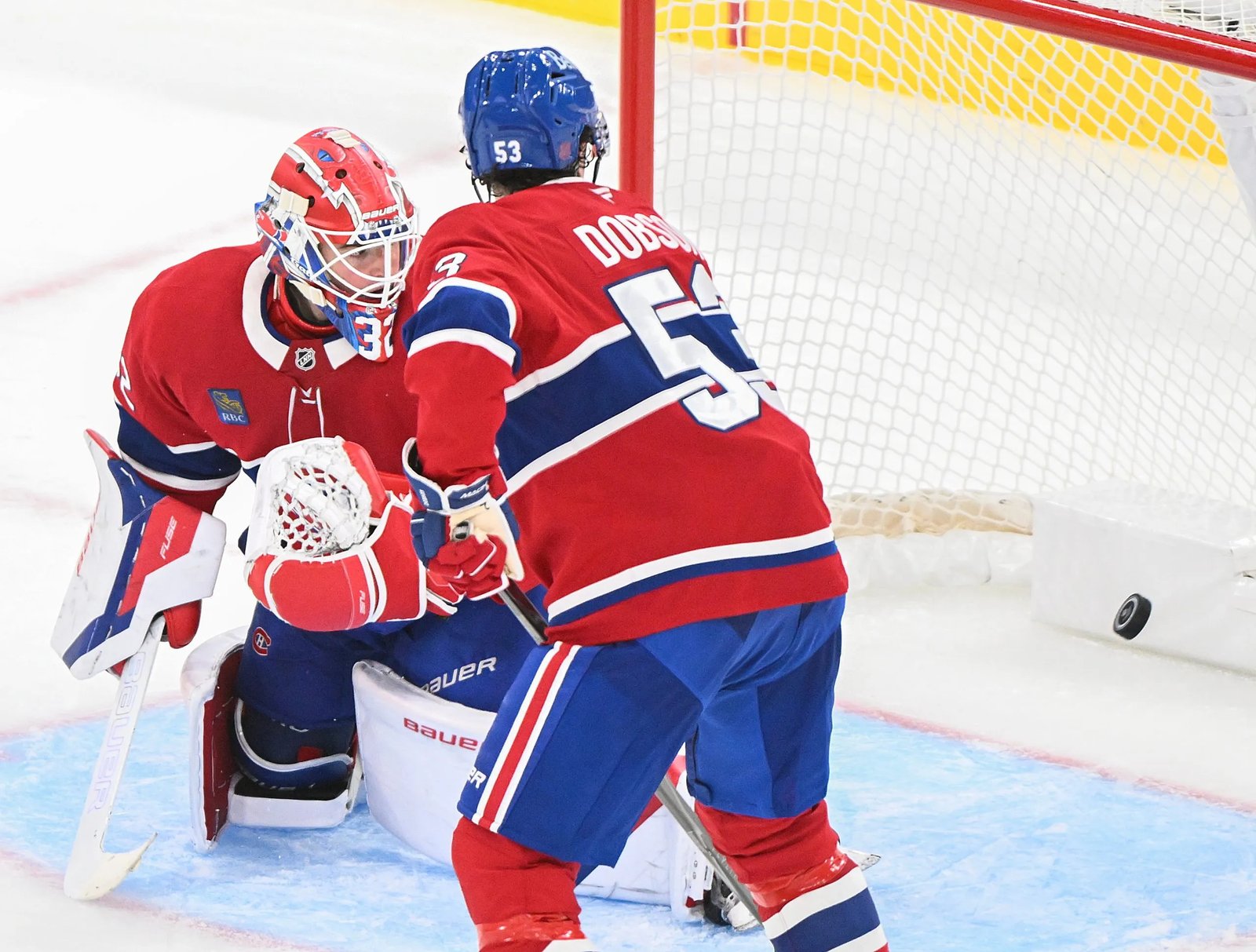
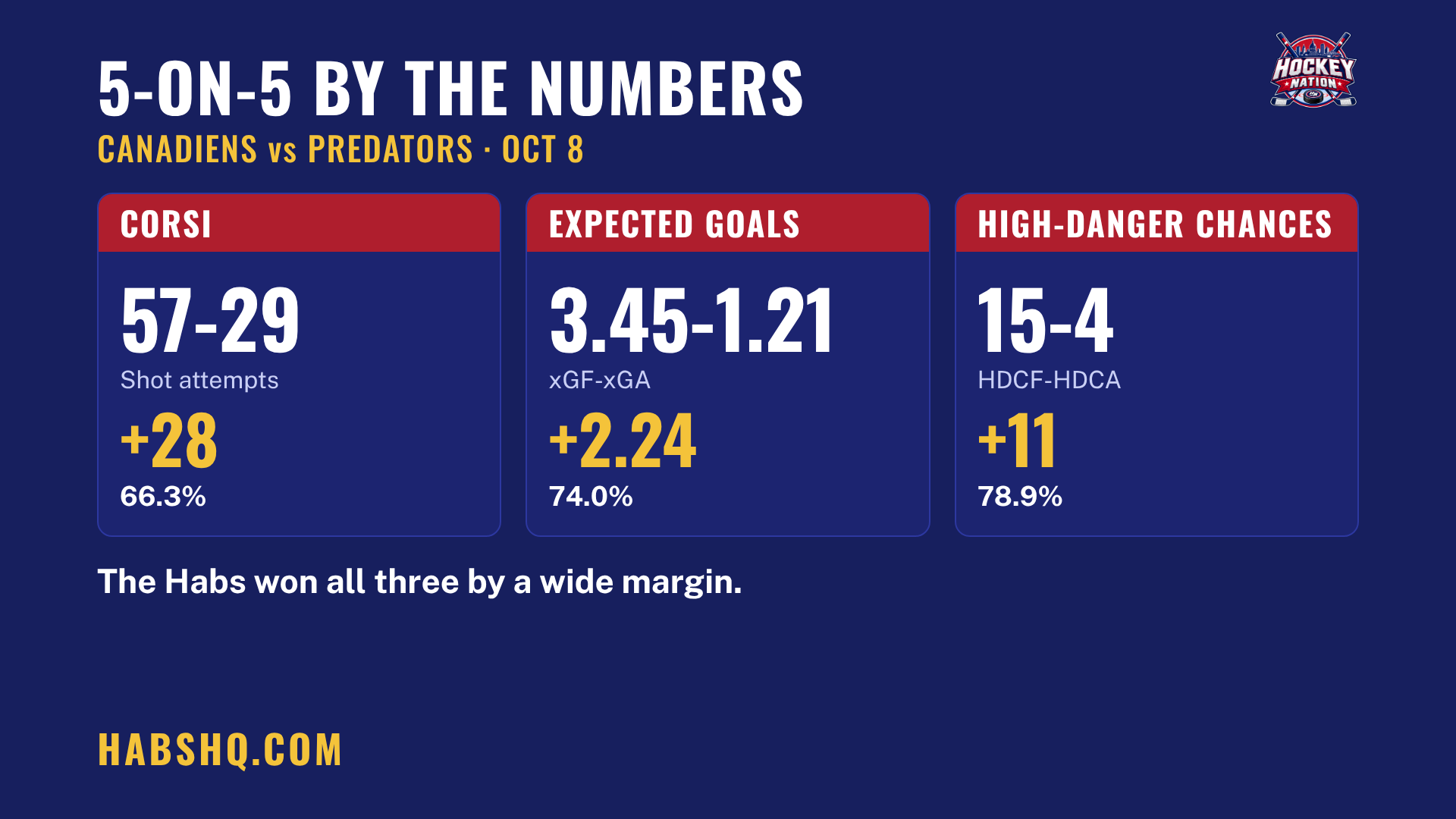
The Montreal Canadiens dominated Nashville on Thursday night, led 2-0, and still lost 5-2 to the Predators. It was their third straight game without a win, and it left them 1-2-1 with 3 points, seventh in the eight-team Atlantic Division. The numbers say it should have gone the other way: Montreal outshot Nashville 34-20, and at five-on-five the Canadiens had 57 shot attempts to 29, 3.45 expected goals to 1.21, and 15 high-danger chances to 4.
So what happened? Three things: Juuse Saros stopped 32 of 34 shots (.941), the special teams went Nashville’s way, and the Canadiens took the wrong penalties at the wrong time. This article looks at how the game slipped away, what the players and the coach said afterward, and what the numbers say about the lineup. For the game story, read our recap.
How the Game Slipped Away
Nick Suzuki opened the scoring at four-on-four at 3:12 of the second period, and Alex Newhook made it 2-0 at five-on-five at 8:50. The Canadiens were in control. Then Alexander Kerfoot cut the lead with a tip-in at 15:06, and the penalties started to decide the game.
Noah Dobson was called for tripping at 18:00 of the second period, and Matthew Wood tied it 2-2 on the power play at 19:28. Emotions boiled over as the period ended: Josh Anderson was called for cross-checking and Arber Xhekaj for a ten-minute misconduct. Around the 11-minute mark of the third period, with the game still tied 2-2, Anderson had a breakaway and could not finish it.
Mike Matheson was called for tripping at 15:45, and Ryan O’Reilly tipped in the game-winning goal on the power play 59 seconds later. Nashville added two empty-net goals after that, which turned a 3-2 loss into 5-2. The empty-netters did not decide the game. The penalties did.
What the Team Said
Martin St-Louis did not look for excuses. “It’s disappointing, they didn’t beat us in that game, they just won,” he said. He called the competitive level very high, said he saw no passengers on his bench, and described the players as proud and disappointed. His first concern after a game like this was their state of mind: life is not always fair, he said, and the team has to go back to work. He also said the penalties have to come down, because you cannot give the referees opportunities to call them, and the special teams have to improve.
Anderson was hard on himself about the breakaway. “It’s frustrating. Every time you can practically put your opponent away with a chance that is on you, you want to score. I still can’t stop thinking about it,” he said, though he liked the level of involvement from his teammates.
Suzuki said five penalties is too many and that it is a point the team will fix. Lane Hutson said there is no cause for concern: there are things to improve, but nothing worrying, and the team just wants to string wins together and get its season started. He said the power play has the chances and is simply not scoring yet.
Is It Time to Worry?
The record looks bad, but the picture is mixed. The Canadiens have allowed 19 goals in four games, and 17 in the last three (three of them into an empty net). The power play is 1 for 13 (7.7 percent) and the penalty kill is 12 for 17 (70.6 percent), with five power-play goals against.
The penalties are the clearest problem. Montreal has taken 21 minor penalties in four games, 5.25 a game, the fourth most in the NHL. The league average is 3.71. Thursday showed what that costs: two of those penalties led straight to the goals that tied the game and decided it. It is early and the sample is small, but it is a habit the team controls, and St-Louis said so himself.
The way the team plays is not the problem. The Canadiens dominated the territory, the chances and the shots, and had three lines that won their minutes. That is not a reason to panic. It is a reason to stop giving games away.
Saros, and Fowler’s First Game of the Year
Saros was the difference. He stopped 32 of 34 shots (.941), including all 10 shots on goal from the Suzuki line at five-on-five, a line that had 1.56 expected goals and could not score.
At the other end, Jacob Fowler played his first game of the season after Samuel Montembeault was hurt at practice (see our story). He stopped 15 of 18 shots (.833). Two of the three goals against him were tip-ins in front of the net, by Kerfoot and by O’Reilly, and Wood’s tying goal was a snap shot on the power play.
The Lineup Puzzle
St-Louis opened camp with a clear goal: balance, four lines that can all threaten to score. That meant putting Chris Kreider next to Suzuki and Cole Caufield, and giving Juraj Slafkovský a line of his own. Then Ivan Demidov was injured and will miss two to four weeks, and the plan had to change. On Thursday, Slafkovský went back to the top line with Suzuki and Caufield. St-Louis described the lineup as a puzzle that keeps changing and can be volatile.
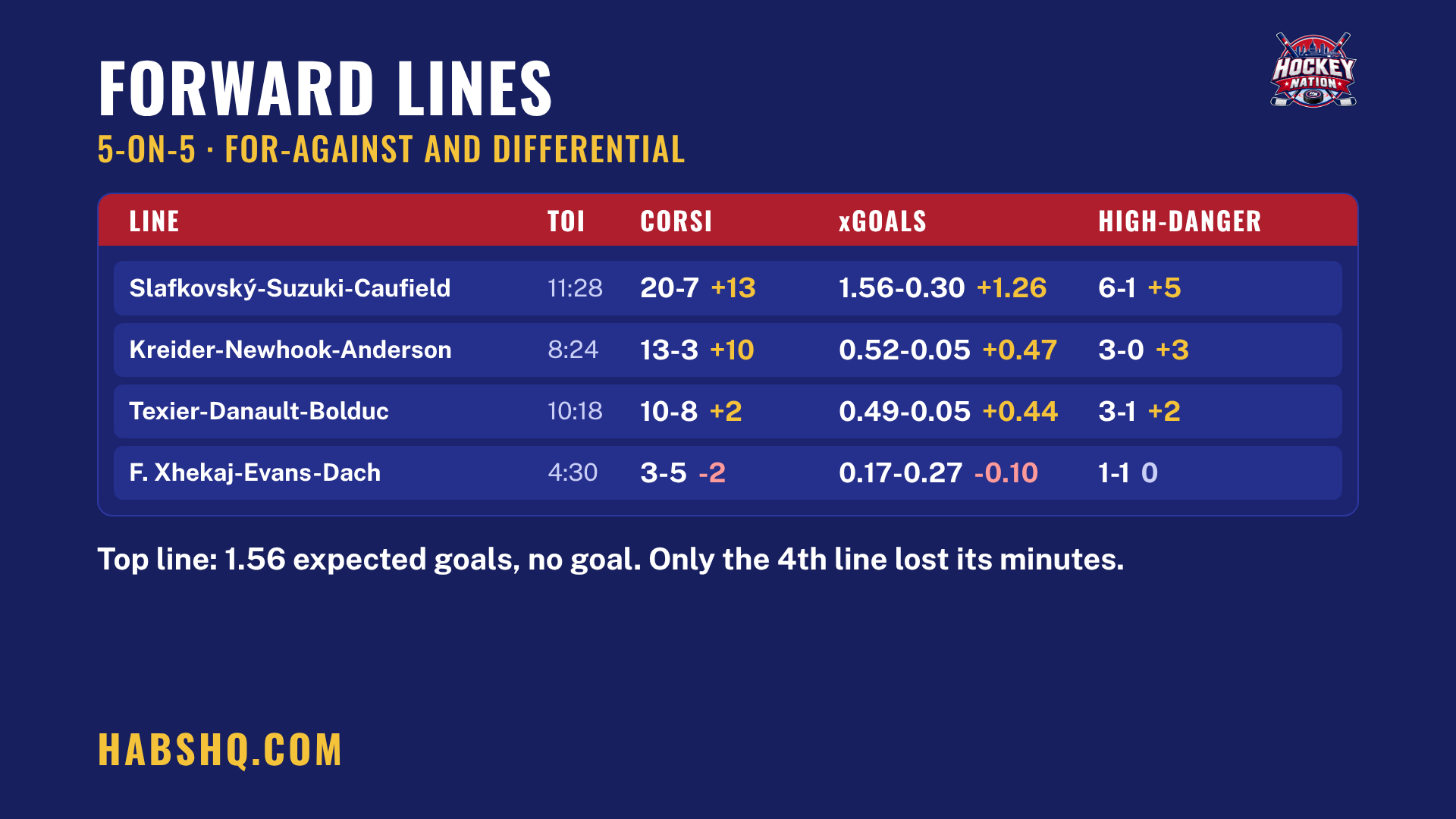
The reunited top line did what it was built to do: 20 shot attempts to 7, 10 shots on goal to 5 and 6 high-danger chances to 1 in 11:28, with an expected-goals share of 84 percent. It did not score. That was only the third-best number among the forward lines. Kreider, Newhook and Anderson were at 91.6 percent in 8:24 (13 attempts to 3, 6 shots to none), and that line produced the only five-on-five goal. Zachary Bolduc, Phillip Danault and Alexandre Texier were at 90.2 percent in 10:18, with 5 shots on goal to 1. St-Louis said he liked what he saw from the Danault line so far, and from Kreider, Anderson and Newhook together. As a team, the Canadiens created about 3.5 goals worth of chances at five-on-five and scored one.
Newhook described the new line as an in-your-face line: it wins pucks back and plays with pace. He said he carried the puck through the neutral zone a lot, while Kreider and Anderson kept it simple coming out of the zone, controlled pucks along the wall and got to the net.
The fourth group was the only one that lost its minutes. Florian Xhekaj, Jake Evans and Kirby Dach were outchanced 5-3 in attempts over 4:30, with high-danger chances even at 1-1. It is a small sample.
Oliver Kapanen has yet to play this season, and Demidov will be back in a few weeks. When both return, the Canadiens will need a new second line, which would likely push the Newhook line down to the third line. That is a good problem to have: three forward lines can win their minutes. The harder part will be finding the right spot for each one.
The Defense Pairs and Engström’s Return
Hutson and Dobson played together for 14:07 and had 15 shots on goal for and 5 against, with 76.5 percent of the shot attempts. Suzuki said the two read off each other and look for plays, almost like having two of the same defenseman.
Adam Engström played his first game of 2026-27 and made it count: 11:49 of ice time and a plus-1. With Xhekaj, he was on the ice for 7 shots on goal for and 1 against at five-on-five in 8:24, with 68.8 percent of the shot attempts. It is a small sample, but it supports the case for keeping him in the lineup.
The weak spot was Matheson and Alexandre Carrier. In 13:18 they had 1 shot on goal for and 3 against, and 35.3 percent of the shot attempts. They did not give up much, but they did not drive play either, and Matheson’s penalty late in the third period was the one that cost the game.
Coach’s Take
Sometimes you play well and lose. Sometimes you play badly and win. That was the Canadiens against Nashville. The numbers above show a team that controlled the game, but poor discipline and weak special teams decided it.
Five-on-five was their best of the season. You usually win when you play like that, and this time the problem was finishing: about 3.5 expected goals, one real goal. The new line combinations helped the first three lines. Slafkovský, Suzuki and Caufield had real chemistry all night and combined for 12 shots on goal. Anderson was excellent, and Newhook’s goal was the second line’s first at five-on-five this season. Danault’s line has been the most consistent since opening night. It still was not enough.
Special teams have been the biggest problem from the start. The power play had one shot on goal and four attempts in three chances. The puck moves and they control it, but they do not hit the net. There is too much talent on that unit not to score. The penalty kill is worse: this was the second time in four games it allowed two power-play goals. The more aggressive system is new for this group and an adjustment is normal, but the results have to improve. One quick measure I like is power-play percentage plus penalty-kill percentage. A team above 105 is usually a playoff team and a top-10 club. Montreal is at 78.3 right now, which is not acceptable.
The penalties come from veterans. Montreal has taken 21 minors in four games, the fourth most per game in the league. Anderson has three. Dobson and Matheson have each taken a minor in three straight games. Most of them are tripping calls or penalties after their own turnovers, so it comes down to moving the feet and managing the stick. On Oct 8 it cost them twice: Dobson’s tripping minor led to Wood’s power-play goal at the end of the second, and Matheson’s tripping minor led to O’Reilly’s winner. It is frustrating for Dobson in particular, because he often plays well and then one penalty changes the game.
Then there is goaltending. The team save percentage is .829, 29th in the league. We cannot put it all on the goalies, but no team wins with that number. It is a long season and there is no need to panic. Still, the injuries changed the plan and the Habs must adjust. Last night was their best game, and they need to turn that into points.
What Comes Next
The Detroit Red Wings visit the Bell Centre on Saturday, October 10, at 7:00 PM ET. Detroit leads the league with 6.0 minor penalties a game, so the special teams could decide that game as well. If the play looks like Thursday and the penalties come down, the results should follow.
Enjoyed this article?
Share it with a Habs fan, and get the HABSHQ newsletter in your inbox.
Get the Habs week in your inbox
Free weekly newsletter from HABSHQ.
Leave a Reply