
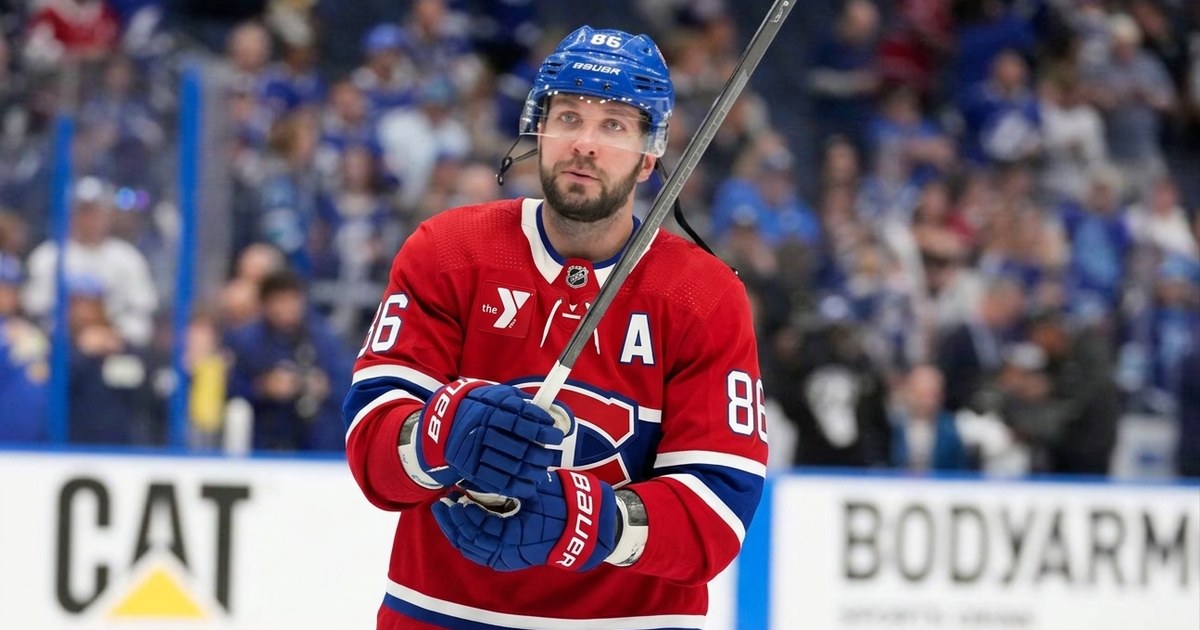
Nikita Kucherov wants out of Tampa, and every contender with cap room is now doing the same math. For a Canadiens site the question is simple: should Montreal be one of those teams? Our answer is a conditional yes, and below we explain exactly what the conditions are.
Kucherov’s Trade Request
According to reports, Kucherov has told the Lightning he will not re-sign and would like to be traded. He met with general manager Julien BriseBois and his agent, Dan Milstein, on Friday, and he also told his teammates on the flight to Nashville ahead of Saturday’s game. For now he keeps playing.
The contract details are what make this interesting. Kucherov is 33 years old and carries a $9.5 million cap hit on the eight-year deal he signed in 2018, which expires at the end of this season. He has a modified no-trade clause with a 10-team list, so he has real say over where he ends up. Reports say he was seeking a six-year extension at around $20 million per season, more than double his current number.
Tampa is not a bad team, which makes the timing stranger. The Lightning are 8-3-1 and third in the Atlantic Division, and Kucherov has 15 points in 12 games. But the core around him is getting older: Vasilevskiy is 32, Hedman is 35, McDonagh is 37, Carlson is 36, Guentzel is 32 and Point is 30. It looks like a player deciding he does not want to ride out the end of that window.
His Season and Career
Before we talk about Montreal, remember what is actually on the table. Kucherov is a two-time Hart Trophy winner, a three-time scoring champion (2018-19, 2023-24 and 2024-25), a two-time Lindsay Award winner (2019 and 2025) and a two-time Stanley Cup champion (2020 and 2021). He has passed Steven Stamkos on the Lightning’s all-time points list and now sits at 1,139 career points (405 goals and 734 assists) in 891 games.
| Season | GP | G | A | PTS | PP points | +/- |
|---|---|---|---|---|---|---|
| 2022-23 | 82 | 30 | 83 | 113 | 50 | -2 |
| 2023-24 | 81 | 44 | 100 | 144 | 53 | +8 |
| 2024-25 | 78 | 37 | 84 | 121 | 46 | +22 |
| 2025-26 | 76 | 44 | 86 | 130 | 37 | +43 |
| 2026-27 (12 games) | 12 | 4 | 11 | 15 | 5 | +2 |
Three things stand out. First, age has not slowed him: he put up 130 points last season. Second, he is a power-play weapon, with 406 career power-play points (105 of them goals). Third, he is producing right now, with 15 points in 12 games and 5 of them on the power play. This is not a decline story. This is a superstar asking out.
Is Kucherov a Fit in Montreal?
On the ice, almost perfectly. On the cap and the calendar, only with conditions.
Start with the power play. The Canadiens are 4 for 39 (10.3%) through 13 games, and they did not score a power-play goal on the 4-0 road trip out West (see our road trip breakdown). That trip was won with goaltending, defense and five-on-five play. A player with 406 career power-play points is the exact piece that fixes the one part of the game that is still broken.
Then there is the injury situation. Nick Suzuki is out two to four weeks and Ivan Demidov is on injured reserve. We looked at who steps up without Suzuki, and the honest answer is that the lineup needs another elite scorer. You can follow the daily changes on our Lineup Tonight page and the team’s position on the standings page. At 8-3-2 and second in the Atlantic, Montreal is a team that could use a push, not a rebuild.
The awkward part is the lineup. Kucherov is a right winger. In the game, Cole Caufield plays the left side and Juraj Slafkovský plays the right side, with Demidov also on the right. Kucherov could play on the top line next to Caufield, and Josh Anderson is not a top-six player, so he is not the one in the way. The real problem is that one of the top six has to come out. Either Slafkovský or Demidov loses his spot on the right side, or one of them is moved to a different position.
The power play is the same story. Kucherov will improve it, but he would take the spot of Slafkovský or Demidov, so one of them loses power-play time. His talent brings a lot, but Montreal would have to make real changes to its lines and its power-play units to fit him.
The cap works, but only just. Montreal has roughly $11 million of space (see our contracts page), so a $9.5 million cap hit fits and leaves about $1.5 million for injuries and call-ups. Tampa has only about $3.2 million of room, which means very little salary can come back to Montreal in a deal, and that is a problem for the Lightning too.
Two unknowns can still kill this idea. We do not know whether Montreal is one of the 10 teams on his no-trade list, and he has already said he will not re-sign with Tampa, which does not mean he would re-sign here. Any team that trades for him either gets an extension done or pays a lot for a rental. At the reported ask of six years at about $20 million per season, which would run until he is 39, we would not sign that deal.
What Would It Cost?
These are HABSHQ’s own estimates, not reported asks. Tampa’s leverage is lower than usual: Kucherov has said he will not re-sign, and his list limits the number of buyers. But he is still a 130-point player, so the price will not be small.
Tampa will not accept picks alone. The Lightning are 8-3-1 and they still want to compete, so they will ask for an NHL player who can help right now. Our estimate is a package built on three pieces: Alex Newhook, a prospect at the level of Michael Hage (an example of the level, not a prediction), and one or two first-round picks. Newhook has a cap hit of about $2.9 million, so Tampa can absorb him with its limited space, and he gives some cap room back to Montreal. Montreal’s own first-rounder in 2027 is part of the picture (see all of our draft picks).
Is Newhook, a Hage-type prospect and two firsts enough? For Tampa it is a very strong offer for a 33-year-old on an expiring contract who has said he is leaving, especially with only 10 teams on his list. But it is expensive for Montreal. Newhook is one of our centers, so trading him thins the middle while Suzuki is hurt, and two firsts plus a top prospect is a lot to pay for a player we might only have for one season. Our view: Newhook, a prospect and one first is a fair price. The second first is what you pay to win a bidding war, and without an extension agreed that is too much.
There is another option: a goalie, Jakub Dobeš or Jacob Fowler. With Vasilevskiy at 32, Tampa could value a young goalie. The problem is the same one: both are part of Montreal’s future, and the goaltending is a big reason the team won four straight on the road. We would treat them as part of the core too, and not offer either one unless the whole deal is clearly worth it.
The red lines are clear: Lane Hutson, Demidov, Caufield, Juraj Slafkovský and Suzuki do not move. They are the young core, and none of them should be traded for a 33-year-old on an expiring contract.
Culture: Does He Fit the Room?
Talent is the easy part of this decision. The harder question is what he does to the locker room. We have no reason to question his character: he is a two-time Stanley Cup champion who has led a winning team for years, and he told his teammates himself on the flight to Nashville instead of letting them read about it. But a trade is about more than the player. It is about the group he walks into.
Montreal’s room is young, it is winning, and it is built around Suzuki, Caufield, Slafkovský, Hutson and Demidov, players who are growing together. Adding a 33-year-old superstar changes the ice time, the power-play roles and the pecking order. A player who asks for a trade and around $20 million per season also raises a fair question: how does the young core, whose contracts are built around the cap, see that? The coaching staff and the leadership group have to manage it, and it is not easy in the middle of a season.
The timing matters too. The Canadiens just went 4-0 on the road without their captain, and that came from a group that trusts each other. Bringing in a star mid-season, possibly as a rental, means someone’s role gets smaller, as we explained above, and that is how chemistry problems start when they are not handled well.
None of this is a no. A champion can make a young team better in the room, by showing how to win in April and May. But culture is a real factor, and management should talk to Suzuki and the leadership group before any deal is made.
Our Verdict: Yes, But Not at Any Price
We say yes to the idea of Kucherov in a Canadiens jersey, but only if all four of these are true. One, Montreal is on his list and he is willing to come. Two, the price is made of Newhook, a non-core prospect and picks, never one of the five names above, and we would not give up Dobeš or Fowler either. Three, there is a realistic path to an extension on a shorter term and a lower cap hit than $20 million for six years. Four, Suzuki and the leadership group are comfortable with the move and the role changes that come with it. If even one of those fails, the Canadiens should walk away.
The Habs are 8-3-2 with a young core that is getting better every week. Adding a superstar to that group is exciting. Mortgaging it for a rental is not. We will update this article as the story develops.
Get the Habs week in your inbox
Free weekly newsletter from HABSHQ.


Leave a Reply