
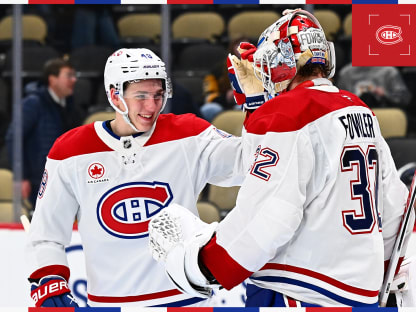
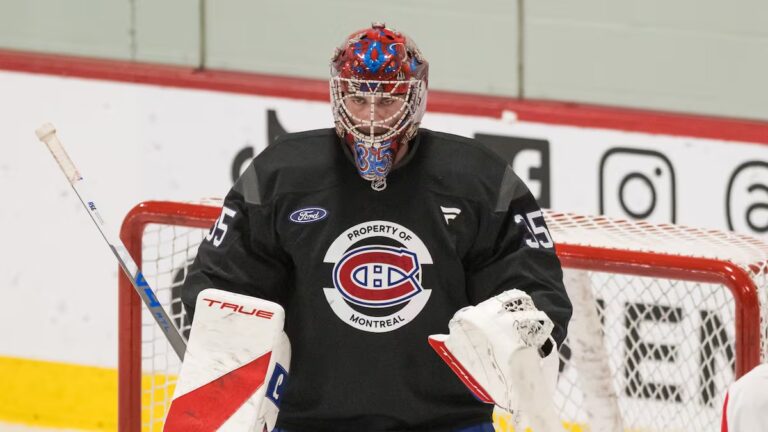
Hutson and Fowler do not play the same position, but they have almost everything else in common. Both are under 23. Both were judged too small by most NHL teams. Both were still available when the Canadiens picked them, Hutson 62nd overall in 2022 and Fowler 69th in 2023. Today they are two of the best players on the team, and the reason is the same for both of them: they are two of the smartest.
Wednesday’s 3-2 win in New Jersey showed it. Hutson assisted on all three Canadiens goals and Fowler stopped 28 of 30 shots, after a 4-1 loss to Colorado on Saturday and a 3-1 loss at the New York Rangers on Monday. But the story is much older than one game, and it starts at the draft table.
Both Were Judged by Their Size Before Their Hockey Sense
Hutson is listed at 5-foot-9 and 162 pounds, and at the 2022 draft that was his biggest problem. Teams look at a defenceman that size and see a player who will be pushed around by NHL forwards. Our read is that if he had been 6-foot-0 with the same skills he would have gone in the first round, and the numbers support that: he was taken in the second round, 62nd overall, which was the 30th pick of that round.
Fowler’s situation was the same in a different position. He is listed at 6-foot-1 and 223 pounds, and the NHL’s draft data lists the five goalies taken ahead of him in 2023 as Adam Gajan (6-foot-3), Michael Hrabal (6-foot-7), Trey Augustine (6-foot-1), Carson Bjarnason (6-foot-3) and Damian Clara (6-foot-6). Four of the five are taller than he is. Fowler went 69th, in the third round.
That is the first thing they share. In our read, they were chosen late because of a number on a measuring sheet and not because of how they played, and that is exactly the kind of mistake a team with good scouting can use.
Montréal Waited, and Both Players Were Still There
In 2022 the Canadiens held three picks before Hutson: Juraj Slafkovský first overall, Filip Mesar at 26 and Beck at 33. Hutson was still on the board 29 picks after Beck, at 62. We think there was luck in that, as well as good scouting, because a team picking a few spots earlier could have taken him. The Canadiens took him where he fell.
They did the same with Fowler. They waited until pick 69, and none of the five goalies taken before him has played an NHL game. Fowler already has 31 NHL games, 19 wins and a .916 career save percentage.
The payoff has been large for both. Since the start of 2024-25 Hutson has 166 points in 186 regular-season games, fifth among all NHL defencemen over that stretch, and he won the Calder Trophy in 2024-25. Fowler is 10-2-2 this season with a .924 save percentage, fourth among the 41 goalies who have played at least 10 games. Two players the league’s teams passed on are producing like first-round picks.
Both Learned the Game in College Hockey in Boston
Neither player was rushed. Hutson played two seasons at Boston University and scored 48 points in 39 games and 49 in 38. Fowler played two seasons at Boston College, with a .926 save percentage in 2023-24 and a .940 save percentage, a 1.63 goals-against average and seven shutouts in 35 games in 2024-25.
Both also played for the United States at the World Junior Championship, Hutson in two tournaments and Fowler in one. Both are American, Hutson from Michigan and Fowler from Florida. Fowler then spent most of last season with the Laval Rocket, where he won 19 of his 27 games with a .916 save percentage, before taking the Canadiens’ job this fall.
Our read is that those years are where the hockey sense we see today was built. Players who are not the biggest or the strongest have to learn the game earlier than others: where to be, when to go, when to wait. Both players study the game and understand it, and in college they had the time to do it.
Hutson Reads the Play Before It Happens
The first Canadiens goal on Wednesday is the clearest example of what we mean. New Jersey had just scored at 10:20 of the first period. At 10:55 the Devils turned the puck over in their own end, and Hutson read the play, intercepted it and fed Newhook, who scored at 11:00. The goal came 40 seconds after the one that put the Devils ahead, and only five seconds after the turnover.
That sequence is not luck and it is not size. To intercept a pass, a defenceman has to read the passer’s eyes and the angle before the puck is moved, close the gap at the right moment, and then know what to do with it. Our read is that he had already seen Newhook open before the puck reached him. That is the difference between a defenceman who breaks up a play and one who turns it into a goal, and it is what makes him dangerous at 5-foot-9 against much bigger opponents.
Hutson’s interception and pass to Newhook for the first Canadiens goal. Video from X.
Hutson Changed How the Canadiens Play
Hutson is the motor of this team, and he has been for two seasons. If the Canadiens become a solid team, everything starts with him. When he arrived, Martin St-Louis changed the system around what he does: the defencemen join the rush constantly and stay active in the offensive zone, and the team no longer waits for its forwards to create everything.
The numbers show how much of the offence runs through him. Of his 168 career points, 147 are assists, which is the profile of a player who makes the others better. In his last 100 games he has 15 goals and 83 assists for 98 points and a plus-41 rating. He averages 25:10 per game this season and has 22 points in 22 games, among the ten highest-scoring defencemen in the league.
Wednesday’s three assists gave him a new place on several historical lists. He has now reached 80 career assists on the road in his 94th road game, faster than all but five players in NHL history.
| Fewest games to 80 career road assists | Games |
|---|---|
| Wayne Gretzky | 77 |
| Peter Stastny | 78 |
| Mario Lemieux | 87 |
| Joe Juneau | 92 |
| Sidney Crosby | 93 |
| Hutson | 94 |
The other lists point the same way. Hutson has 8 games with three or more assists before turning 23, the same as Brian Leetch and behind only Bobby Orr (20), Paul Coffey (17), Robert Picard (11), Denis Potvin (10), Quinn Hughes (10) and Phil Housley (9). He is also plus-52 in his first 94 road games, second only to Bill Nyrop’s plus-59 and ahead of Larry Robinson’s plus-51. And with 22 points through the first 22 games of this season, he is tied with Guy Lapointe’s 1976-77 total on the list of Canadiens defencemen, behind Robinson’s 28, Gaston Gingras’ 24 and 23 each for Sprague Cleghorn, Lapointe in 1974-75 and Chris Chelios.
He also has 10 games of three or more points before turning 23 as a Canadien, tied with Mario Tremblay and Saku Koivu and behind only Stéphane Richer (18), Henri Richard (16) and Guy Lafleur (13). Our read is that what those lists have in common is vision: a defenceman does not reach them by shooting, he reaches them by seeing the play before the other team does.
The test comes on Thursday in Carolina, against the team that controls play better than anyone in the league. Hutson played 29:21 against Carolina on Oct. 6 and had one assist in a 6-4 loss at the Bell Centre. The more Carolina keeps the puck in the Canadiens’ end, the more his first pass will matter, and he will play next to Carrier on the second pair.
Fowler Resets Faster Than Most Goalies
Fowler looked upset after the first goal on Wednesday, and then he reset right away. That is the quality we notice most. After Meier made it 2-1 at 14:43 of the first period, he faced 22 more shots and stopped all 22. Twelve of them came in the roughly 27 minutes between Suzuki’s goal for 2-2 and Evans’ winner, and the Devils answered the winner within 30 seconds with a shot from the point and a tip-in from about 11 feet, both of which Fowler stopped.
The pattern is in his season numbers too. In the six games where he faced 30 or more shots he has stopped 209 of 219 (.954) and Montréal is 5-0-1. In the eight games with fewer than 30 shots he is .888. Our read is that he is sharper when he is busy, which is a trait you see in goalies who trust their reads rather than the ones who are waiting for the puck to hit them.
The other net made it a bigger test. New Jersey started Connor Hellebuyck, the goalie who was the hero for the United States in the Olympic gold medal game in February, and Fowler, an American rookie, outplayed him: 28 saves on 30 shots (.933) against Hellebuyck’s 25 on 28 (.893). Fowler said that he respects everyone out there, but that the job at hand and a goalie like that make him raise his level and “not give up any freebies”. Our read is that this is the right way to handle a matchup like that: treat it as a job and not as an event.
Captain Suzuki, who scored the power-play goal that tied the game, described the same quality after the win. He said Fowler understands the game at a very high level, that he reads plays and situations and stays ahead of the play, and that he does not force anything and stays composed. Then he went further: Fowler, he said, has “probably been our best player all year.” Our read is that this is the best evidence for the idea of this article. The captain is not describing size or athleticism, he is describing a goalie who thinks the game.
The historical lists put him in strong company too. Fowler is 10-2-2 after 14 games, and only Don Edwards of the 1976-77 Sabres reached ten wins in fewer games (13) among rookie goalies aged 21 or younger. Fowler is tied with Tom Barrasso, Jim Carey, Semyon Varlamov and Braden Holtby at 14.
| Rookie goalies, age 21 or younger: fewest games to 10 wins | Games |
|---|---|
| Don Edwards (Sabres, 1976-77) | 13 |
| Fowler (Canadiens, 2026-27) | 14 |
| Tom Barrasso (Sabres, 1983-84) | 14 |
| Jim Carey (Capitals, 1995-96) | 14 |
| Semyon Varlamov (Capitals, 2009-10) | 14 |
| Braden Holtby (Capitals, 2010-11) | 14 |
On the road, Fowler’s save percentage through his first seven road games of the season is .949, fourth among rookies behind Ross Brooks (.958), Thomas of the Canadiens in 1973-74 (.955) and Calvin Pickard (.951). His 2.19 goals-against average through 14 games is the sixth lowest by a Canadiens goalie in 70 seasons, behind only Carey Price (1.71 in 2016-17 and 1.97 in 2012-13), Jacques Plante (2.07), Charlie Hodge (2.14) and Jose Theodore (2.15). Those are some of the best goalies the franchise has had.
It is rare to see that at 21. He is in his rookie season, even though he played 18 NHL games last year, and he turns 22 on Nov. 24. Last season he was .908 in the NHL; this fall he is .924. Hutson was 21 when he won the Calder Trophy after a 66-point season, so the Canadiens have now seen this from two players at the same age.
Both Competed and Took Charge When the Team Needed It
Monday night in New York was, in St-Louis’s words, the worst game of the season. Hutson played 28:38 and had one assist, and Fowler stopped 23 of 26. Two days later Hutson, in his third full season, and Fowler, in his rookie season, acted like veterans. Hutson had three assists in 26:44 and Fowler stopped 28 of 30, even though the Devils had the shots, 30-28.
What stands out is what they have in common as competitors. Both love to compete at the highest level, and both want to win every night. St-Louis likes to talk about a player’s “computer”, the ability to read and process the game, and both of these players have an elite one. They also want to learn and get better, which is the reason we expect them to keep improving.
Our view is that this is what the Canadiens’ scouts and coaches were right about. Size was the question mark for both of them, and the player who sees the game early and competes every night answers that question again and again in the NHL.
Next Up
Thursday, Nov. 19: Canadiens at Hurricanes, 7:00 p.m. ET, Lenovo Center. Dobeš starts in goal and Fowler is the backup, so Hutson is the one we will watch against Carolina. Saturday, Nov. 21: Philadelphia at the Bell Centre, 7:00 p.m. ET.
Sources: NHL official game, player, draft and standings data and play-by-play; historical rankings from NHL stats research posted on X; Nick Suzuki’s and Jacob Fowler’s comments as reported after Wednesday’s game.
Get the HABSHQ Newsletter in Your Inbox
Every Monday, the HABSHQ newsletter brings you the full Canadiens, Rocket, Lions and prospects report, our takes, the stats of the week and the preview of the week ahead, straight to your inbox. It is free.

Get the Habs week in your inbox
Free weekly newsletter from HABSHQ.
More from HABSHQ
Watch the analysis
Coach Frenchy breaks down every Canadiens game live on the Hockey Nation Live Show, with the lines, the numbers and the plays that mattered.
Watch on YouTubeAbout Coach Frenchy
Coach Frenchy (Pierre) hosts the Hockey Nation Live Show, the daily live Canadiens and NHL commentary show on YouTube. HABSHQ is where he brings the lines, the numbers and the prospects together in one place.
Leave a Reply