

Anyone watching the NHL this fall can feel it: more goals, more power plays and more penalties. I wanted to see whether the numbers agree, so I pulled every game from this season and compared it with last season at the same point. Both samples are exactly 282 games: this season through November 8, and last season through November 14, 2025. One note before we start: the NHL is playing an 84-game schedule this year, the first since 1993-94, so every pace number below uses 84 games.
The league is scoring more
Goals per game are up from 6.19 to 6.33, which is 3.16 goals per team compared with 3.10 last year. The power play is a big part of the story. It is converting at 22.7% compared with 20.8%, with 410 power play goals compared with 365. The penalty kill sits at 77.3%, down from 79.3%.
Teams are also getting more time with the man advantage. Penalties are up to 8.06 per game from 7.67 (4.03 per team compared with 3.84), and major penalties jumped from 131 to 172. As a coach, my read is that special teams are deciding more games than they did a year ago.
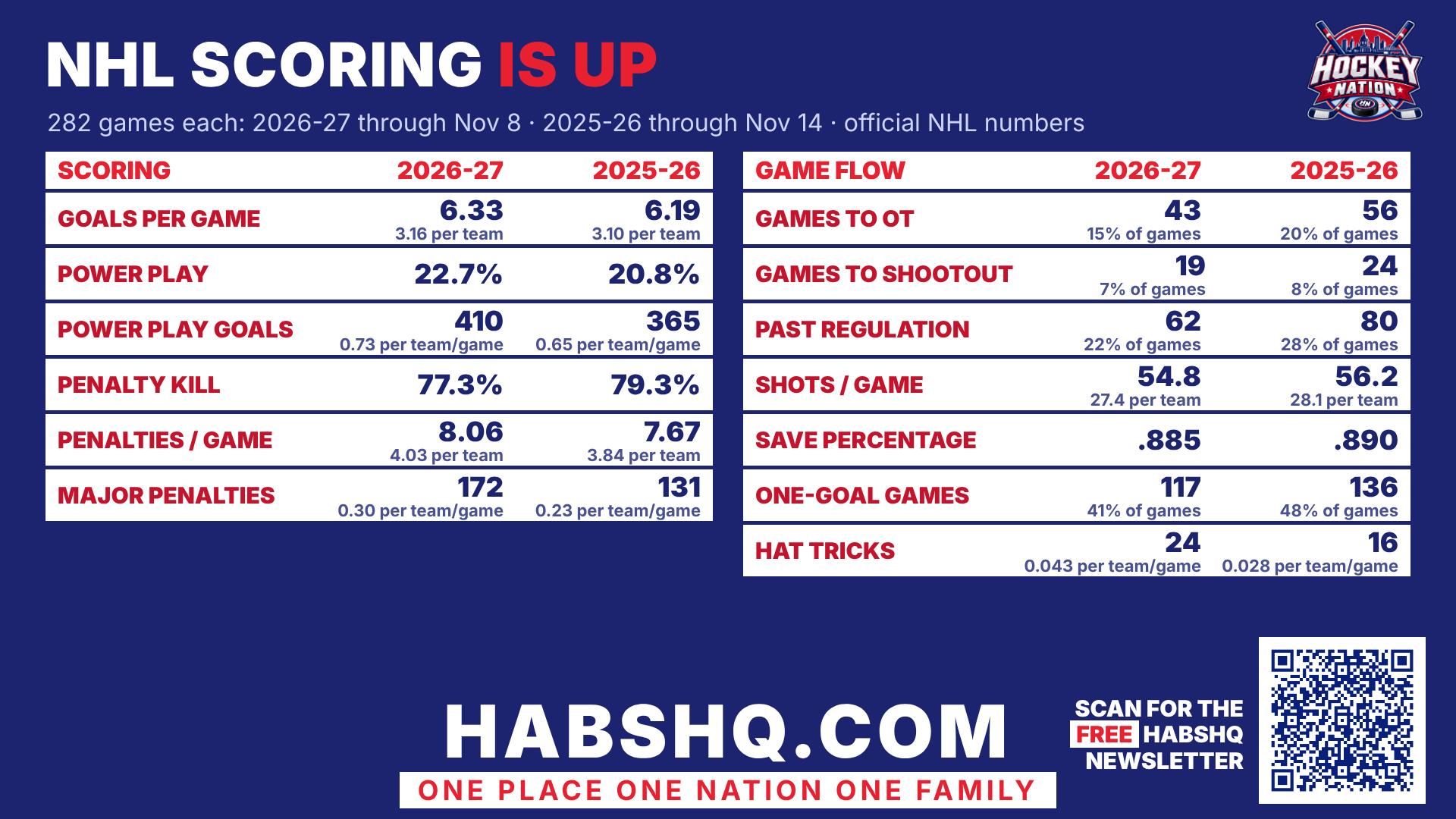
Shots are going the other way. Teams average 27.4 shots per game compared with 28.1 last year, and the league save percentage is .885 compared with .890. Fewer shots and more goals points to better quality, not more volume. That is my read of the numbers, not something the NHL data proves by itself.
Games are also being settled sooner. Only 62 of 282 games went past regulation (22%) compared with 80 last year (28%): 43 went to overtime (56 last year) and 19 to a shootout (24 last year). One-goal games are down too, 117 (41%) compared with 136 (48%).
Hat tricks tell the same story. There are 24 so far, compared with 16 at the same point last year. Cutter Gauthier has three of them, Logan Cooley and Brady Tkachuk have two each, and Evan Bouchard has one, which is rare for a defenseman. Nobody has scored four in a game yet this season. At this rate the league is on pace for about 114 over the full schedule, compared with about 74 at last year’s rate.
McDavid is playing at a level we have not seen in years

Connor McDavid has 47 points in 18 games, with 10 goals and 37 assists. That is 2.61 points per game, a pace of 219 points over 84 games. At the same point last year he had 27 points, and his best full season is 153 points in 2022-23.
Here is the context. Since 2000, nobody has finished a season of 60 or more games above 1.87 points per game, and that player was McDavid himself in 2022-23. This year he is at 2.61. If he could hold that for a full season, it would be the sixth best points-per-game season in NHL history. The five seasons above it belong to Gretzky (2.77, 2.69 and 2.65) and Lemieux (2.67 and 2.62).
Eighteen games is a small sample, so treat this as a pace, not a result. Our simulation gives him a 100% chance of 100 points, 80% for 150 and about 15% for 200.
His teammate Evan Bouchard is having a season of his own. He has 31 points in 18 games (10 goals and 21 assists), first among all defensemen, with 11 of those points on the power play, while playing 25:47 a night. Last season he finished with 95 points, the best total by a defenseman, and he had 15 at this point. A coach’s warning: he is shooting 20.4%, which is very high for a defenseman, so expect the goals to slow down. The assists and the power play minutes are what make 100 points realistic. We give him an 80% chance.
The race to 50 goals
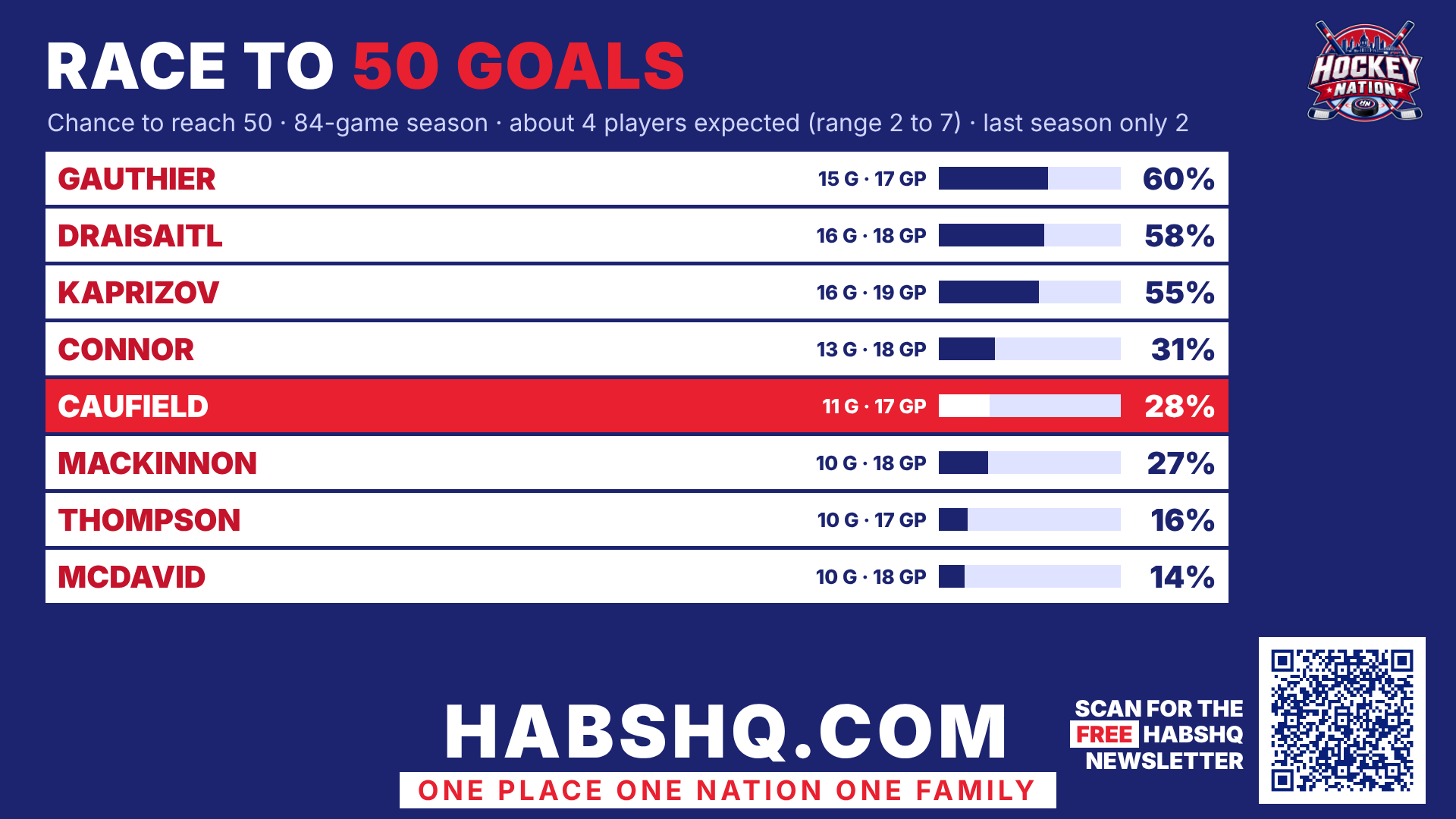
Fifty goals is getting harder to reach. Last season only two players got there, even though 15 were on a 50-goal pace at this point of the season. This year eight players are on pace, and our model expects about four to finish with 50 (a likely range of two to seven). Cutter Gauthier is at 60%, Leon Draisaitl 58% and Kirill Kaprizov 55%. Then come Kyle Connor (31%), Cole Caufield (28%) and Nathan MacKinnon (27%).
The race to 100 points
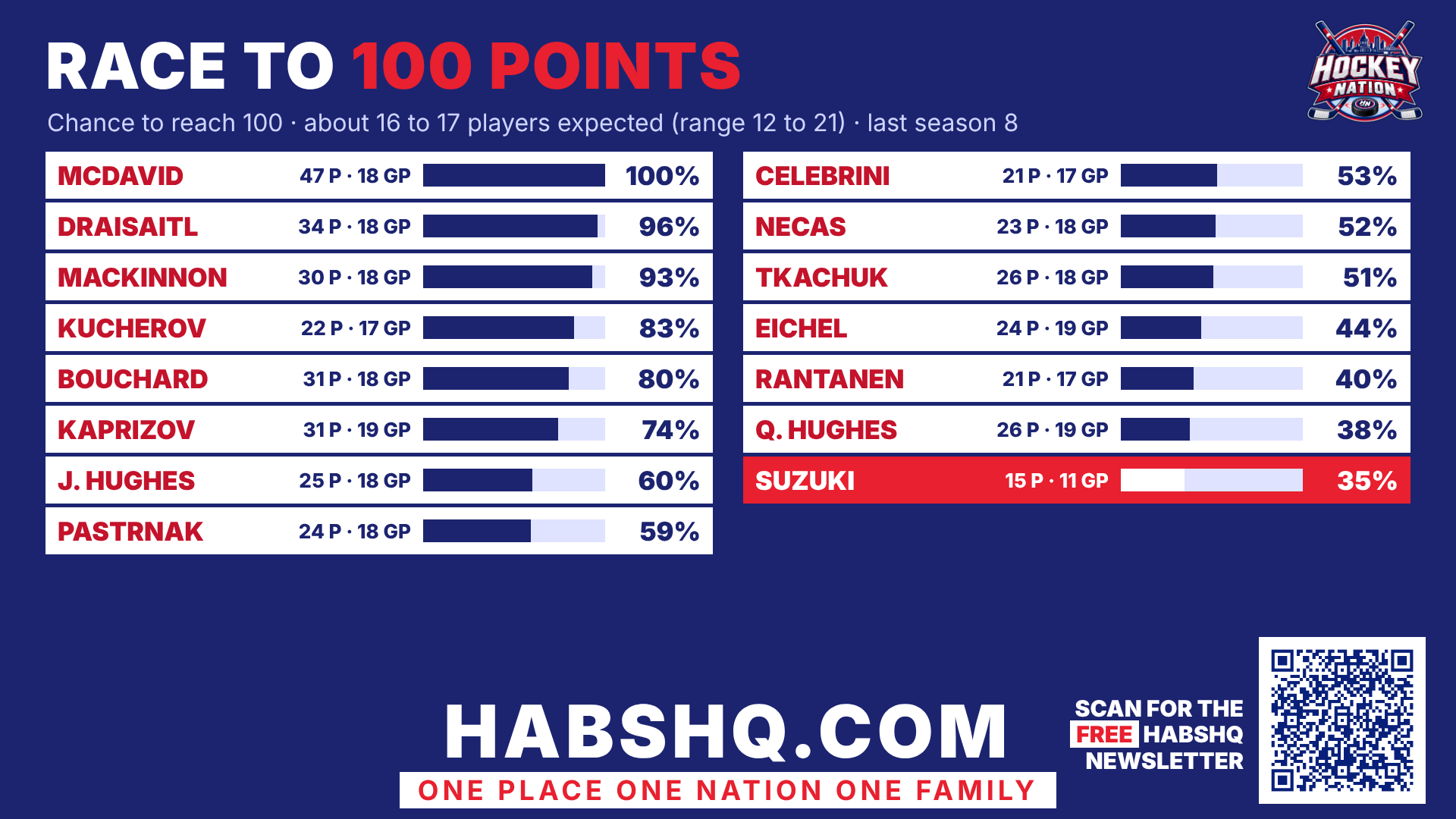
The 100-point club will be crowded. Last season eight players reached 100 points. Our model expects about 16 or 17 this year (a likely range of 12 to 21). McDavid is a lock, Draisaitl is at 96% and MacKinnon at 93%, then Nikita Kucherov (83%), Bouchard (80%) and Kaprizov (74%). Jack Hughes (60%), David Pastrnak (59%), Macklin Celebrini (53%), Martin Necas (52%) and Matthew Tkachuk (51%) are close to coin flips.
Can a defenseman reach 100 points?
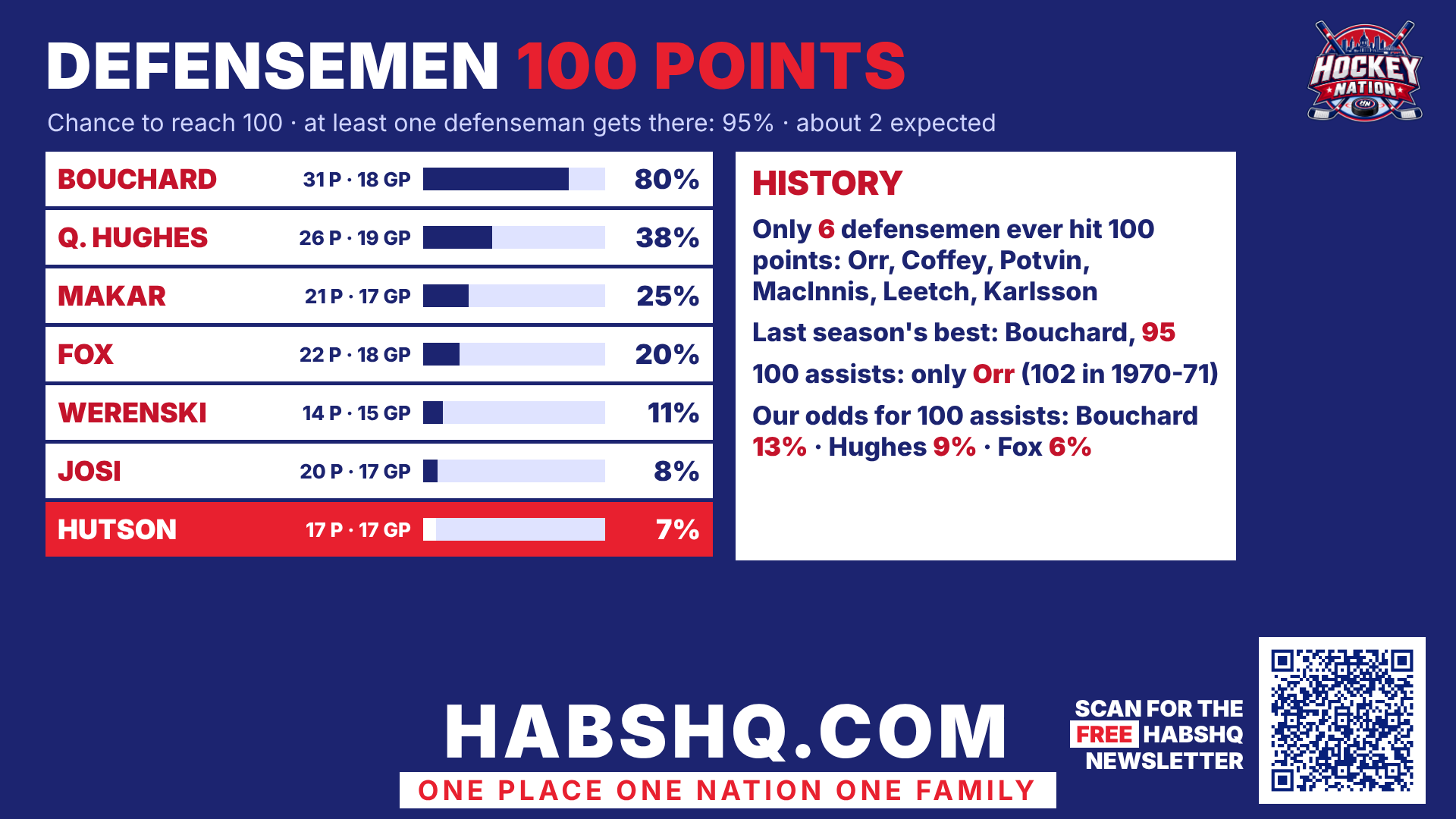
Only six defensemen have ever scored 100 points in a season: Bobby Orr, Paul Coffey, Denis Potvin, Al MacInnis, Brian Leetch and Erik Karlsson. Our model gives a 95% chance that at least one does it this year. Bouchard leads at 80%, then Quinn Hughes (38%), Cale Makar (25%) and Adam Fox (20%).
The 100-assist mark is a different story. Only Orr has done it, with 102 in 1970-71. Bouchard has about a 13% chance, Hughes 9% and Fox 6%. I would treat those as long shots.
What it means for the Canadiens
Cole Caufield has 11 goals in 17 games, a pace of 54 over 84 games. The simulation gives him a 28% chance at 50 goals and 71% to reach 40. Nick Suzuki has 15 points in 11 games and projects to about 94 points, with a 35% chance of reaching 100. Lane Hutson has 17 points in 17 games and projects to about 77, with a 41% chance of 80 and 7% for 100. We looked at Caufield’s two-year run as the NHL’s best goal-scorer in a recent article, and you can follow the Canadiens game by game on our standings page and the Lineup Tonight page.
How we got these numbers
All the counting stats come from the official NHL data. The probabilities are our own estimates: for every player, we play out the rest of the season 20,000 times using his current rate pulled toward his rate from last season, and we allow for missed games. They are estimates, not predictions, and one injury can change a player’s odds quickly.
Get the HABSHQ Newsletter in Your Inbox
Every Monday, the HABSHQ newsletter brings you the full Canadiens, Rocket, Lions and prospects report, our takes, the stats of the week and the preview of the week ahead, straight to your inbox. It is free.

Get the Habs week in your inbox
Free weekly newsletter from HABSHQ.
Leave a Reply