
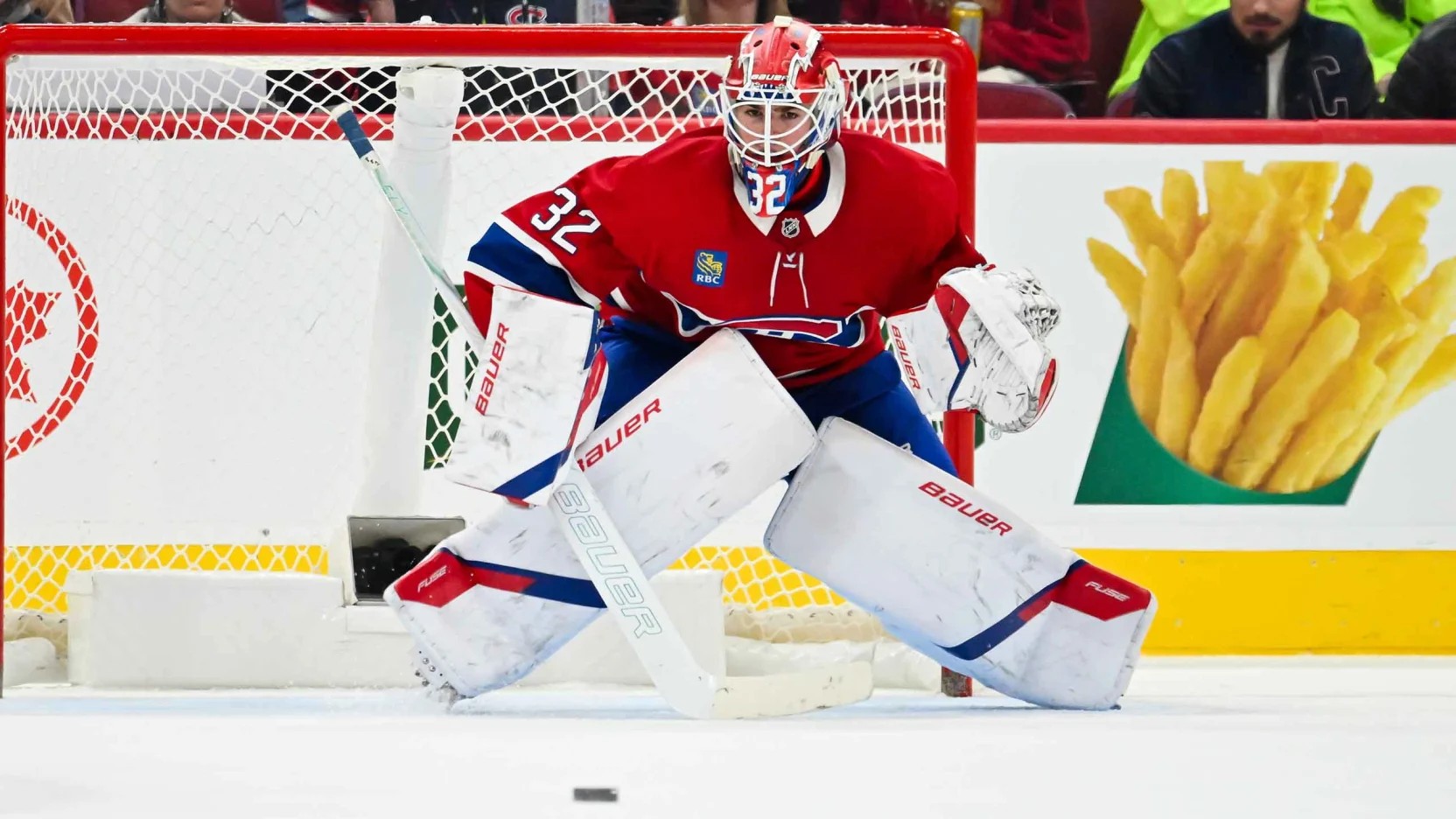
Jacob Fowler has been the story of the Canadiens’ first month. The 21-year-old goalie, a Florida native taken in the third round in 2023, was called up from Laval when Samuel Montembeault got hurt, lost his first start of the season, and has not lost since. He is 7-1-0 with a .932 save percentage and a 1.84 goals-against average. He was named the NHL’s Rookie of the Month for October and he is the Canadiens’ Molson Cup winner for the month. His seven straight wins also put him level with Carey Price (2007-08) and Jakub Dobeš (2025-26) for the most consecutive wins by a rookie goalie in Canadiens history.
Wins are one thing. The real question is whether the numbers say he is earning them. We took the league’s NHL EDGE tracking data, added our own shot-by-shot work from all eight of his starts, and put the two side by side. The short answer is yes, with one caution at the end. For the monthly award itself, read our Rookie of the Month article.
Where Fowler Ranks in the League
Through October 31, Fowler sits in the top five of the league in almost every goalie category that matters, and he does it on a team that has asked him to face a lot of rubber.
| Category | Fowler | NHL rank |
|---|---|---|
| Wins | 7 | Tied 3rd |
| Goals-against average | 1.84 | 5th |
| Save percentage | .932 | 2nd |
| Shutouts | 2 | Tied 2nd (Oettinger 3) |
| 5-on-5 save percentage | .935 | 5th |
| Mid-range save percentage | .967 | 2nd |
| High-danger save percentage | .871 | 6th (goalies with 6+ GP) |
| Saves above projected | +8.76 | 2nd (Oettinger +10.86) |
Source: NHL EDGE tracking data through Saturday, October 31. Saves above projected ranks goalies with at least 150 shots faced.
Only Jake Oettinger is ahead of him in saves above projected, and only Oettinger has more shutouts. Four of Fowler’s eight starts were quality starts. That is a goalie giving his team a real chance to win almost every night, not a goalie riding a hot streak.
Start by Start: The Eight Games
Here is every start, with the shots he faced. We list the result as the team scored it, so the shootout wins are marked.
| Date | Opponent | Result | Shots against | Goals against | Save % |
|---|---|---|---|---|---|
| Oct 8 | vs. Nashville | L 2-5 | 18 | 3 | .833 |
| Oct 10 | vs. Detroit | W 1-0 (SO) | 30 | 0 | 1.000 |
| Oct 13 | vs. Buffalo | W 4-3 (SO) | 16 | 3 | .813 |
| Oct 17 | vs. Buffalo | W 4-3 (OT) | 26 | 3 | .885 |
| Oct 23 | at Chicago | W 4-1 | 21 | 1 | .952 |
| Oct 25 | at Winnipeg | W 2-1 | 34 | 1 | .971 |
| Oct 27 | at St. Louis | W 2-0 | 46 | 0 | 1.000 |
| Oct 31 | vs. Pittsburgh | W 5-4 | 29 | 4 | .862 |
| Total | 7-1-0 | 220 | 15 | .932 |
Source: NHL game logs. Nashville’s last two goals were empty-netters and are not charged to the goalie.
Read the table twice. The losing night in Nashville was his first NHL start of the season and the only one where the Canadiens did not find a way to win behind him. After that, the pattern is clear. Montreal scored two goals or fewer in regulation in four of his eight starts (Nashville, Detroit, Winnipeg and St. Louis), and in three of those four he held the line long enough to win. In the two Buffalo games and in Pittsburgh, he allowed three or four goals and the team scored enough to cover. Those are the three nights where his numbers dip, and they are also the games where Buffalo and Pittsburgh made a push and the Canadiens had to hold on. If you want the full story of those games, read our Sabres recap and our Penguins recap.
Where He Wins: A Shot-Quality Look
NHL EDGE gives the league view. We also built our own shot map from the NHL play-by-play, using every shot on goal that Fowler faced in his eight starts (shootouts left out). We split the shots into three zones: high-danger, which is inside 25 feet and in front of the middle of the net; mid-range, from 25 to 45 feet; and long range, beyond 45 feet.
| Zone | Shots against | Goals against | Save % |
|---|---|---|---|
| High-danger (inside 25 feet, in front) | 75 | 9 | .880 |
| Mid-range (25 to 45 feet) | 96 | 2 | .979 |
| Long range (beyond 45 feet) | 49 | 4 | .918 |
| All shots | 220 | 15 | .932 |
HABSHQ shot map from NHL play-by-play coordinates. Our zone lines are not identical to the NHL EDGE zones, so the percentages differ slightly.
The mid-range number is the one that jumps out. Ninety-six shots from the area just outside the slot, and only two of them beat him. That is the area where most teams get their goals from the point and the half-wall, so it is exactly where a goalie has to be strong. In close, where goalies are supposed to give up goals, he is at .880, close to EDGE’s .871, which ranks sixth in the league. Our own count shows .935 at 5-on-5 (153 shots, 10 goals), which matches the league’s figure exactly.
There is one place to watch. Four of his 15 goals against came from beyond 45 feet. NHL EDGE shows the same thing: his long-range save percentage is .889, well below the league average of .963, while he is above average in every other area. Those are the goals that coaches hate, because the goalie sees them all the way. It is a small sample, but it is the first thing opposing teams will test if the numbers hold.
The Save Map: Zone by Zone
NHL EDGE also splits the ice into zones and gives Fowler’s save percentage in each one. The shading compares him with the rest of the league: the hatched zones are below the 50th percentile among goalies, the blue zone is between the 51st and 80th, and the dark zones with green numbers are in the 81st percentile or better.
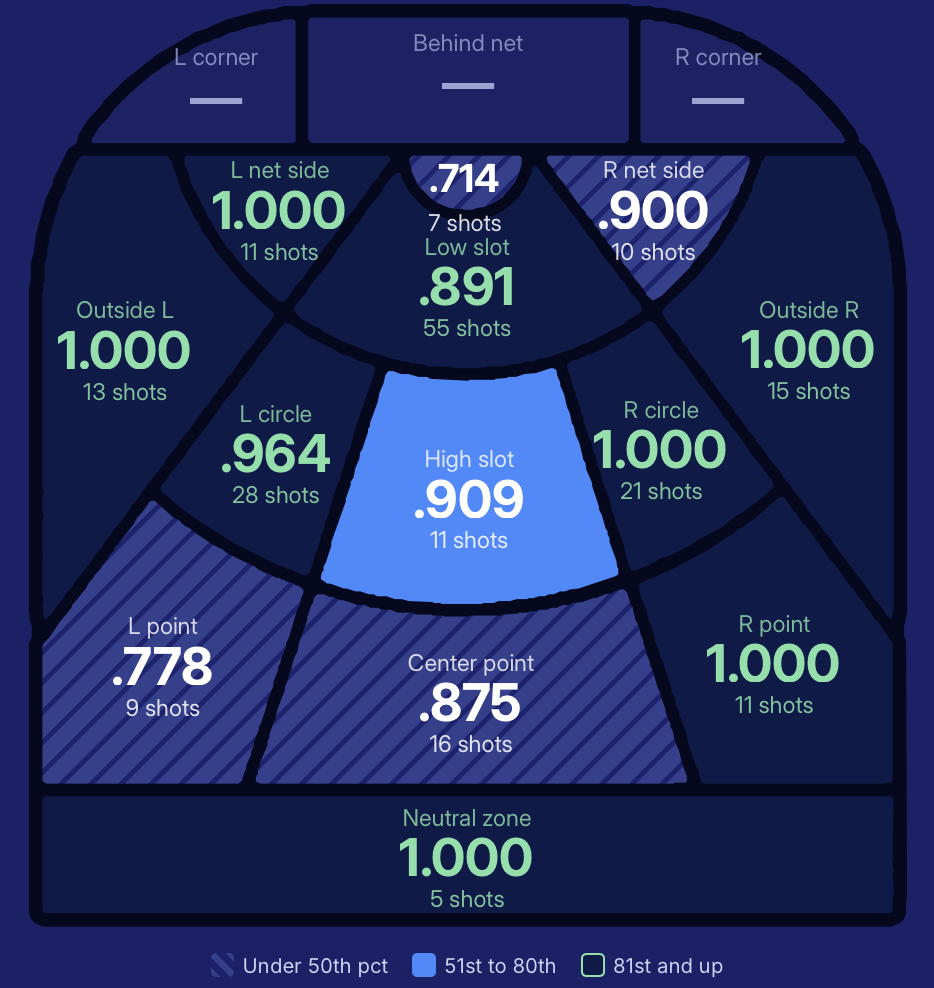
Fowler’s save percentage by shot zone this season, with percentile shading. Source: NHL EDGE.
Eight of the 13 zones are in the top group. The biggest one is the low slot, the area right in front of the net. He has faced 55 shots there, more than any other zone, and he is stopping .891 of them, which is still in the 81st percentile or better. That is the area where goals are supposed to happen, and it is where he is holding the line. He has also stopped every shot he has seen from the left net side (11), outside left (13), outside right (15), the right circle (21) and the right point (11), plus all five from the neutral zone. The left circle is almost as clean at .964 on 28 shots.
The soft spots are small samples, but they are real. He is at .778 from the left point on nine shots, .875 from the center point on 16, .714 at the top of the crease on seven, and .900 from the right net side on ten. The two point zones are worth watching, because they match what our own shot map showed: four of his 15 goals against, two from the left point and two from the center point, came from the blue line. Teams that want to beat him will shoot early from the blue line and look for a tip or a rebound. If he keeps the point numbers close to his other zones, there is no real hole in his map.
The 46-Save Night in St. Louis
Any Fowler story has to stop at October 27. The Canadiens were outshot 46-20 and won 2-0, and every save counted. According to NHL EDGE, he made 18 high-danger saves, the most by any goalie in a game this season, and he stopped all 10 mid-range shots he faced. That is 28 saves from the dangerous areas in one night, also the most this season. His 46 saves in a shutout are the most by any goalie this year, and the most ever by a Canadiens rookie goalie since shots were officially tracked in 1955-56. Our Blues recap has the full game.
Two days earlier he had become the youngest goalie to start an outdoor game in NHL history, stopping 33 of 34 in the Heritage Classic. Back to back, those two starts are the best argument in his file.
What Saves Above Projected Really Says
Save percentage can lie, because it depends on the quality of the shots. Saves above projected fixes that. The model looks at every shot a goalie faces, the location, the type and the situation, and projects how often an average goalie would stop it. Add up the projected goals and compare them to what actually went in, and you see how many goals he saved above average. Fowler is at +8.76, second in the league. Put plainly, an average goalie facing the same shots would have let in about nine more goals.
We cross-check the model with a second one. MoneyPuck’s goals saved above expected had him at +9.8 for October (read the details in our Rookie of the Month article). Two different models built by two different groups land on nearly the same number. That is the strongest sign that this is not an accident of shot luck.
Fowler vs. Dobeš
The comparison with the other goalie on the roster is not a knock on Jakub Dobeš. He carried the Canadiens to the Eastern Conference Final last spring. But the early numbers this season are a gap that the coaching staff cannot ignore.
| Measure | Fowler | Dobeš |
|---|---|---|
| Record | 7-1-0 | 2-2-2 |
| Games started | 8 | 6 |
| Save percentage | .932 | .853 |
| Goals-against average | 1.84 | 4.05 |
| 5-on-5 save percentage (league average .905) | .935 | .876 |
| Mid-range save percentage (league average .882) | .967 | .804 |
| High-danger save percentage (league average .809) | .871 | .750 |
| Goal differential with him in net | +7 (22-15) | -4 (20-24) |
Sources: RDS (quotes from Fowler, Martin St-Louis, Cole Caufield and Alexandre Carrier, translated from French), NHL game logs and NHL EDGE tracking data through October 31.
Be fair to Dobeš. Six starts is a small sample, and his last time out was a 5-2 win in Dallas where he stopped 19 of 21. But the shot-quality numbers say his problem is not bad luck. He is giving up more than the league average from the mid-range and the slot. The Canadiens are 7-1 when Fowler plays and 2-2-2 when Dobeš does, and the team is scoring just 2.7 goals a game for Fowler, which ranks 36th among 47 goalies with at least six games. That means Fowler is doing it with less help than most goalies get.
The Calder Race
Goalies rarely win the Calder Trophy. The last one was Steve Mason with Columbus in 2009, and Fowler would be the first since. He is still rookie-eligible because he played only 17 games last season. The skaters in the race are strong. Gavin McKenna of Toronto and James Hagens of Boston each have 11 points, Ivar Stenberg of San Jose has 9 and Cole Hutson of Washington has 7. Montreal has been here before: Lane Hutson won the Calder in 2025, and the team knows what a rookie with a high floor looks like.
The longer road runs through the record book. The NHL record for consecutive wins by a rookie goalie is 12, set by Ross Brooks of Boston between December 30, 1973 and February 28, 1974. Fowler has seven. He needs five more in a row to tie it. The Canadiens play the Jets on Tuesday night at 7:00 p.m. ET at the Bell Centre, and the team has not confirmed the starter. Winnipeg is winless in nine games (0-7-2) and has 11 points in 15 games, so expect a desperate opponent. You can follow the lines on our Lineup Tonight page.
Coach’s Take
October was a special month for Jacob Fowler. A 1.84 goals-against average is excellent, but the number that impresses me most is saves above projected, where he is second in the NHL, behind only Oettinger. The Canadiens finished the month at 9-3-2, and Fowler won seven of those nine games. That is how a goalie shapes a record.
The expectations were always going to be high, because everywhere he has played, he has delivered. He was the playoff MVP with the Youngstown Phantoms in the USHL. He went 57-13-3 in two seasons at Boston College, with 10 shutouts, a 1.90 goals-against average and a .932 save percentage. In the AHL he went 22-9-1 in 32 games with Laval, with three shutouts, a 2.20 goals-against average and a .918 save percentage. Those numbers are not an accident. The kid is a winner, and he has the talent to become a very good NHL goalie. It is still early in his career, and I want to be careful, but it is not only the numbers. It is the way he plays.
Everyone who watches him closely says the same thing: he is calm in the crease. He is always in the right spot, he tracks the puck well, he controls his rebounds, and the puck seems to stick to his body instead of bouncing away. Martin St-Louis says Fowler is really focused on his process and does not get caught up in the emotions that come with results, and Cole Caufield points to his very mature behavior every day, in practice and in games. That is technique and mindset, and it is why many people compare his game to Carey Price. Even Alexandre Carrier, who says Fowler’s calm reminds him of Price, adds that Fowler knows he is not Price and still has a lot to learn. I am not ready to go that far yet, but I do believe Fowler has what it takes to be a solid goalie at this level for a long time.
Listen to him after a game and you can hear how mature he is for his age. His most recent comments are a good example. After being named Rookie of the Month, he said: “It’s a good month, but it’s not yet a good season.” He added that there are many games left and that the award is nice, but that he wants to keep improving every month. One month is not a season, and Fowler knows it. That is the right mindset for a young goalie. The kid gets it.
Calder and Vezina: Let’s Wait
I know some people are already talking about the Calder Trophy and even the Vezina for Fowler. Before we go there, let’s watch his performance over the next few months. One great month does not make a candidate for either trophy.
The Calder will not be easy. The list of rookie candidates is long and strong, and goalies almost never win it. As noted above, Steve Mason in 2009 is the only goalie to win it in the last 20 years.
I do not see the Vezina yet. Under Martin St-Louis, the Canadiens have allowed about 3.3 goals per game over four full seasons. They have improved every year and sit at 3.00 right now, but I have a hard time seeing this team hold that level for 84 games. A Vezina goalie usually needs a heavy workload and a team that limits the chances in front of him.
And that is the message in the Canadiens’ room. The players and Martin St-Louis say it the same way: nobody cares about individual trophies, the only focus is the Stanley Cup for the team. That is the attitude Fowler showed in his own words after the month.
What It Means for the Canadiens
The question we asked in our Fowler No. 1 goalie article is now close to answered. Fowler has the net. The numbers hold up when we remove the luck, look at the shot quality, and count every start. That puts pressure on Kent Hughes and Martin St-Louis, because Samuel Montembeault is working his way back from a lower-body injury and the team is carrying three NHL goalies. Our Three Goalies Again article lays out how that problem has followed this team for four seasons.
The caution is simple. Eight starts is eight starts. A .932 save percentage is hard to hold for 84 games, and the team is winning close games, which does not last forever. But the process is good. He is stopping the shots goalies are supposed to stop and making the big saves when the game needs them. If he keeps doing that, the question stops being whether he is the Canadiens’ number one goalie and becomes how high he can finish in the Calder voting.
Sources: NHL.com (NHL EDGE tracking data), NHL game logs and play-by-play, MoneyPuck.
Get the Habs week in your inbox
Free weekly newsletter from HABSHQ.
Leave a Reply