

For three straight seasons, the Canadiens led the NHL in a category no team wants to lead: man-games lost to injury. That changed with a quiet front-office decision that got a fraction of the attention a trade deadline move would get — a full rebuild of the team’s sports medicine department. Three years later, the numbers say it worked.
In 2021-22 and again in 2022-23, Montreal finished dead last in the league in games lost to injury — a brutal stretch that gutted lineups already thin on talent and made an already difficult rebuild that much harder. Behind the scenes, ownership responded by overhauling the medical and performance staff, bringing in Jim Ramsay as Director of Sports Medicine, Performance and Head Athletic Therapist, and consolidating the organization’s top physician roles under Dr. Thierry Pauyo, who now serves as both Head Team Physician and Head Orthopedic Surgeon.
It wasn’t a single hire or a single system — it was a structural change to how the organization manages player health, from load monitoring to surgical decision-making. Here’s how it was built, and what the injury numbers actually show since.
The Architecture of the Overhaul
The Canadiens didn’t just replace one athletic therapist with another. The sports medicine department was rebuilt around a few clear pillars:
- Jim Ramsay leads the department as Director of Sports Medicine, Performance and Head Athletic Therapist, overseeing both day-to-day player care and the organization’s broader performance program.
- Dr. Thierry Pauyo now holds both the Head Team Physician and Head Orthopedic Surgeon titles, consolidating the organization’s top medical decision-making under one person rather than splitting it across multiple outside physicians.
- The org’s previous head physician, Dr. Deckelbaum, is no longer with the team — part of the broader staff turnover that came with the rebuild.
- Sports medicine and performance were folded under one reporting structure instead of operating as separate silos, tightening the loop between injury prevention, in-season load management, and return-to-play decisions.
None of that shows up on a highlight reel. But it shows up in the one stat that measures a team’s health better than any other: games actually played.
Measuring the Impact
The clearest way to see the shift is season over season, tracking both the team’s league-wide injury rank and — more importantly — how many Canadiens players stayed durable enough to play close to a full 82-game slate.
| Season | NHL Rank: Man-Games Lost (MGL) | Players 80+ Games | Players 82 Games |
|---|---|---|---|
| 2021-22 | 1st (most injured) | 0 | 1 |
| 2022-23 | 1st (most injured) | 0 | 1 |
| 2023-24 | 3rd | 0 | 5 |
| 2024-25 | 27th | 3 | 7 |
| 2025-26 | 9th | 7 | 5 |
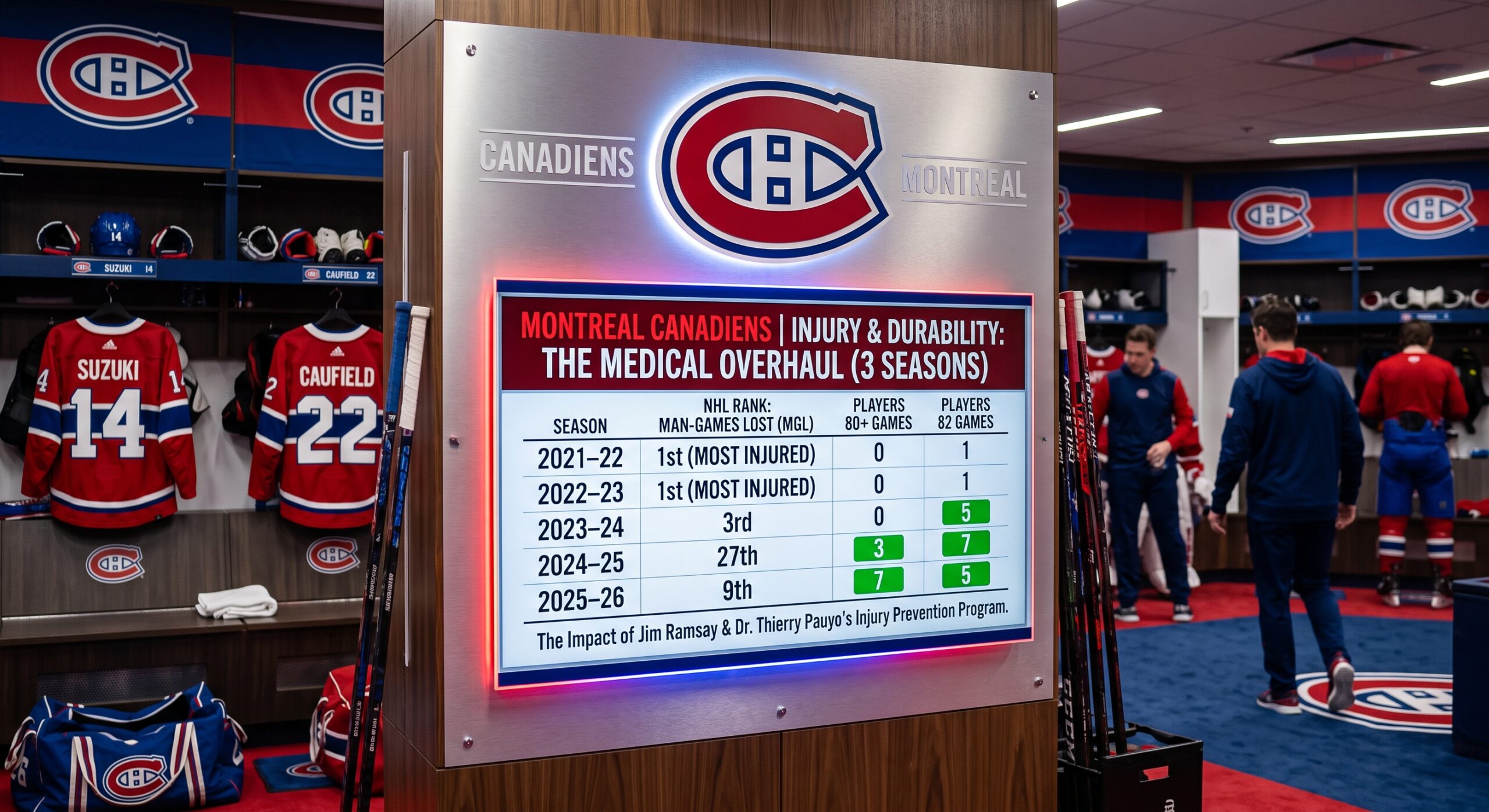
The rank alone tells part of the story, but the real headline is the durability trend on the right side of that table. Two seasons ago, the Canadiens didn’t have a single player reach 80 games. Last season, they had seven — and five players played the full 82. That’s not a one-year blip; it’s a three-year climb that lines up exactly with when the new medical staff took over.
The Verdict
Montreal’s core is getting younger and better by the season, and a big part of why that core has been able to build chemistry is simple: they’ve actually been on the ice together. A lineup built around players like Nick Suzuki, Lane Hutson, and Cole Caufield only gets to develop its identity if that group stays healthy and in the lineup night after night — and for the first time in years, that’s exactly what’s happening.
Durability doesn’t show up in a highlight package, but it shows up everywhere else that matters: fewer emergency call-ups disrupting the lineup, a coaching staff that can actually build consistent line combinations, and a front office that can plan contracts and cap allocation around players it can reasonably expect to be available. Check out the team’s full breakdown on the Contracts page to see how that durability is starting to show up in the organization’s long-term planning.
The rebuild in Montreal has mostly been told through prospects and draft picks. But this is the part of the story that doesn’t get a highlight reel — and it might end up being just as important.
Get the Habs week in your inbox
Free weekly newsletter from HABSHQ.
Leave a Reply