
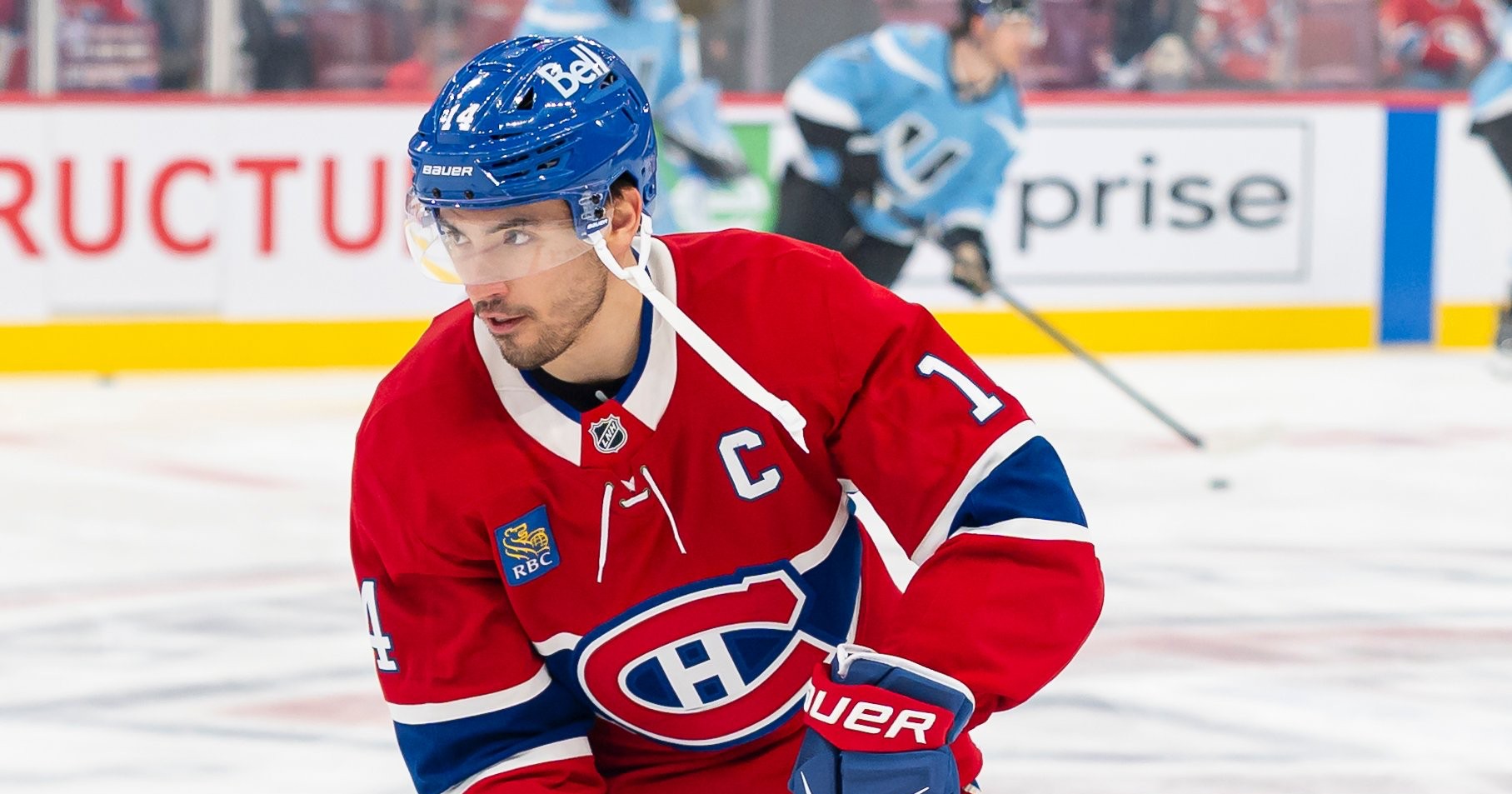
The Canadiens beat Utah 5-4 in overtime on Thursday night, and the box score shows exactly where the win came from. Nick Suzuki came back from a six-game absence and put up three points. Juraj Slafkovský played his best game of the season. Arber Xhekaj, Kirby Dach and Adam Engström each scored for the first time this year, and that group of players is what turned a 2-0 hole into a win.
Here are the three stories that matter after the game: what the captain’s return changed, why Slafkovský finally looked like himself, and how far Xhekaj has come in 16 games. Then we look at the three first goals of the season that made the comeback possible.
| Canadiens Player | G | A | PTS | +/- | SOG | TOI |
|---|---|---|---|---|---|---|
| Nick Suzuki | 1 | 2 | 3 | +2 | 4 | 20:04 |
| Juraj Slafkovský | 0 | 1 | 1 | +1 | 4 | 19:41 |
| Arber Xhekaj | 1 | 0 | 1 | 0 | 2 | 9:53 |
| Kirby Dach | 1 | 1 | 2 | +2 | 2 | 11:28 |
| Adam Engström | 1 | 0 | 1 | +1 | 2 | 10:48 |
The five players who made the difference against Utah, Thursday, November 5.
The Return of Suzuki Makes an Impact
Utah arrived with a perfect record when scoring first, and when Logan Cooley made it 2-0 in the first period, the Canadiens were in the same spot that has hurt them all month: two goals down, with a team that had just blown a 4-0 lead to Winnipeg on Tuesday. This is where a captain matters. Suzuki had missed six games with a hand injury suffered blocking a shot against San Jose, and the team went 5-0-1 without him, so nobody can say the Canadiens cannot function without him. But what he did on Thursday shows what a leader gives you beyond the score sheet.
Kirby Dach put it well after the game. Suzuki is more vocal than people think, he controls the temperature of the room and the bench, and he makes big plays at key moments. Martin St-Louis said the same thing in his own way. He liked having Suzuki on the bench and hearing him push for the next goal, and he pointed out that Suzuki is one of the first players to calm the group down when a game starts to go the wrong way.
On the ice, you could see it. Suzuki scored at 15:25 of the first period, off a pass from Slafkovský and Noah Dobson, to make it 2-1, and suddenly the Canadiens had life. In the third period he set up Dach’s goal to tie the game 3-3, and in overtime he assisted on Cole Caufield’s winner. That is three points, a plus-2, four shots and 20:04 of ice time in his first game back, with a hand in three of the five Canadiens goals. The league’s three stars made him the first star.
Put his last two games together and the picture is clear: five points (two goals and three assists) and a plus-5 in the two games he has played since October 20.
The bigger change was in how the game was played. During the six games without Suzuki, the Canadiens were outshot 133-106 at 5-on-5 and out-attempted 266-237, which is 47.1 percent of the shot attempts. It was even worse in the two games right before Utah, against Pittsburgh and Winnipeg, when they were out-attempted 104-76 and outshot 51-38. The team was spending too much of the game defending, chasing the puck and playing in its own end.
Thursday flipped that. At 5-on-5 the Canadiens outshot Utah 23-13 and had 54.0 percent of the shot attempts, and Suzuki’s ice time is where the difference shows. With him on the ice, the Canadiens had 24 shot attempts against 14 (63.2 percent) and 10 shots on goal against 6. With him on the bench, it was 23 attempts against 26 (46.9 percent), which looks a lot like the last six games. That is what a number one center does: he wins the faceoffs and the puck battles, he gets the puck out of the zone clean, and he keeps the game in the other team’s end. It is one game, and Utah still created good chances at 5-on-5, but the direction of the game changed when he stepped on the ice.
| 5-on-5 Sample | Att. For | Att. Against | Att. % | SOG For | SOG Against |
|---|---|---|---|---|---|
| Six games without Suzuki (Oct 23 to Nov 3) | 237 | 266 | 47.1% | 106 | 133 |
| Utah game, all of 5-on-5 | 47 | 40 | 54.0% | 23 | 13 |
| Utah game, Suzuki on the ice | 24 | 14 | 63.2% | 10 | 6 |
| Utah game, Suzuki off the ice | 23 | 26 | 46.9% | 13 | 7 |
Canadiens shot attempts (shots on goal, misses and blocked shots) and shots on goal at 5-on-5, from NHL play-by-play and shift data.
From a coach’s chair, this is what a returning center does for everybody else. The minutes, the matchups and the responsibilities shift back to where they belong, and players who were asked to do too much go back to doing what they do best. That is why the depth scored on Thursday. Suzuki himself gave the credit to his teammates and called it a team effort, which is what a captain is supposed to say. The score sheet says something else.
Slafkovský Steps Up
Slafkovský went into Thursday without a goal in seven games, and through 16 games he has two goals and 12 points. Every week the question is the same: where is the player we saw at his best? And every week St-Louis gives the same answer. On Thursday he gave it again, but for the right reason. He called it Slafkovský’s best game of the season and said the reason was simple: “It’s all pace. It’s his feet.”
Here is why the feet matter for a big winger. When Slafkovský skates, he gets to loose pucks first, he attacks open ice, and defenders have to back up because they know what happens if he gets a head of steam. That is how he wins board battles and brings his physical game. When he stands still, he is easy to defend: he receives the puck on the half wall with no space, and he is forced into plays he does not normally make. Suzuki watched the last six games from the outside and saw exactly that. He said Slafkovský was not moving his feet, was struggling on the half wall and was doing things he does not usually do.
Thursday was different. Slafkovský finished with four shots on goal, 19:41 of ice time and the primary assist on Suzuki’s goal that started the comeback. He could have had even more: he hit the right post in the second period, and Cossa made a big save to rob him on another good chance, so four shots on net and seven attempts in total could easily have meant a goal. Over his last seven games he has five assists and 15 shots on net, so the production never completely disappeared, but the pace did. After that game, he was honest about it: he had not played his best hockey so far, he liked this game, and now he has to build on it. He also said there is no magic pill to get your feet moving, because it is mostly in the head and has to be the mindset every night.
He dismissed the idea that watching Cooley score a hat trick, the player Montreal could have taken first overall in 2022 before choosing Slafkovský, gave him extra motivation. Believe him. His motivation was how he felt about his own season. One game is not a trend, so the real test is Saturday in Toronto and the games after that: the same pace, the same feet, every shift.
Xhekaj: The Most Improvement After 16 Games
If I had to name one Canadien whose game has changed the most since the start of the season, it is Arber Xhekaj. And it is not only because of the goal.
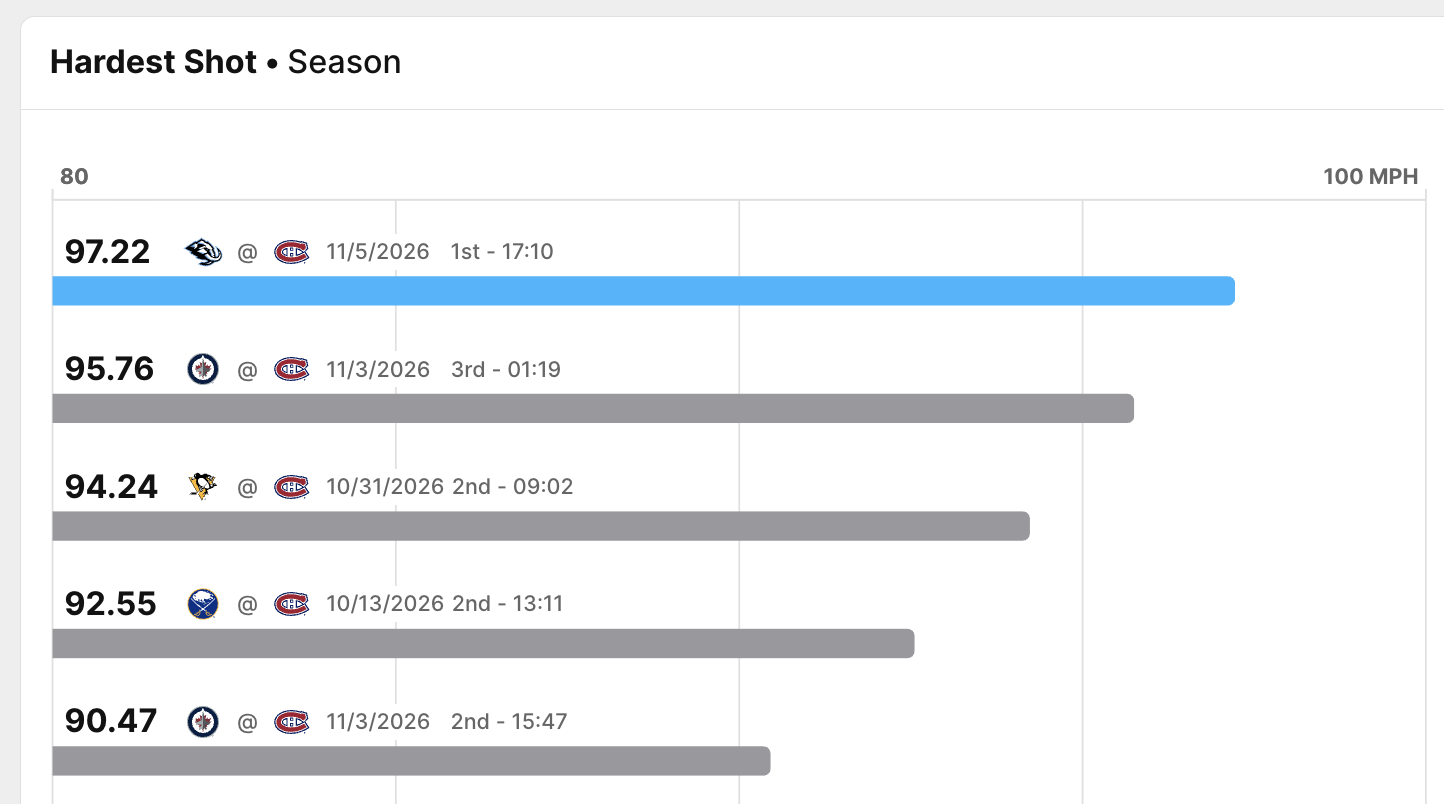
On Thursday he scored his first goal of the season at 17:10 of the first period, a slap shot that tied the game 2-2, off a great play by Dach along the boards. The shot was clocked at 97.22 miles per hour, the hardest shot by any Canadien this season. Moments later he dropped the gloves with Utah’s O’Brien.
It was his second fight in two games, after his fight with Winnipeg’s Bauer on Tuesday, and he now has three points in his last three games (one goal and two assists). But the points are not the story. Coaches give ice time to players they trust, and Xhekaj is earning more of it where it counts: he averages 1:43 per game on the penalty kill. That is a big step for a player who was a healthy scratch on October 27 in St. Louis. Since he came back, he has one goal and two assists in four games.
| Date | Opponent | G | A | PTS | TOI |
|---|---|---|---|---|---|
| Oct 29 | @ Dallas | 0 | 0 | 0 | 11:02 |
| Oct 31 | vs. Pittsburgh | 0 | 1 | 1 | 13:40 |
| Nov 3 | vs. Winnipeg | 0 | 1 | 1 | 13:05 |
| Nov 5 | vs. Utah | 1 | 0 | 1 | 9:53 |
Arber Xhekaj since returning from the October 27 healthy scratch.
The real improvement is in his game, not only his stat line. The biggest difference is his decision-making in the offensive zone: he is choosing the right play and the right shooting lane instead of forcing it. He is also using the slap shot more often and getting it on net, with five shots in his last four games compared with six in his first 11. Two more things have improved: his gap control, which is how tight he keeps the space between himself and the attacker on the rush, and his defensive-zone coverage. It is not perfect, but what matters is that he is proving he can play in the NHL, and not only because of his physicality or his fighting. That is the reason he is getting more confidence from his coaches.
The Defensemen Are Driving the Offense
Xhekaj’s goal is part of a bigger trend. The Canadiens defensemen are producing at a rate we have not seen this season. In the last three games, the group has 13 points (two goals and 11 assists), which is 4.33 points per game. Lane Hutson has five assists in those three games, Noah Dobson has three, and Xhekaj has a goal and two assists. Engström’s goal on Thursday is one of the two goals from the blue line in that stretch.
Widen the view and the picture stays the same. Over the last 10 games, Canadiens defensemen have 34 points, and Hutson (two goals, eight assists) and Dobson (seven assists) lead the way, with Kaiden Guhle at five points and Alexandre Carrier at four. That means 34 of the 44 points from the defense this season came in the last 10 games, against only 10 in the first six. When your defensemen join the rush, get pucks through from the blue line and pinch at the right time, the forwards get more time and space, and that is what has been happening.
| Canadiens Defensemen | Games | G | A | PTS | PTS per Game |
|---|---|---|---|---|---|
| Last 3 games | 3 | 2 | 11 | 13 | 4.33 |
| Last 5 games | 5 | 2 | 18 | 20 | 4.00 |
| Last 7 games | 7 | 6 | 21 | 27 | 3.86 |
| Last 10 games | 10 | 7 | 27 | 34 | 3.40 |
| Season (16 games) | 16 | 9 | 35 | 44 | 2.75 |
Points by all Canadiens defensemen combined, through the Utah game on November 5.
One More: A Trifecta of First Goals of the Season
Three of the five Canadiens goals on Thursday were the first of the season for the player who scored them: two defensemen and one first career NHL goal. The first line made an impact, but once again the support players contributed to the win. We covered Xhekaj above, so here are the other two.
Kirby Dach
Dach came back after missing two games with an illness and scored his first of the season at 1:09 of the third period, on the power play, to tie the game 3-3. He has been the favorite target of Canadiens fans for years, and an easy one to criticize, but lately he has been playing better. In his last five games he has four points (one goal and three assists), a plus-5, seven shots on goal and 12:35 of average ice time.
He also made a difference on a goal that does not show up next to his name. On Engström’s goal, Dach was screening the goalie and bothering him with his presence in front of the net. Two things will define the next stretch for him: consistency and staying healthy. We know his time in Montreal could end soon, and he is in the final year of his contract, but until then Dach wants to prove he can play and perform in the NHL, and he is raising his value right now.
Adam Engström
Engström had difficulties in the first period, maybe his worst of the season so far. He did not get discouraged. He bounced back in the third period, and at 14:54 he tied the game 4-4 with a shot over Cossa’s glove, on a play started by Jake Evans and Dobson. It was his first NHL goal, in his 25th game, and it made him the 612th player in Canadiens history to score a goal for the club. It also pushed the game to overtime, where Caufield finished it 30 seconds in.
What to Take From It
The Canadiens are now 10-3-3 with 23 points, and a win like this tells you what the team looks like when everyone is available. The captain gave them their leader, Slafkovský showed what the line looks like when his feet are moving, and the bottom of the lineup scored three of the five goals. That is how you beat a quality opponent that was a perfect 9-0-0 when leading after two periods. The details are still a work in progress, but the compete and the fight are there, and those are the things you cannot teach. Next up is Toronto on Saturday at 7 PM ET.
Sources: official NHL statistics and game data, NHL.com, RDS and The Athletic.
Get the Habs week in your inbox
Free weekly newsletter from HABSHQ.
Leave a Reply