
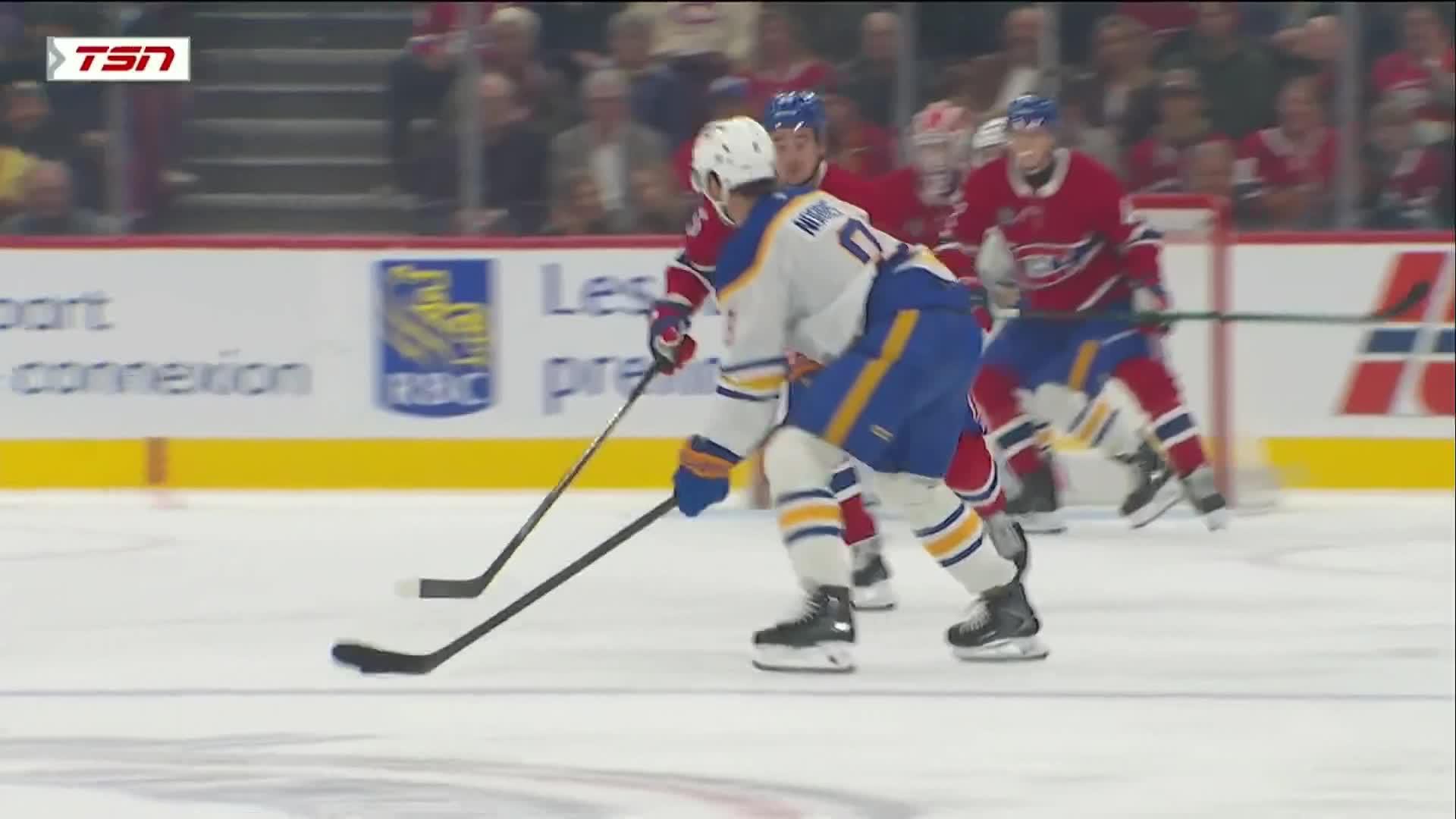
Montreal escaped with a 4–3 shootout victory over Buffalo, but another blown two-goal lead exposed the fine details that Martin St. Louis and his young team must master to become legitimate contenders.
The Montreal Canadiens found another way to win. But once again, they made the game more difficult than it needed to be.
Montreal built a 3–1 lead against the Buffalo Sabres on Tuesday night before surrendering two goals just 61 seconds apart in the third period. The Canadiens eventually secured a 4–3 victory in the shootout, earning two valuable points while leaving their coaching staff with plenty to review.
There is a positive side to this story. Montreal has demonstrated its ability to fight back, handle pressure and find ways to win close games. That resilience was an important part of the team’s identity last season.
However, there is another side to consider.
A team that knows how to come back from a deficit must also learn how to prevent its opponents from doing the same.
For the Canadiens, this is becoming an important part of their development. The question is whether their difficulties protecting leads are a matter of maturity or a failure to execute consistently for 60 minutes.
The answer might involve both, but the distinction matters. Maturity develops with experience, while consistency requires players to understand their responsibilities and execute them shift after shift.
Martin St. Louis has emphasized the importance of details since training camp. Tuesday’s game offered a clear demonstration of why those details matter.
1. Protecting a Lead: A Question of Maturity?
Montreal has built a reputation for being a dangerous team when chasing a game. The Canadiens have shown that they can generate momentum, increase their offensive pressure and find a way to force overtime when trailing.
But protecting a lead requires a different mindset.
When a team is behind, it must take calculated risks. Defensemen may become more involved in the attack, forwards may push higher into the offensive zone, and the team must find ways to generate scoring chances.
When leading, the priorities change.
The team must manage the puck intelligently, make responsible decisions at the offensive blue line, maintain defensive positioning and avoid giving the opponent easy opportunities to attack in transition.
That does not mean sitting back and allowing the opposition to dictate the game. A team that becomes too passive can surrender the initiative, spend too much time defending and eventually give up a goal.
The challenge is to remain aggressive without becoming careless.
This is where experienced teams often distinguish themselves. The Carolina Hurricanes, Tampa Bay Lightning and Florida Panthers have demonstrated how effective disciplined systems can be when protecting a lead. They understand how to manage pressure, limit dangerous opportunities and force opponents to work for every scoring chance.
Montreal is still developing that level of consistency.
The Canadiens are a young team, but youth alone cannot explain every mistake. Players must learn to recognize how the game changes when they are ahead, understand what the situation requires and execute their assignments accordingly.
Maturity is not simply knowing how to win a game. It is knowing how to manage the game when you are in a position to win it.
And that brings us to the most concerning part of Tuesday’s performance: the speed with which Buffalo erased Montreal’s advantage.
2. 61 Seconds That Changed the Game
Montreal entered the third period with a 3–1 advantage. Buffalo needed only 61 seconds to turn that two-goal deficit into a tie.
Josh Norris scored at 4:24, and Olen Zellweger followed at 5:25.
The numbers make the collapse even more striking. Montreal outshot Buffalo 38–17 on the night and 11–8 in the third period, yet the Sabres scored twice on those eight third-period shots. Jacob Fowler stopped 14 of the 17 shots he faced, while Ukko-Pekka Luukkonen stopped 35 of 38 at the other end.
Those two goals changed the entire complexion of the game. Montreal went from controlling the scoreboard to fighting to regain control of the contest.
The important question is not simply how Buffalo scored twice. It is how the Canadiens allowed the game to change so quickly.
When a team gives up a goal, the next shift becomes particularly important. Players must reset mentally, maintain their structure and avoid allowing the opponent to build on its momentum.
Instead, Buffalo found another opening almost immediately.
This is where the distinction between maturity and consistency becomes important. Experienced teams understand that conceding one goal does not mean the entire defensive structure must change. They remain composed, execute their responsibilities and prevent one mistake from becoming two.
Montreal needs to develop that response.
The Canadiens cannot expect to eliminate every mistake over an 84-game season. Even the best defensive teams concede goals. What separates a reliable team from an inconsistent one is often its ability to recover from a mistake before the damage becomes greater.
The first goal can happen. Preventing the second one is often a test of composure, communication and execution.
But Tuesday’s game also revealed something more specific about Montreal’s defensive responsibilities: the work required to protect the area in front of the net.
3. Adam Engström and the Physical Realities of the NHL
Adam Engström is an interesting example of a young defenseman learning that offensive talent and defensive reliability are two different requirements.
He has many of the qualities NHL teams value in a modern defenseman. He skates well, moves the puck effectively and can contribute offensively. Those abilities help a team transition from defense to attack and maintain possession under pressure.
But the NHL presents a different challenge when the puck is in the defensive zone.
Engström’s first shift against Buffalo illustrated that difference.
After turning the puck over in his own zone, he attempted to recover by challenging Beck Malenstyn below the goal line. Malenstyn won the physical confrontation, knocking Engström down and leaving the young defenseman trying to recover his position as Buffalo moved the puck toward the net.
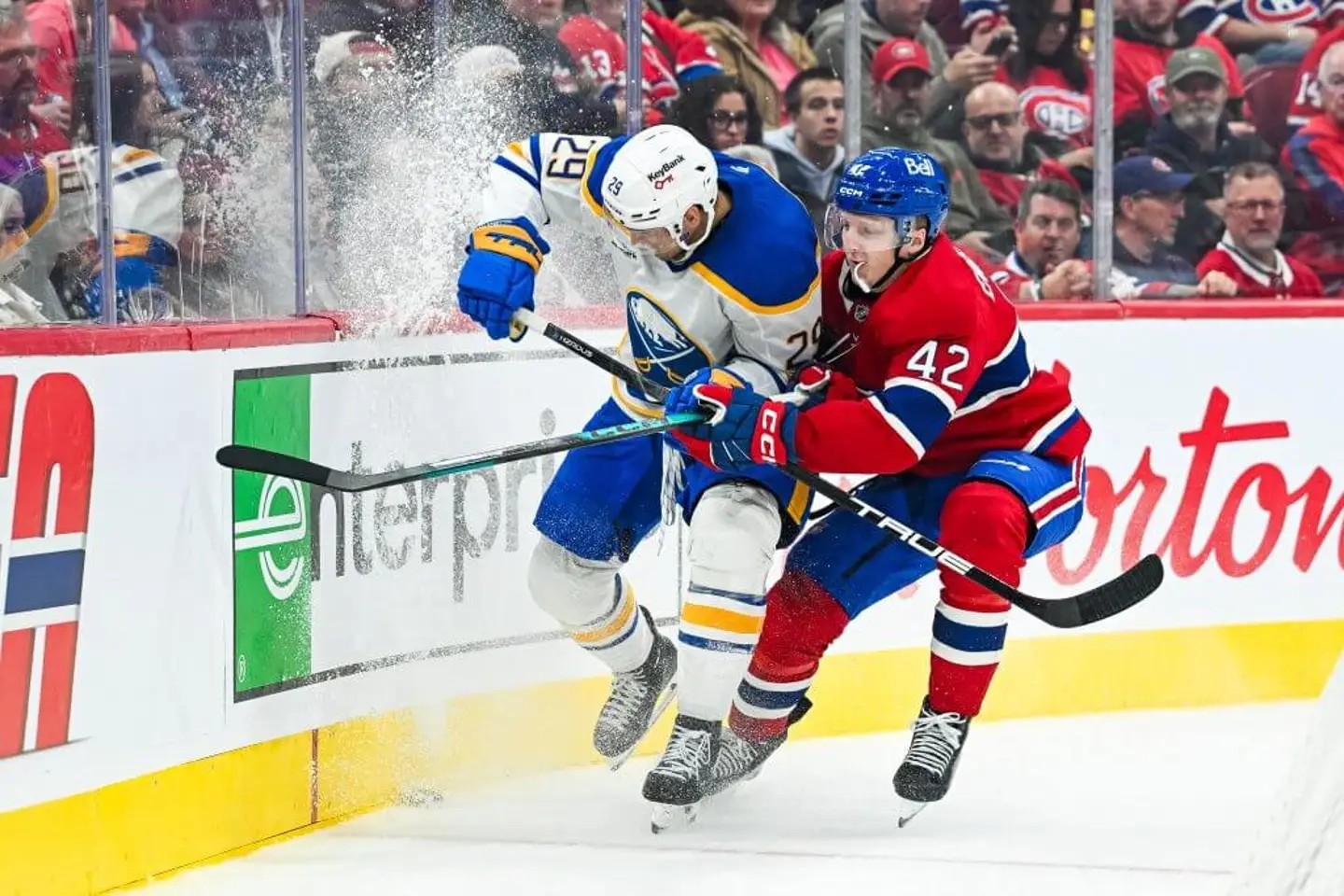
Zellweger’s point shot eventually found its way into the goal at 2:16 of the first period.
The sequence illustrates why a defensive-zone turnover can be so costly. The initial mistake was losing possession, but the consequences continued as Engström was forced to recover physically and reposition himself while the play developed.
Once a defenseman loses that first battle, he can find himself a step behind the play. That delay can be enough to compromise the team’s coverage in front of the net.
Engström was also on the ice for Buffalo’s second goal, scored by Josh Norris, and again struggled to establish position in front of the net.
These are difficult lessons for a young defenseman, particularly one whose game has been built around mobility and puck skills.
However, becoming more effective defensively does not simply mean becoming stronger in the gym.
Strength helps players withstand contact, but defensive effectiveness also depends on body positioning, timing, anticipation and the ability to establish leverage before the opponent arrives.
A defenseman must recognize where the attacking player wants to go, establish position between that player and the net, and use his stick and body to make the scoring opportunity more difficult.
The objective is not to win a physical battle after losing position. It is to establish the right position before the battle begins.
That is part of the learning process for Engström, and it is a requirement for any young defenseman hoping to become a regular NHL player.
Martin St. Louis has been clear about that priority. Skating and puck skills are valuable, but a defenseman must first demonstrate that he can defend.
Engström showed encouraging qualities over his 13 minutes of ice time. His performance was not defined entirely by those two difficult sequences.
The lesson is that, at this level, a few seconds of poor execution can outweigh several minutes of otherwise solid play.
4. Lane Hutson: Even Elite Skills Cannot Replace Defensive Details
Lane Hutson delivered another strong offensive performance against Buffalo, scoring a goal and adding an assist. He was named the game’s first star.
Yet his performance also provided an example of the defensive details St. Louis wants his players to master.
On Buffalo’s tying goal, Hutson was responsible for dealing with Tage Thompson in front of the net.
That is an especially difficult assignment. Thompson has a significant size advantage over Hutson, and attempting to move him purely through physical strength would be an unrealistic solution.
But net-front defense is not just about strength.
It involves anticipating the play, establishing position early, maintaining contact with the attacking player and preventing him from obtaining an unobstructed path to the puck or the goaltender.
A smaller defenseman must be particularly smart about how he uses his body and stick. He needs to recognize the opponent’s tendencies and understand when to establish contact before the puck reaches the shooting area.
Hutson acknowledged after the game that he was still learning the finer points of boxing out. He recognized that he had not executed his assignment properly on Buffalo’s third goal.
That is an important admission from a player who otherwise had an excellent game.
Offensive production can make a defenseman’s mistakes less noticeable, but the defensive responsibilities remain the same. A player who creates scoring chances must also help prevent them at the other end of the ice.
Hutson’s skating and hockey intelligence give him tools to defend effectively against larger opponents. The next step is using those tools consistently when the puck is in dangerous areas.
A defenseman does not need to overpower every opponent. He needs to prevent the opponent from gaining the advantage in the first place.
For Hutson, Engström and the Canadiens’ other young defensemen, that is a skill developed through repetition, experience and a clear understanding of their responsibilities.
And it is precisely the type of detail that becomes critical when a team is trying to protect a one- or two-goal lead.
5. The Defensive System: When One Missed Assignment Affects Everyone
Yesterday, we looked at how Montreal’s defensive approach has been evolving, particularly the combination of more aggressive man-to-man coverage higher in the defensive zone and a more compact structure closer to the net.
That distinction matters when analyzing Buffalo’s goals.
In the higher part of the zone, around the area above the faceoff circles and toward the blue line, Montreal wants its players to apply pressure and remain responsible for their assignments. The objective is to limit the time and space available to opposing players, preventing them from comfortably setting up their offense.
Closer to the net, defensive priorities change. The Canadiens must protect dangerous shooting areas, manage traffic and prevent opponents from obtaining clean looks at the goaltender.
The transition between these responsibilities is critical.
If a forward is late applying pressure to a defenseman at the blue line, that defenseman has more time to prepare his shot. If the shot then travels through traffic in front of the net, the goaltender’s ability to track the puck becomes much more difficult.
This is where individual execution and team structure become inseparable.
The Danger of Allowing Shots From the Blue Line
According to HabsHQ’s own tracking, Montreal has already conceded six goals this season on shots originating from the blue line, including shots that went directly into the net and those redirected in front.
That is a trend worth monitoring.
A shot from the blue line is not necessarily a dangerous scoring opportunity on its own. However, its danger increases considerably when the shooting defenseman has time and space, the goaltender’s vision is obstructed, and attacking players are positioned to redirect the puck or collect a rebound.
The defending team must therefore solve several problems simultaneously.
The first is applying pressure to the shooter. The second is preventing opponents from establishing an effective screen. The third is controlling sticks and bodies in the immediate area around the crease.
Failure in any one of these areas can compromise the entire defensive sequence.
On Buffalo’s tying goal, Slafkovský was late applying pressure to Zellweger. The defenseman was able to get his shot through Montreal’s defensive coverage, while traffic in front made life difficult for Fowler.
Fowler cannot be expected to stop every shot when his vision is obstructed. The defensive players in front of him must help by limiting the quality of the shot and improving his ability to see the puck.
This is why St. Louis emphasized the need to challenge opposing defensemen more aggressively and block more shots.
However, blocking shots is only one part of the solution.
The best defensive play may be preventing the shot from being taken cleanly in the first place.
That means the forward responsible for pressuring the defenseman must arrive on time, maintain the correct angle and take away the available shooting lane.
Meanwhile, the players closer to the net must establish position, control opposing sticks and ensure that the goaltender has the best possible chance to make the save.
These responsibilities are connected. When one player is late, another may be forced to compensate, and that can create a second opening elsewhere in the zone.
The Canadiens need to become more consistent in executing these assignments.
6. Martin St. Louis and the Importance of the Details
St. Louis has repeatedly stressed the importance of details, and Tuesday’s game provided several examples of what he means.
The issue is not necessarily that Montreal’s defensive system is fundamentally wrong. A system can provide the right structure and still fail when players do not execute their responsibilities.
Consider the sequence of events that can lead to a goal against.
A forward fails to pressure the puck carrier. The opposing defenseman has time to shoot. A Canadiens player fails to establish proper position in front of the net. Another player does not get into the shooting lane. The goaltender must then react to a shot through traffic.
Looking only at the final shot might suggest that the goaltender should have made the save. Looking at the entire sequence reveals several opportunities for the defending team to prevent the scoring chance from developing.
This is how coaches analyze goals against.
They examine what happened before the shot, identify where the defensive structure began to break down and determine which responsibilities were not executed properly.
The objective is not simply to identify the player closest to the mistake. It is to understand how the play developed and what the team can do differently next time.
For Montreal, this process involves several areas of improvement:
- Applying pressure to opposing defensemen before they can generate clean shots.
- Establishing stronger positioning in front of the net.
- Controlling opposing sticks and preventing clean deflections.
- Getting into shooting lanes when the puck moves toward the blue line.
- Recovering quickly after turnovers or lost physical battles.
- Maintaining concentration immediately after conceding a goal.
These are not spectacular aspects of hockey. They rarely produce highlight-reel plays or generate the same attention as a beautiful goal.
But they often determine whether a team wins or loses.
The Canadiens’ training camp message, “Dominance Is in the Details,” captures the challenge facing this young group.
Dominance is not simply controlling possession, generating scoring chances or playing well for long stretches. It also means consistently executing the small responsibilities that prevent opponents from taking advantage of mistakes.
The Verdict: Two Points Won, Important Lessons Learned
The Canadiens deserved to enjoy their 4–3 shootout victory over Buffalo. They generated offense, received contributions from important players and found a way to secure the win after losing their two-goal lead.
There were positives in the performance, and Engström’s and Hutson’s defensive mistakes should not overshadow everything else they contributed.
But the result should not prevent the coaching staff from examining what went wrong.
Montreal’s ability to come back in games is encouraging. Its inability to consistently protect leads is a different challenge, and one that becomes increasingly important as the team develops.
The defensive issues exposed against Buffalo were not limited to one player or one situation. They involved puck management, physical positioning, pressure on opposing shooters, net-front coverage and the execution of individual responsibilities within the team’s structure.
These are precisely the areas where a young team can improve.
The Canadiens do not need to become a perfect defensive team overnight. They need to recognize their recurring mistakes, understand why they happen and reduce how frequently those mistakes cost them goals.
The next step is turning those lessons into habits.
Because over an 84-game season, a shootout victory can earn two points. But a team that consistently protects its leads, manages the puck and executes its defensive assignments gives itself a much better chance of winning without needing a comeback or extra time.
Montreal is learning how to win. Now it must learn how to control the game it has already put itself in a position to win.
That is the difference between a promising young team and a team ready to take the next step.
And for Martin St. Louis, the details remain the key.
Next Up: The Canadiens Visit the Washington Capitals
There is little time to dwell on any of this. The Canadiens play tonight, and it is their first back-to-back of the season.
Montreal visits the Washington Capitals at 7:30 PM ET at Capital One Arena. Jakub Dobes is the starter after Jacob Fowler played Tuesday against Buffalo. Check the Lineup Tonight page for the lines and injuries before puck drop.
It is the first chance to show that Tuesday’s lessons about protecting a lead, net-front coverage and pressure on shooters have started to stick.
Get the Habs week in your inbox
Free weekly newsletter from HABSHQ.
Leave a Reply