

Three games into the season, the Canadiens have a clear problem, and it is not talent. It is decision-making. After a tight opening-night win in Toronto, they fell behind 5-1 in Pittsburgh, then dug another early hole in the home opener against Carolina. Both times they fought back, both times it was not enough, and both times the same habits put them there: forced plays, careless turnovers and too many players trying to be the hero. On Wednesday, Martin St-Louis answered with the simplest tool he has, a practice drill.
St-Louis Wants His Team’s Identity Back
The Canadiens spent part of Wednesday’s practice on a chip-and-chase drill: put the puck in behind the defence, win it back and build the play from there. St-Louis called it an identity drill, and his reasoning is easy to follow. When this team is patient, it is dangerous. It puts pucks deep, it forechecks well and it creates chances in the offensive zone. Against Carolina, it did not do that often enough, and it did not wear the Hurricanes down. Instead the group got stubborn at the offensive blue line, tried to carry the puck in when the lane was not there and gave it right back.
His point goes beyond one game. Every team in the league knows it should not turn the puck over, so odd-man rushes and clean controlled entries are hard to find. The way to win is to make the opponent defend for the full length of the ice, with deep dumps, a heavy forecheck and a mentality built on the long game rather than the highlight.
There is an awkward side to this. It is a drill the group has done before, and a team that sees itself on the edge of contender status should not need a reminder. But that is exactly the situation. The Canadiens reached the conference final last spring before Carolina ended their run, and carrying those expectations is a new experience for this group. The drill is there to bring them back to what got them this far: knowing when to carry the puck across the blue line and when to simply put it in.
Same Problem, Three Games in a Row
The pattern is hard to miss. In Pittsburgh, a second period full of puck mismanagement turned a game into a 5-1 deficit, and the team spent the rest of the night chasing it. Against Carolina, the Hurricanes took control with five goals before Juraj Slafkovský cut it to 5-4 late in the third. In both games the comeback deserved credit, but the room cared more about how the games had slipped away than about how close they got at the end.
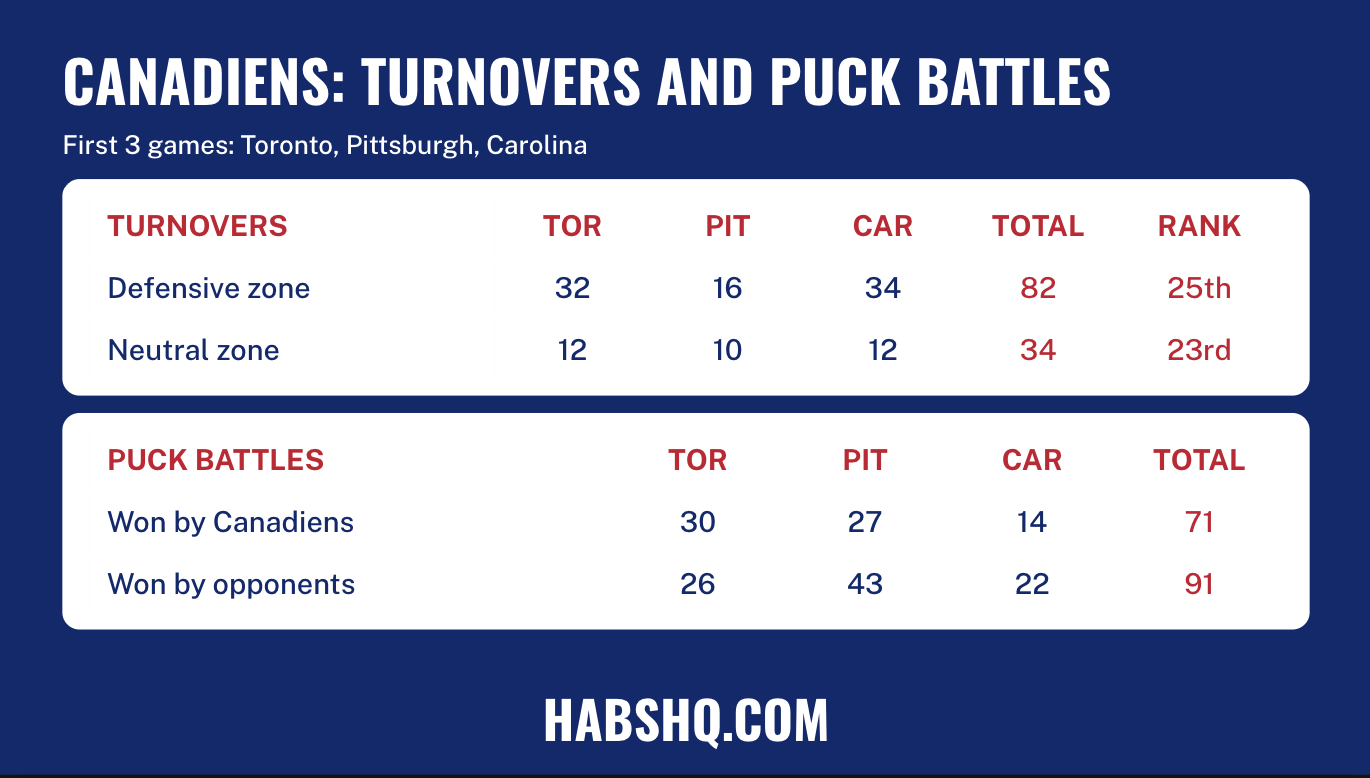
The tracking numbers from the first three games tell the same story. The Canadiens have turned the puck over 82 times in their own zone, 25th in the league, and 34 times in the neutral zone, 23rd. They have also lost more puck battles than they have won, 91 to 71, and the gap was widest in Pittsburgh, where the Penguins won 43 battles to Montreal’s 27.
St-Louis said the players already know it. He is not the one pointing it out, and the next step is maturity: being able to repair a mistake quickly instead of having everyone chase the big play to fix it. He does not need anything extraordinary from his team. He needs ordinary plays, done again and again, because that is what produces the extraordinary results.
The talent and the depth are there. The open question is the maturity.
Slafkovský Wants to Control His Emotions
No player needed that chip-and-chase drill more than Juraj Slafkovský. The 22-year-old scored his first goal of the season against Carolina, scored with the goalie pulled in the third period to make it 5-4, but the rest of his night was a different story. He turned the puck over in the neutral zone several times, hesitated with it on other occasions, and two of those mistakes led directly to Carolina goals: his turnover in the first period before their opening goal, and a lost puck late that led to the empty-netter.
He did not hide from it afterwards. Slafkovský admitted that some nights nothing works, that he gets frustrated and that it shows. He understands that frustration helps no one, least of all in a home opener against the team that knocked Montreal out in the spring. His message was clear: one bad shift cannot turn into a bad mood, and he has to stay positive at all times.
St-Louis sees the issue as a question of process versus result. Slafkovský wants to make the difference, and that is not the problem, but there is a path to get there. The puck will not always arrive in open space with speed. The coach wants him to play the game that is in front of him, to stack the percentages in his favour and to stop trying to manufacture something that is not there. He also drew a line on the ice: from the Canadiens’ goal line to the top of the circles in the offensive zone, Slafkovský’s game should stay the same no matter who his linemates are. Past that point, his habits can adapt to the line.
His situation makes that harder. Slafkovský started the season away from Nick Suzuki and Cole Caufield, building chemistry with Alex Newhook, and with Ivan Demidov injured, the line now includes Kirby Dach. As the leader of that group, he has to find the balance between driving the play and doing too much. The early numbers show a line that has not found it yet. Over the first three games, the Canadiens have been outshot 14-6 at five-on-five when Slafkovský and Newhook were on the ice together, with no goals for and one against. Slafkovský himself believes the line can be much better. He said he has to learn the right way to lead it, be smarter with the puck and understand that sometimes putting it deep is the better way to build the next play.
A Slow Start Is Not New for Slafkovský
The slow start is the other side of this story, and it has become a habit. In 2022-23, Slafkovský had one point in his first five games. In 2023-24, he had one point in his first ten. Even his best opening, four points in five games in 2024-25, included just one goal. Last season he started with one point in the first five games and five points in the first ten, then finished with 30 goals and 73 points, a career high.
Now he has one point, the Carolina goal, through three games. The history says a slow first week does not decide a season for him, and that should calm some of the panic. It also explains why the emotional side matters. If the points come late again, how he handles these first weeks, and how quickly he stops pressing, will decide how long the dip lasts. That is the same message as the drill, coming from the player himself. And at 22, the fact that he seemed to have already turned the page, focused on the next game and not the last one, is a good sign for his maturity.
What to Watch Against Nashville
The Canadiens host the Predators on Thursday at 7:00 PM ET at the Bell Centre. The question is not about Nashville’s quality. It is whether the patient version of this team shows up: deep pucks when the entry is not there, simple plays in the neutral zone and a line led by Slafkovský that plays what is in front of it. If the drill worked, we will see it early.
Get the Habs week in your inbox
Free weekly newsletter from HABSHQ.
Leave a Reply