

Dylan Larkin’s Canadiens debut ended in a 2-1 loss to the Kings on Monday night, the fourth straight home game without a win (0-3-1), and it dropped Montreal to 14-7-4. He finished with an assist, three shots, 19:57 of ice time and 10 wins on 17 faceoffs. He also missed the best chance Montreal had to tie the game. The scoreboard says the night was a failure. The faceoff circle says something different about why Kent Hughes paid such a high price.
Why Montreal Moved Now
The need was not a secret. The Canadiens have been looking for a second-line center for a long time, and the problem got louder this fall. Suzuki missed six games, and when he was out there was no real answer behind him in the middle. The power play has been the clearest symptom of a lineup that lacks one more finisher: through 25 games Montreal is 10-for-73 at 13.7%, 31st in the league, ahead of only Ottawa.
The results at the Bell Centre made the case just as strongly. Since March 28 of last season, regular season and playoffs combined, Montreal is 9-13-3 at home. The Kings loss was one more night where Montreal controlled the puck and could not finish. The team does not need more possession. It needs players who turn possession into goals.
Hughes said on Monday that the organization had known for a long time that Larkin would end up in Montreal. At Larkin’s request the deal was kept quiet, because a public story would have been a distraction for both teams, and Hughes said he was privately more than 90% sure it would get done. This was not a panic trade. It was a plan that waited for the moment when injuries, a weak power play and a poor home record all pointed to the same hole.
What Larkin Brings
The numbers are the first reason the trade makes sense. Larkin has scored 30 or more goals in six of his 11 full NHL seasons, including each of the last five, and he scored a career-high 34 last season. Over those five seasons he averaged almost 71 points a year (69, 79, 69, 70 and 67). In 819 career games he has 278 goals and 650 points, and he plays 19:33 a night on average.
The power play is where he helps most directly. He scored 16, 14, 13 and 14 power-play goals in his last four full seasons, which is exactly the type of production Montreal does not have right now. A first unit with Suzuki, Caufield, Slafkovský and Hutson already creates plenty of attempts. What it has lacked is another player who is comfortable scoring from the middle of the zone.
The second reason is something that does not show up in a goals column: Larkin is a left-handed center who wins faceoffs. He is at 52.8% for his career and has been above 50% in every full season since 2018-19 (the only exception was the 44-game 2020-21 season, at 49.5%). Suzuki shoots right, so the Canadiens never had a left-shot center to give the coach a second option on the draw. They have one now, and that is the point of the next section.
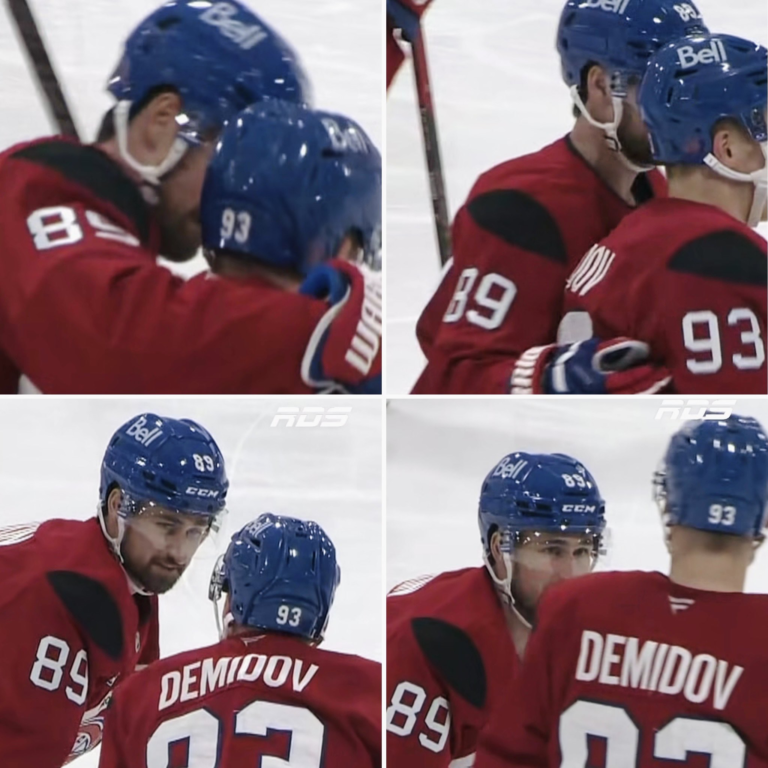
The fit with the wingers matters just as much. Once Demidov is back in the lineup, Larkin gives the second line a real center for the first time this season. That takes pressure off the Suzuki line, which has been asked to carry the offense almost alone, and it frees Newhook and Texier to play on the wing or in the bottom six, where their skating is more useful than in a role they were filling out of necessity. That is our read of how the lines will be built, and it is the biggest lineup change the trade makes.
The other benefit is experience. Larkin has played 819 NHL games, wore the captain’s C in Detroit for years and played for Team USA at the 4 Nations Face-Off. He is also a responsible player away from the puck. St-Louis said after the game that he was in control offensively and defensively, he has nine career shorthanded goals, and Montreal had the better of the expected goals (0.64 to 0.46) while he was on the ice. A coach trusts that player in the last minute, whether the team is protecting a lead or chasing one, and on Monday we saw St-Louis do exactly that.
Larkin’s Debut: The Faceoff That Showed the Fit
Larkin’s first period at the faceoff dot was ordinary: he won one of five draws. The third period was a different story. He won seven of ten, and two of the draws that mattered most came with Montreal chasing the game.
The first came with about 15 minutes left in regulation and the Canadiens on the power play, down 2-1. Martin St-Louis put the draw on the left side of the ice, which is a choice he almost never has. With Suzuki, a right shot, the draw goes to the right side because that is where he is strongest. With Larkin available, the coach used the left side and handed him the draw. Larkin lost it to Quinton Byfield, and nothing came of that power play.
The second came in the last minute. Adrian Kempe took a hooking penalty at 19:00 of the third period with Jakub Dobeš already pulled, so Montreal had a 6-on-4. St-Louis called a timeout, and the conversation was about which side to take the draw on. St-Louis explained afterward that Larkin had lost a couple of power-play draws on that side, and when the staff talked about switching, Larkin spoke up and said he had it. The coach agreed, and said the choice made sense analytically because the Kings’ centers shoot left. “And he said he was due to win one, and he did,” St-Louis said. Larkin won the draw exactly the way he had described it: he stacked Suzuki on the inside and had him sweep the puck out above the dot, expecting a 50-50 puck that Montreal could win.
Then came the miss. Montreal went to work and put six attempts on net in the final minute, and none reached Darcy Kuemper: Slafkovský had three blocked and one missed shot, Newhook had one blocked, and Larkin’s attempt, with about six seconds left, was also blocked according to the NHL play-by-play. Larkin was the first to say it was a chance he should have finished. He rushed it, he said, and he had more time than he thought. It is an honest answer from a player who had not played a game since Oct. 26.
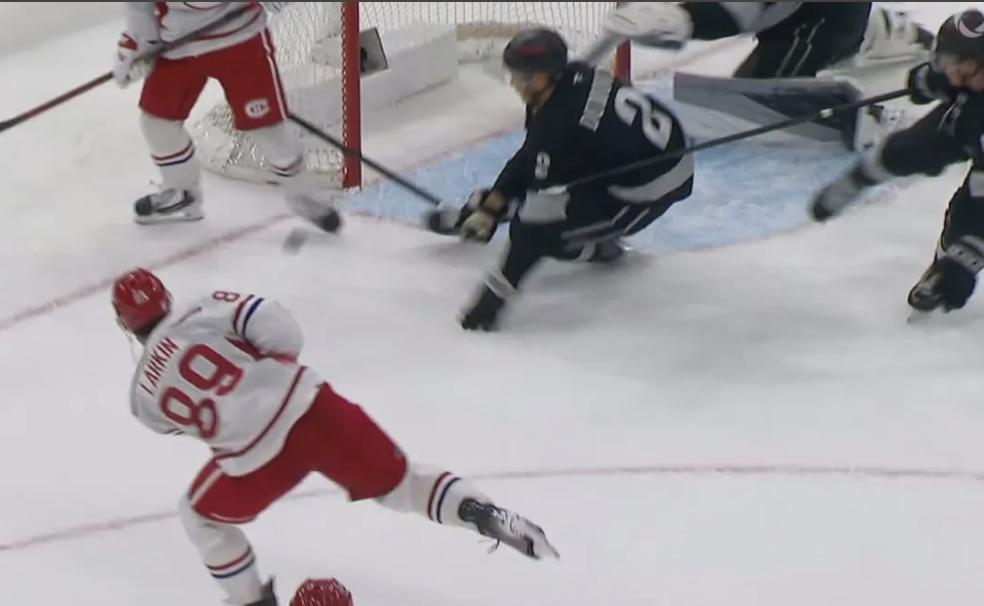
This is our read: the moment that mattered was not the miss, it was the decision before it. Before Larkin, Montreal’s answer in that situation was predetermined, because the draw went to the right side and the Kings’ penalty killers knew it. Now the coach can choose the side based on who is standing across the circle. That is a real advantage on every power play, every late faceoff in the offensive zone and every time the team needs a puck after a stoppage. Suzuki, whose faceoff it used to be, saw it right away: “We’ll take the advantage when we can.”
A Welcome Worth Noting
The Bell Centre had been waiting for this since Oct. 10, when fans chanted for Larkin during the Red Wings’ visit. On Monday the crowd roared when the scoreboard showed him getting ready for warmups, again when he came out, and again when he tapped his chest to thank the fans. Suzuki said he had never seen a salute like that in warmups, and by the time the game started the chant had changed from “We want Larkin” to “We got Larkin.”
Larkin called the reception special and said he will remember it for the rest of his life.
What St-Louis, Suzuki and Larkin Said
St-Louis liked what he saw from his new center: “He is in control offensively and defensively,” he said, adding that he is not loading Larkin up with information yet. The details on faceoffs, the power play and the penalty kill will come in stages.
The coach was less happy with the attack as a whole. Few teams play the Kings’ style, he said, and Montreal still had a lot of offensive-zone time (almost five more minutes than Los Angeles) and 69 shot attempts, but he called the offense average right now. Suzuki gave the Kings credit for defending well and staying in their positions all night, and Larkin said he was delighted with the puck possession and the way the defensemen got involved, adding that a few chances around the net would have changed the result.
The Press Conference: Character and Calm
The most telling part of Monday happened before the game. Larkin and Hughes spent more than 20 minutes in front of the media, and the tone mattered as much as the answers. Hughes took the time to talk about the person he was getting, not only the player, and he explained why nobody heard about the deal: Larkin asked that it stay quiet so neither team would be distracted. Larkin, for his part, answered every question about how things ended in Detroit calmly. He said the months after he asked for a trade were hard, that he is proud of his time with the Red Wings, and that he will explain why he wanted out when the time is right. He also brushed aside the idea that he did not want to play in Montreal.

This is our read, from watching the press conference: that is what a captain sounds like. A player who asked out of one team can come across as bitter or defensive, and Larkin was neither. He respected his old club, spoke about the Montreal group and St-Louis with obvious respect, and kept his composure throughout. It is also what he did after the game, when he owned the chance he missed instead of looking for an excuse. For a dressing room that has lost four straight at home and is built around young players such as Hutson, Caufield and Slafkovský, a veteran who has been a captain and handles pressure without drama is a real addition, beside Suzuki and not instead of him.
The Price, and Why We Understand It
The price was high and we will not pretend otherwise. Montreal sent Michael Hage‘s rights, Kirby Dach, Samuel Montembeault and four draft picks (the 2027 and 2029 first-rounders, both protected in the top 10, plus a 2027 second and a 2028 fourth) to Detroit for Larkin and two picks. Hage is the part that hurts, because he is a real prospect with a future in the NHL. Hughes joked on Monday that the scouts will have to draft the next one.
The case for the deal is that it costs the Canadiens less than the list suggests. Dach and Montembeault were mostly salary and depth pieces, not core players, and if Montreal improves while Detroit climbs, the picks will land later than they look today. Hughes also still has David Reinbacher, Alexander Zharovsky and other picks in the system. The risk is fair too: Larkin is 30, his contract runs five more years at $8.7 million, and Hage may become a very good NHL player. This is our read: the trade makes Montreal better this season without emptying the organization.
What One Game Cannot Tell Us
Larkin played the night with Texier and Newhook, and he had an assist on Newhook’s goal. MoneyPuck gave him a game score of 0.91, a good first night for a player coming off a month without games.
It is only one game. The power play was 0-for-3 even with Larkin on the first unit, the home record (9-13-3 over a year) will not change because of one center, and the lines will shift as injured players return. The test is the next ten games: does the second line score at 5-on-5, does the power play get shots through, and does he win draws when it matters.
The debut told us what Montreal bought: a center who scores, wins draws and gives the coach choices he never had. It did not tell us whether that is enough to fix a power play at 13.7% and a home record under .500. That answer starts Wednesday in Colorado.
Next Up
The Canadiens play at Colorado on Wednesday, Nov. 25 (9:30 p.m. ET), at Vegas on Saturday, Nov. 28 (4:00 p.m. ET), and at Utah on Monday, Nov. 30 (9:30 p.m. ET). All times are Eastern. The full Game Card for Monday is in our Kings recap, and more cards live on the HABSHQ graphics page.
Sources: NHL.com (play-by-play, game logs, career and season totals), MoneyPuck (game score and expected goals), RDS (trade column, trade analysis, press conference, debut), The Athletic (debut report).
Get the HABSHQ Newsletter in Your Inbox
Every Monday, the HABSHQ newsletter brings you the full Canadiens, Rocket, Lions and prospects report, our takes, the stats of the week and the preview of the week ahead, straight to your inbox. It is free.

Get the Habs week in your inbox
Free weekly newsletter from HABSHQ.
More from HABSHQ


Watch the analysis
Coach Frenchy breaks down every Canadiens game live on the Hockey Nation Live Show, with the lines, the numbers and the plays that mattered.
Watch on YouTubeAbout Coach Frenchy
Coach Frenchy (Pierre) hosts the Hockey Nation Live Show, the daily live Canadiens and NHL commentary show on YouTube. HABSHQ is where he brings the lines, the numbers and the prospects together in one place.
Leave a Reply