

The Canadiens have played 21 games, a quarter of the season, and they are 12-5-4 with 28 points. That puts them third in the Atlantic Division and fifth in the Eastern Conference, on a pace of about 109 points. It is a strong start. The record also hides some weaknesses, and the last four games, a 1-2-1 stretch, showed several of them.
The Canadiens are even with their opponents at five-on-five, their power play is among the worst in the league, and their goaltending has carried a lot of the weight. This review looks at how the first 21 games went, who drove them, who fell short, who improved, and what has to change before the halfway mark at game 42.
| Stat | Canadiens |
|---|---|
| Record | 12-5-4, 28 points |
| Points percentage | .667 (8th in the NHL) |
| Home / road | 5-3-3 / 7-2-1 |
| Goals for / against per game | 3.19 / 3.05 |
| Shots for / against per game | 27.6 / 28.1 |
| Power play | 12.5% (31st) |
| Penalty kill | 78.8% (15th) |
Through 21 games. Goals do not include shootout goals.
A Record Built on Close Games
Twelve of the 21 games were decided by one goal, and the Canadiens won seven of them. Eight games went past regulation: they won four (two in overtime and two in a shootout) and lost four in overtime. Excluding shootouts, they have outscored opponents 67-64, a difference of only three goals. That is the profile of a team that is good at winning close games and not yet good enough to avoid them.
The reason is that the games have been even. At five-on-five the Canadiens have taken 51.5% of the shot attempts (930 to 875) and have 134 shots on goal from inside 20 feet against 133 for their opponents. Nobody has controlled the game against them, and they have not controlled it against anyone. When a game is even at five-on-five, it is decided by goaltending, special teams and a few bounces, and the Canadiens have gotten far more from the first of those than from the other two.
They have been resilient when they fall behind. The Canadiens allowed the first goal in 10 games and went 6-2-2 in them, and they scored first in 10 others and went 5-3-2. The other game, against Detroit, was scoreless through overtime. When they led after two periods they went 10-0-2, and both overtime losses in that group came after the lead disappeared. They are 1-3-1 when trailing after two periods and 1-2-1 when tied, so the margin for error is thin once a game is level late.
The nine games that were not one-goal games split 5-4. The Canadiens won by two goals or more against Chicago, St. Louis, Dallas, Toronto and Boston, and lost by two or more to Carolina, Nashville, Colorado and the Rangers. Over those nine games they outscored opponents 28-25, so even their decisive results have not produced much separation.
MVP: Fowler Is the Reason the Record Is 12-5-4
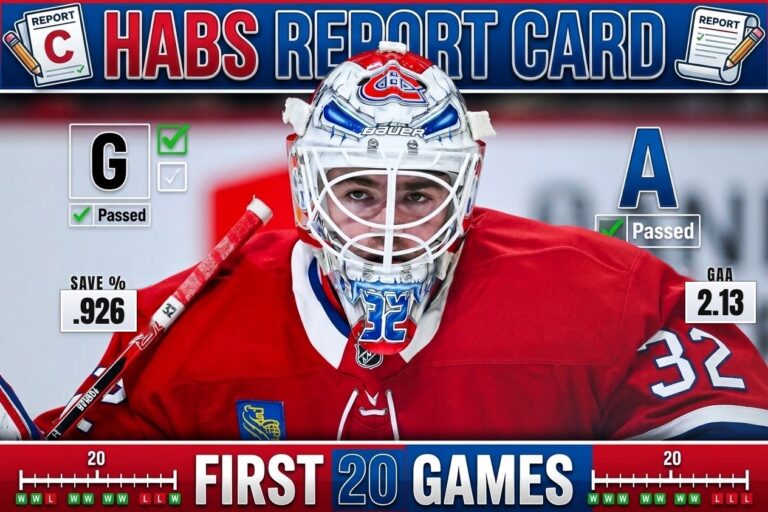
Jacob Fowler is 9-2-2 in 13 starts with a .923 save percentage, a 2.21 goals-against average and two shutouts. The Canadiens have earned 20 of a possible 26 points in his starts. Those are very good numbers for a rookie, and the shot data show they are not an accident.
Fowler has faced 377 shots and allowed 29 goals. We graded every shot by its distance from the net and compared it with what goalies around the league have done on shots from that distance this season. An average goalie facing the same shots would have allowed about 40 goals. Fowler has allowed 29, about 11 fewer, which is worth roughly two wins over 13 starts.
He has been strongest where goalies are usually the most beatable. On shots from inside 10 feet he has stopped 47 of 55 (.855), when the league average is about .806. From 10 to 20 feet he has stopped 54 of 60 (.900), against a league average of about .827. Those are the shots that come off rebounds, tips and passes across the slot, and he has handled them better than most goalies.
He has also been at his best when he is busiest. In the five games where he faced 30 or more shots, the Canadiens went 4-0-1 and he stopped 181 of 189 (.958). That includes a 46-shot shutout in St. Louis on Oct. 27 and a 30-save shutout against Detroit that the team won in a shootout. The quieter nights have been less clean. In the eight games where he faced fewer than 30 shots he stopped 167 of 188 (.888), and the goals came in bunches: three on 18 shots against Nashville on Oct. 8, three on 16 against Buffalo on Oct. 13, and four on 29 against Pittsburgh on Oct. 31.
Caufield and Hutson were the other candidates. Caufield leads the team in goals and Hutson in points, but the Canadiens are even at five-on-five, 31st on the power play and 12th in goals per game, so their offense does not explain a record that ranks eighth in points percentage. The goaltending does. Fowler’s 11 goals saved above an average goalie is worth roughly two wins, and it is the clearest reason the team is where it is.
Thirteen starts is too small a sample to call that a trend, and our read is that it is a pattern to watch and not a flaw. Young goalies often stay locked in when the shots keep coming and can lose a step when a game gives them long stretches with nothing to do. The bigger point is that no goalie stays this far above average for 82 games. The Canadiens are getting points from Fowler that the team in front of him has not yet earned, and over a full season they will have to give up fewer chances to keep them.
Dobeš Has Not Matched Fowler
Jakub Dobeš is 3-3-2 in eight starts with a .852 save percentage and a 3.93 goals-against average. He has faced 209 shots and allowed 31 goals. An average goalie on the same shots would have allowed about 24, so he is about seven goals worse than average, almost the mirror image of Fowler’s plus-11.
The goals have come from the area goalies are supposed to defend. From inside 20 feet Dobeš has stopped 57 of 74 shots (.770), when the league average is about .817. He has been fine from long range, with one goal allowed on 44 shots from beyond 45 feet, so the problem is the close-range saves and not the routine ones.
The penalty kill has been his biggest issue. When the Canadiens have been shorthanded, Dobeš has stopped 28 of 39 shots (.718), while Fowler has stopped 61 of 66 (.924). Shorthanded shots are not all the same, and Dobeš has seen fewer of them, but 11 of his 31 goals against came with a Canadiens player in the penalty box, and goals like that decide games.
The Canadiens have used the backup in 8 of 21 games, 38% of the schedule, and earned 8 of 16 points in them, against 20 of 26 in Fowler’s starts. The question for the second quarter is how the team splits the starts, and whether Dobeš can give them games they can win without needing the offense to bail him out.
Caufield and Hutson Drive the Offense
Cole Caufield leads the team with 12 goals and 69 shots on goal, both the most on the roster, from 127 attempts. Ten of the goals came at even strength and two on the power play, both in one game against Winnipeg on Nov. 3. Seven came from inside 20 feet and five from farther out, so he is a shooter who scores from range as well as from the slot.
His production has come in bursts. He has scored in eight of the 21 games and has four multi-goal games. He has one goal in the last four games, and the team has scored one goal in three of them. When a team leans this hard on one shooter, a short drought by him shows up in the scoreboard right away.
Lane Hutson has 19 points (3 goals, 16 assists), the same total as Caufield, while averaging 25:05 of ice time a game. Nine of his 16 assists were primary assists. Twelve of his points came at even strength, five on the power play and two with the goalie pulled. He has a point on five of the eight power-play goals the team has scored, which shows how much of that unit runs through him, and how little it has when his passes do not get through.
Nick Suzuki has 8 goals and 17 points in 15 games, 1.13 points a game, after missing six games between Oct. 23 and Nov. 3. The Canadiens went 5-0-1 in those six games and scored 22 goals, but Fowler started five of them, so the stretch is no proof that they play better without him. Beyond Caufield, Suzuki and Josh Anderson (8 goals in 19 games), the scoring thins out quickly: Zachary Bolduc has 6, Alex Newhook has 5, and Juraj Slafkovský has 2 goals and 11 assists. When that small group goes quiet, as it did in the last four games, there is little behind it.
Biggest Disappointment: Juraj Slafkovský
Juraj Slafkovský scored 30 goals and 73 points last season and opened this one on the first line. Through 21 games he has 2 goals and 11 assists. He has not scored since Oct. 20 against San Jose, a drought of 12 games, and he has no power-play goals after scoring 15 of his 30 last season. His points per game have fallen from 0.89 to 0.62, a steep drop for a player the team counts on to score.
Some of it is bad luck. He is shooting more than last season, 2.4 shots on goal a game against 2.2, and 17 of his 50 shots on goal came from inside 20 feet. Using the league scoring rate for each distance, an average shooter would have scored about six goals on those 50 shots, and he has two. His five-on-five shot-attempt share is up from 48.4% to 50.6%, and the Canadiens have outscored opponents 15-14 at even strength with him on the ice. He is not being buried. The puck is just not going in.
The details behind the slump are not all about luck. He gives the puck away 4.2 times per 60 minutes, up from 3.2 last season, and he is hitting less, 3.0 per 60 against 4.1. On the power play he has 15 shots on goal and no goals, and only four of those 15 came from inside 20 feet. He has also missed the net five times from that area. Last season he had 15 power-play goals and 28 power-play points. This season he has four power-play points, and the unit now works the perimeter, away from the slot where he did most of that damage.
Our read is that confidence is part of it. He has not looked the same since the playoff series against Tampa Bay, his decisions with the puck have been poor, and he lost his temper in each of the last two games, once with the coach and once with his captain. In fairness, he is still setting up teammates at last year’s pace, 11 assists in 21 games, 0.52 a game in both seasons, and he is only 22. The Canadiens do not need a new player. They need the old Slafkovský back as a scorer, because with Caufield cold and the power play 31st, there is no easy replacement for those goals.
Most Improved: Arber Xhekaj
Arber Xhekaj has played 20 of the 21 games and already has the same four points (1 goal, 3 assists) that he had in all 65 games last season. He is a plus-1 after finishing minus-8 last year and minus-13 the year before. At even strength the Canadiens have outscored opponents 13-12 with him on the ice, a big change from 23-32 last season.
The reason is that the team is keeping the puck when he plays. With Xhekaj on the ice at five-on-five, the Canadiens take 53.8% of the shot attempts, up from 46.8% last season. That is 2.1 points better than the team does when he is off the ice, and last year it was 1.1 points worse. The numbers say the Canadiens are spending more time in the other end when he plays, which is the first job of a third-pair defenseman.
The discipline is better too. He takes penalties 2.2 times per 60 minutes, down from 2.7, and he has 9 penalties in 20 games compared with 34 in 65 last season. He gives the puck away 2.0 times per 60 minutes, down from 2.8, and he has more takeaways, 0.5 per 60 against 0.2. He is hitting less, 10.1 per 60 compared with 14.4, which fits what we see: he is playing smarter and not just harder.
Part of the improvement comes from how he is used. He plays 12:13 a game on the third pair, up from 11:25, and 64.4% of his five-on-five shifts start in the offensive zone, up from 56.5%. The eye test says the change is real as well. He is driving to the net, joining the offense more and protecting the front of the net better, and his best game came against the Rangers on Nov. 16, with three shots on goal and four hits. Our read is that it was the best game of his career. The next test is whether he can keep it up on the nights the opponent’s best line is on the ice.
Three Problems the First Quarter Exposed
1. The power play does not create enough shots
At 12.5% the Canadiens have the 31st-ranked power play in the NHL, with 8 goals on 64 chances. Volume is the first reason. Over 65 two-minute power plays, 14 ended without a single shot on goal, about one in five. When they do get a shot, the first one takes an average of 46 seconds, so more than a third of the two minutes goes to getting set up. The unit averages 1.22 shots on goal per power play, 24th in the league and below the league average of 1.35.
2. The shots come from the wrong places
Only 28 of their 78 power-play shots on goal came from inside 20 feet. Those 28 produced five goals (17.9%), a little below the NHL rate of 22.2% from that range. The other 50 shots, from mid-range and outside, produced two goals (4.0%), well below the league rate of 12.1%. The unit settles for the perimeter and rarely gets the puck to the slot. Slafkovský has 15 power-play shots on goal and no power-play goals, and Caufield has 18 shots on goal and two goals, so the two shooters the penalty killers watch most have not finished from where they shoot.
3. Mistakes turn the power play into a liability
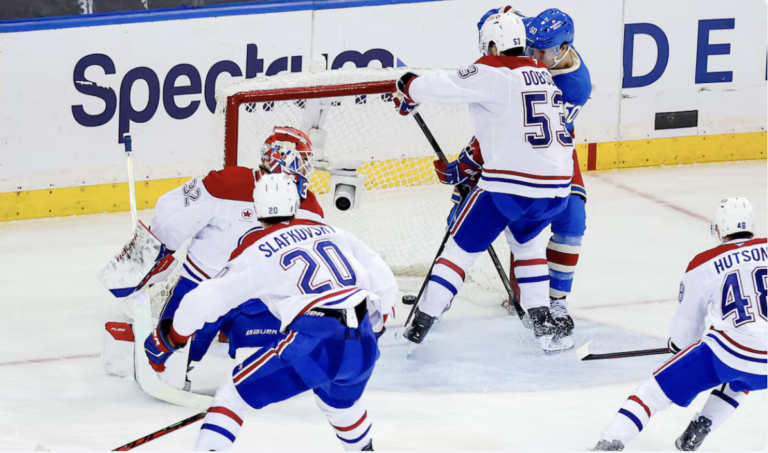
The unit has allowed three shorthanded goals, tied for the fourth-most in the league, and its net of plus-5 (eight scored, three allowed) is the second-lowest in the NHL, with only Ottawa lower. One of the three decided a game. On Nov. 16 the Rangers scored shorthanded late in the second period to go ahead 2-1, in a game they won 3-1 (see our look at the loss in New York). The other two came in Washington, a 5-4 regulation loss, and against Buffalo, a 4-3 overtime win. A power play has to be safe first, and every turnover and loose puck is an opening against it.
The Third Period Has Been the Weak Spot
The Canadiens have outscored opponents 51-33 in the first two periods and been outscored 23-12 in the third, not counting empty-net goals. At five-on-five they still take about half of the shot attempts in the third period (293 of 574, 51.0%), so they are not being pinned in their own end. The difference is in the quality of the chances. Over the first two periods the Canadiens have 101 five-on-five shots on goal from inside 20 feet against 92 for their opponents. In the third period they are out-chanced 41-33 from that area and outshot 134-123 overall.
The goals against tell the same story. Of the 23 third-period goals, 15 came at even strength, five on opponents’ power plays and three with the opponent’s goalie pulled for an extra attacker, so penalties explain only a small part. Our read is that a team protecting a lead gives up the middle of the ice, and the next 21 games will show whether this is a trend or a small sample. The problem has cost points more than games, since the Canadiens went 10-0-2 when leading after two periods.
What Has to Change Before the Halfway Mark
Start with the first 20 seconds of the power play. A unit that takes 46 seconds to produce its first shot is giving the penalty killers time to settle into their shape. Faster entries and an early shot from the point or the half wall, with a body at the net for the rebound, will force the penalty kill to move and open the slot. That is where the unit scores: 17.9% from inside 20 feet, 4.0% from farther out. Caufield and Slafkovský take about 35% of all the unit’s attempts, and the penalty killers know it, so a third shooter has to become a real threat.
Next is discipline. The Canadiens have allowed power-play goals in tight games, and a backup goalie who has stopped .718 of the shots he faces shorthanded is a reason to take fewer penalties on the nights Dobeš plays. The penalty kill is 15th at 78.8%, which is average, and average is not enough when the power play is 31st.
The third piece is protecting Fowler. The Canadiens give up 28.1 shots a game, 19th in the league, and have been getting a goalie performance that cannot last. Cutting the chances inside 20 feet, which are even with their opponents at five-on-five and tilt against them in the third period, is the most direct way to keep the points coming when his save percentage settles.
Finally, the offense needs more than a small group. The Canadiens played the Rangers without Chris Kreider, Josh Anderson and Mike Matheson, and the lineup looked flat. The team has to find goals from the lines below Suzuki and Caufield, because three of the last four games ended with one goal and that will not win often.
Next Up: Devils, Hurricanes and Flyers
The Canadiens play at New Jersey on Wednesday, Nov. 18 at 7:30 PM ET, at Carolina on Thursday, Nov. 19 at 7:00 PM ET, and host Philadelphia on Saturday, Nov. 21 at 7:00 PM ET.
Sources: NHL game data, play-by-play and standings.
Get the HABSHQ Newsletter in Your Inbox
Every Monday, the HABSHQ newsletter brings you the full Canadiens, Rocket, Lions and prospects report, our takes, the stats of the week and the preview of the week ahead, straight to your inbox. It is free.

Get the Habs week in your inbox
Free weekly newsletter from HABSHQ.
More from HABSHQ


Watch the analysis
Coach Frenchy breaks down every Canadiens game live on the Hockey Nation Live Show, with the lines, the numbers and the plays that mattered.
Watch on YouTubeAbout Coach Frenchy
Coach Frenchy (Pierre) hosts the Hockey Nation Live Show, the daily live Canadiens and NHL commentary show on YouTube. HABSHQ is where he brings the lines, the numbers and the prospects together in one place.
Leave a Reply