A deep look at Jakub Dobeš’s breakthrough 2025-26 season, playoff performance, technical development, workload and the Canadiens’ goaltending situation entering 2026-27.
PLAYER PROFILE & CONTRACT DOSSIER
Player: Jakub Dobeš
Position / Catches: Goaltender / Left
Vitals: 6’4″, 215 lbs | Age: 25
Born: May 27, 2001 — Ostrava, Czechia
Draft: 2020 NHL Draft — Round 5, 136th Overall
New Contract: 3 years | $16,072,725 total | $5,357,575 AAV
Contract Term: 2027-28 through 2029-30
Previous Contract: 2 years | $965,000 AAV
Montreal did not hand Jakub Dobeš a three-year, $16.07 million extension because of one hot month or one memorable playoff run. The Canadiens made the decision after watching a 25-year-old goaltender move from a developing NHL option into the crease for 43 regular-season games and then start all 19 games of a run to the Eastern Conference Final.
The contract, signed July 2, 2026, carries an average annual value of $5,357,575 and begins with the 2027-28 season. (Puckpedia)
That distinction matters.
Dobeš is not being paid $5.36 million because Montreal already knows exactly what he will become. He is being paid because the organization believes the evidence is strong enough to invest in his next stage of development.
And there is now a very interesting question in front of the Canadiens.
Can Dobeš move from a successful first full NHL season into the workload expected of a legitimate No. 1 goaltender?
Not necessarily 60 games.
But can he handle 50, 55 or even more starts while maintaining the athleticism, concentration and technical consistency that allowed him to succeed in 2025-26?
That is the real Dobeš question entering the new season.
1. THE 2025-26 TRIAL BY FIRE
The numbers tell an interesting story.
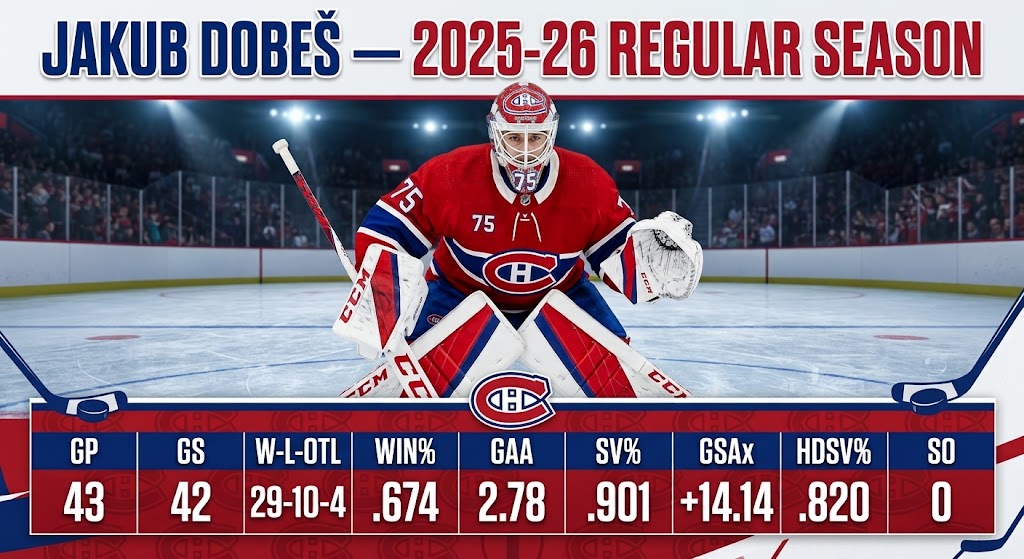
Dobeš played 43 games and started 42, finishing with 29 wins, 10 regulation losses and four overtime losses. His 2.78 goals-against average and .901 save percentage were not numbers that immediately screamed elite goaltending.
But there is another layer to the season.
HockeyStats lists Dobeš at +14.14 GSAx for the 2025-26 regular season, meaning his performance relative to expected goals was substantially better than the basic save percentage suggests.
The NHL’s official record also confirms the 29-10-4 record, 2.78 GAA and .901 save percentage, with Dobeš leading all rookie goaltenders in wins and ranking ninth among all NHL goalies in that category.
The most important part of the season, however, may have started before anybody was talking about a long-term contract.
The October Surge
Dobeš opened the season 6-0-0 with a 1.97 GAA and .930 save percentage, earning NHL Third Star honors for October.
He also became only the 10th rookie goaltender in NHL history to win each of his first six appearances in a season.
That stretch changed the conversation.
Dobeš was no longer simply a young goaltender waiting for his opportunity.
He was forcing Montreal to give him more responsibility.
And that is one of the most important elements of his 2025-26 season: the workload was earned.
2. FROM REGULAR SEASON BREAKOUT TO PLAYOFF TEST
ROUND 1 — TAMPA BAY
ROUND 2 — BUFFALO
EASTERN CONFERENCE FINAL — CAROLINA
Dobeš’s regular season established that he could play NHL hockey consistently.
The playoffs asked a completely different question:
Could he handle the pressure when every mistake became magnified?
The answer was impressive.
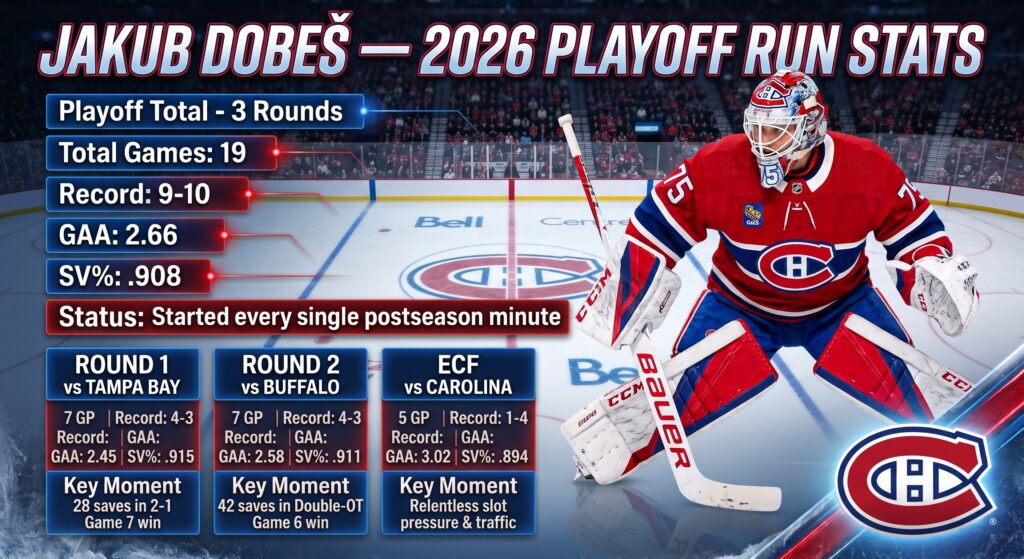
Dobeš started all 19 of Montreal’s playoff games as the Canadiens advanced through two rounds before facing the Carolina Hurricanes in the Eastern Conference Final. He finished the postseason with a 9-10 record, a 2.66 GAA and a .908 save percentage. (NHL)
Round 1: Tampa Bay
The first test was against Andrei Vasilevskiy and the Tampa Bay Lightning.
The pressure was immediate.
Dobeš was playing in his first extended NHL playoff run, and suddenly every save had a different meaning.
The series went seven games.
Then came Game 7.
Dobeš stopped 28 shots in Montreal’s 2-1 victory, sending the Canadiens into the second round.
That performance placed him in Canadiens history.
He became only the fifth Montreal goaltender to win a playoff Game 7, joining Jacques Plante, Ken Dryden, Patrick Roy and Carey Price. (NHL)
That is not a small accomplishment.
Round 2: Buffalo
The Buffalo series created a different challenge.
Montreal was facing a team capable of creating dangerous chances through speed, pressure and offensive-zone possession.
Dobeš continued to carry the crease.
The important part wasn’t that every game was perfect.
It was that Montreal continued putting him back into the net.
That is what you want to see from a young goaltender in the playoffs.
Eastern Conference Final: Carolina
Then came Carolina.
The Hurricanes pushed Montreal into a different type of series, one that tested the Canadiens’ defensive structure and placed even more pressure on the goaltender.
Dobeš eventually finished the postseason after starting all 19 games.
The Canadiens lost the Eastern Conference Final 4-1 to Carolina, but the larger conclusion remained clear: Dobeš had successfully carried the crease through three playoff rounds.
For me, this is where the Dobeš evaluation becomes much more interesting.
The playoffs did not prove that he is already an elite NHL No. 1.
They proved that he can operate under pressure.
Now Montreal needs to find out whether he can do it over a much larger regular-season workload.
3. INSIDE DOBEŠ’S GOALTENDING ENGINE
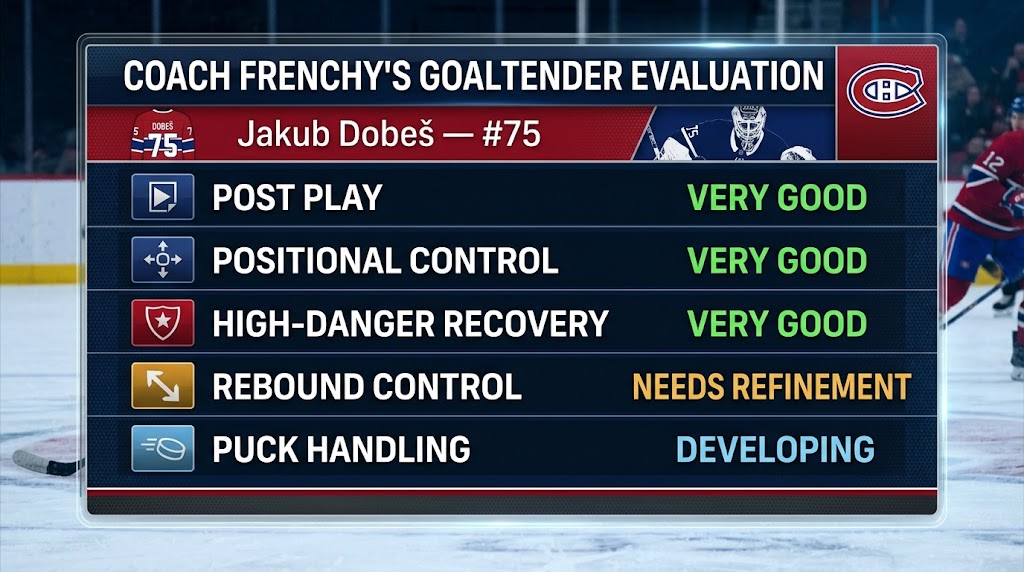
Coach Frenchy’s evaluation is a subjective scouting assessment, not an official NHL rating.
At 6-foot-4 and 215 pounds, Dobeš has the physical frame to cover a significant portion of the net without needing to over-challenge every shooter.
What interests me more is how his game has evolved.
The Dobeš I watched earlier in his development could sometimes appear aggressive with his depth. When a play moved laterally, that aggression could create additional recovery distance.
The more mature version of Dobeš appears more comfortable allowing the play to develop in front of him.
That is important.
Goaltending is not simply about stopping the first shot.
It is about controlling the next movement.
Where is the puck going after the save?
Can the goaltender recover before the next pass?
Is the chest facing the new shooting lane?
Can the goalie stay connected to the post without becoming trapped there?
Those details become increasingly important when a goaltender moves from 40-plus starts toward 50 or 55.
The RVH and Post Game
Dobeš’s work around the post is another area I would continue monitoring.
His size gives him a natural advantage when he gets properly connected to the post, particularly on plays below the goal line and around the short side.
The goal isn’t simply to seal the post.
The goal is to remain capable of moving immediately when the puck comes back into the slot.
That is where Dobeš’s next level will be determined.
The Area I Want to See Improve: Rebound Control
If there is one technical area I would put at the top of the Coach Frenchy Target Card, it is rebound management.
A big save is only part of the job.
The next question is:
Where does the puck go?
A controlled rebound into the corner can end the sequence.
A loose rebound into the slot can create another scoring chance before the defense has time to recover.
That becomes especially important against teams that attack the crease aggressively.
I don’t see rebound control as a reason to doubt Dobeš.
I see it as one of the areas that could determine whether he moves from promising starter to established top-end No. 1.
4. WHAT DO THE ADVANCED NUMBERS TELL US?
This is where I don’t want to overwhelm the reader.
The advanced numbers are not the reason for this article.
They are evidence supporting the larger evaluation.
GSAx: +14.14
Goals Saved Above Expected attempts to measure how many goals a goaltender prevented compared with the goals expected based on the shots and chances faced.
For Dobeš, the important takeaway is simple:
His .901 save percentage does not tell the entire story of his 2025-26 performance.
His positive GSAx indicates that he performed better relative to the quality of chances he faced than the traditional save percentage alone suggests. PuckPedia lists him at +14.14 GSAx for the regular season.
HDSV%: .820
High-Danger Save Percentage focuses specifically on dangerous scoring opportunities.
For a young goaltender expected to play behind an aggressive team, this is an important number to watch.
The question isn’t whether Dobeš will face dangerous chances.
He will.
The question is whether he can continue making enough of those difficult saves as his workload increases.
That is why I don’t want to separate GSAx and high-danger performance into two giant statistical sections.
They belong together because they help answer the same question: how much of Dobeš’s success came from actually stopping difficult chances?
5. THE TEAM IN FRONT OF HIM MATTERS
A goaltender cannot be evaluated completely outside of his environment.
Montreal plays with an aggressive transition identity. The Canadiens want to attack with speed, move the puck quickly and create offensive pressure.
That style creates opportunities.
It can also create moments when possession turns over and the goaltender suddenly has to deal with a dangerous chance before the defensive structure is fully established.
That makes Dobeš’s ability to recover, track laterally and remain composed particularly important.
Montreal does not need Dobeš to win every game 2-1.
The Canadiens have enough offensive talent to create goals.
What they need from their goaltender is consistency.
They need him to stop the shot that changes the game.
They need him to prevent a two-goal lead from becoming a one-goal lead.
They need him to make the difficult save when the defensive structure breaks down.
And they need him to do that without becoming physically or mentally overloaded.
That brings us to the most important question of the entire article.
6. THE CREASE DYNAMIC: MONTEMBEAULT AND FOWLER
Dobeš’s new contract does not eliminate Montreal’s goaltending questions.
It actually makes them more interesting.
2025-26 GOALTENDING SNAPSHOT
| Goaltender | GP | Record | GAA | SV% | SO |
|---|---|---|---|---|---|
| Jakub Dobeš | 43 | 29-10-4 | 2.78 | .901 | 0 |
| Samuel Montembeault | 25 | 10-8-4 | 3.43 | .872 | 0 |
| Jacob Fowler | 17 | 9-6-2 | 2.43 | .908 | 1 |
Fowler became Dobeš’s primary backup late in the season while Montembeault moved down the depth chart after struggling.
Montembeault’s Crossroads
Montembeault’s 2025-26 season was difficult.
After serving as Montreal’s No. 1 goaltender the previous season, he finished this one with a 3.43 GAA and .872 save percentage in 25 games. NHL.com described him as Montreal’s No. 3 goalie down the stretch after Fowler passed him on the depth chart.
Now the Canadiens need something from Montembeault.
They need him to bounce back.
Not because Dobeš cannot play.
Because Dobeš should not have to play everything.
If Montreal wants Dobeš to handle a larger workload, the backup goaltender must be capable of giving him legitimate nights off.
That means Montembeault has something to prove.
And that competition is healthy for Montreal.
The Fowler Factor
Then there is Jacob Fowler.
Fowler’s rookie NHL season produced a 9-6-2 record, 2.43 GAA and .908 save percentage in 17 games. He also played 27 games for Laval in the AHL, going 19-7-1 with a 2.23 GAA, .916 save percentage and three shutouts.
That is an important development path.
But I would not rush Fowler into the conversation as Montreal’s future No. 1 based on one NHL season.
He is still developing.
The 2026-27 season should tell us much more.
For Dobeš, Fowler represents something different.
Competition.
If Fowler continues progressing, Dobeš will have another young goaltender pushing for NHL opportunities.
That is exactly what Montreal wants.
7. HOW MUCH SHOULD DOBEŠ PLAY?
This is where I believe the conversation should move away from the automatic 60-game target.
A 60-game workload is a significant commitment for any NHL goaltender.
The question shouldn’t be:
Can Dobeš play 60?
The better question is:
How much can Dobeš play while remaining at his best?
If he earns 50 starts, that’s a major step.
If he reaches 55, even better.
If the Canadiens eventually determine that he can handle 60 without losing efficiency, then that option exists.
But Montreal does not need to decide that before the season begins.
The smarter approach is to monitor his workload throughout the year.
If Dobeš is playing well, physically fresh and technically sharp, keep giving him responsibility.
If the workload begins affecting his rebound control, lateral movement or concentration, the coaching staff needs to trust the backup.
That’s why Montembeault and Fowler matter so much.
The best way to protect Dobeš may not be to play him less. It may be to make sure Montreal has a reliable second option when he needs a night off.
8. COACH FRENCHY’S TARGET CARD — 2026-27
DOBEŠ DEVELOPMENT TARGETS
WORKLOAD:
50–55+ starts
TECHNICAL FOCUS:
Rebound control and secondary puck management
PHYSICAL FOCUS:
Maintain consistency through heavier workload
MENTAL FOCUS:
Continue handling pressure without chasing the game
TEAM SUPPORT:
Montembeault or Fowler must provide dependable starts
BIG QUESTION:
Can Dobeš maintain his level when the workload becomes a season-long responsibility?
This is where the 2026-27 season becomes so important.
Dobeš has already shown he can win.
He has shown he can play under pressure.
He has shown he can carry Montreal through a long playoff run.
Now we need more data.
More starts.
More situations.
More adversity.
More games against teams that have had time to study him.
That is how we will know whether the Canadiens have found their long-term No. 1.
THE VERDICT: A NO. 1 CANDIDATE, NOT A FINISHED PRODUCT
I believe Jakub Dobeš has earned the opportunity to become Montreal’s No. 1 goaltender.
I do not believe one season is enough to declare that question permanently answered.
That’s an important distinction.
His 2025-26 season was impressive.
His 29 wins led NHL rookies. He started all 19 playoff games during Montreal’s run to the Eastern Conference Final. His .908 playoff save percentage improved on his .901 regular-season number, and he demonstrated that the pressure of playoff hockey did not overwhelm him. (NHL)
His contract tells us what Montreal believes.
The next season will tell us whether that belief was justified.
Dobeš does not need to become Connor Hellebuyck overnight.
He does not need to play 60 games simply because the organization gave him a $5.36 million AAV extension.
He needs to continue developing.
He needs to control rebounds.
He needs to remain technically efficient when fatigue arrives.
And perhaps most importantly, Montreal needs to make sure he has enough support behind him that every missed game does not become a crisis.
The Canadiens may have found their long-term answer in Jakub Dobeš.
But the 2026-27 season will tell us how much of that belief is projection and how much is reality.
He has already shown that he can win.
He has shown that he can handle pressure.
Now we need to find out whether he can do both consistently while carrying a much larger NHL workload.
Can Dobeš become Montreal’s long-term No. 1 without asking him to do too much, too soon?
That is the Dobeš Blueprint.
SOURCES
- NHL.com
- Hockeystats.com
- PuckPedia
- NHL Edge
Statistical note: Traditional NHL statistics are based on NHL game records. Advanced statistics such as GSAx and HDSV% can vary by provider and methodology; HABSHQ should identify the source used for each advanced metric rather than combining calculations from different providers.
Get the Habs week in your inbox
Free weekly newsletter from HABSHQ.
Leave a Reply