
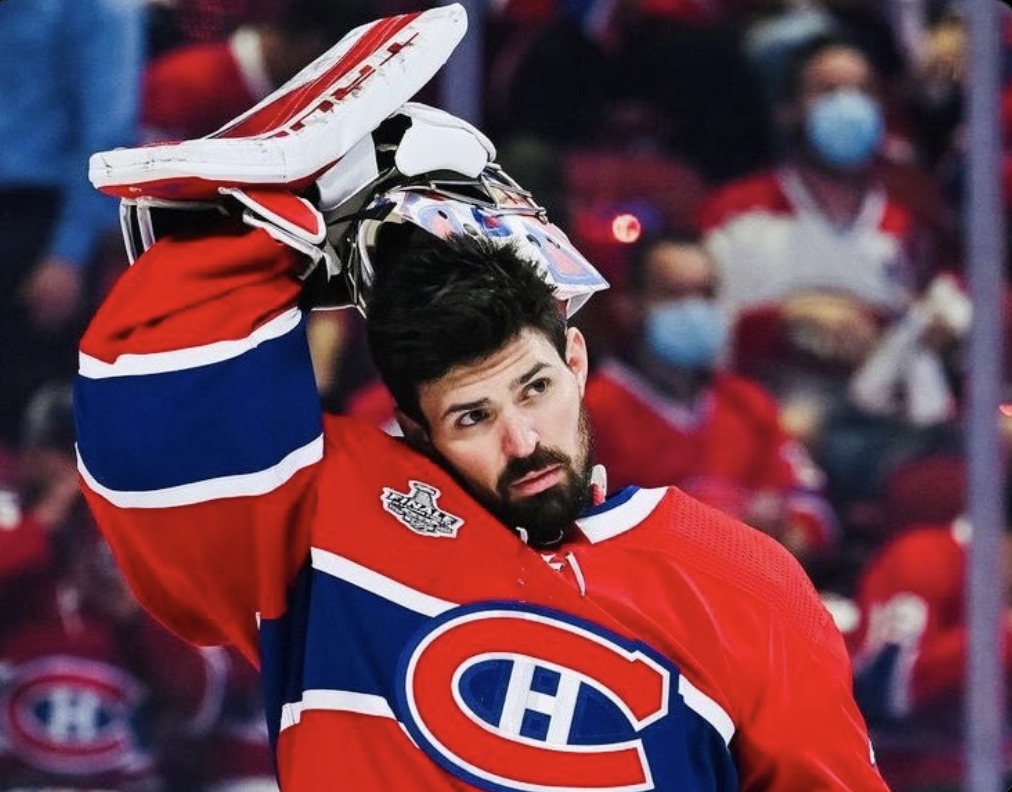
Two nights, two ceremonies, one goalie. On Monday night, Nov. 9, in Toronto, Carey Price will be inducted into the Hockey Hall of Fame with the Class of 2026, in his second year of eligibility. One night later, on Tuesday, Nov. 10, the Canadiens will honour him at the Bell Centre before the game against the Minnesota Wild and add his name to the Ring of Honour as its 62nd member, the first since Shea Weber in 2024. For a whole generation of Habs fans, this is more than a celebration. It is a thank-you to the man who stood in our net for 15 seasons, most of them behind a team that was never built to score.
From Anahim Lake to the fifth overall pick
Price was born on August 16, 1987, in Vancouver, but he grew up in Anahim Lake, British Columbia, a community so remote that a trip to play in Williams Lake meant a ten-hour round trip. His father, a goalie himself who was drafted by the Philadelphia Flyers, eventually bought a small plane to get him to games and practices. His mother, Lynda, served as chief of the Ulkatcho First Nation, and Price has carried that heritage proudly his whole career.
He debuted with the Tri-City Americans of the WHL at only 15 years old and played parts of five seasons there. At the 2005 NHL Entry Draft, the Canadiens used the fifth overall pick on him, and in 2006-07 he was named goaltender of the year in both the WHL and the CHL. From a coach’s point of view, you could see why. He was tall, he was calm, he tracked pucks through traffic like a veteran, and he never looked rushed.
Calder Cup and world junior gold in the same year
The spring of 2007 was the first proof that this kid was special. At the 2007 World Junior Championship, Price won all six of his starts with a 1.14 goals-against average and two shutouts. He was named the tournament’s best goaltender, an all-star, and the Most Valuable Player as Canada took gold.
Then he turned pro with the Hamilton Bulldogs, the Canadiens’ AHL affiliate, and carried them through the Calder Cup playoffs. He went 15-6 with two shutouts and a 2.06 goals-against average in 22 games, and Hamilton beat the Hershey Bears four games to one, clinching on June 7, 2007. Price was named playoff MVP with the Jack A. Butterfield Trophy. He was 19 years old.
Arriving in Montreal, and the offence he never had
Price made his NHL debut on October 10, 2007, stopping 26 shots in a 3-2 win over Pittsburgh. In his rookie year he played 41 games, won 24, and finished with a 2.56 goals-against average and three shutouts, helping a 104-point Canadiens team win the Northeast Division and the top seed in the East.
That team is important to this story, because it was the exception. The 2007-08 Canadiens had seven 50-point scorers, more than any club in the league, and Alex Kovalev led them with 84 points (35 goals and 49 assists) in 82 games. A point per game, just barely, and it is the only time it happened in Price’s entire career with Montreal. It was also the last time a Canadien reached 80 points until Nick Suzuki did it in 2024-25, 17 years later.
Think about what that means. Price spent 15 seasons in Montreal, and for almost all of them his team scored just enough to stay in the fight. Games were 2-1 and 3-2, and one mistake could cost him a win. Today’s Canadiens are a different animal. Through January of last season they were scoring about 3.37 goals per game, third in the NHL, with five players above 40 points. Price never had that kind of support on a nightly basis. He won anyway.
The best goalie in the world: 2014-15
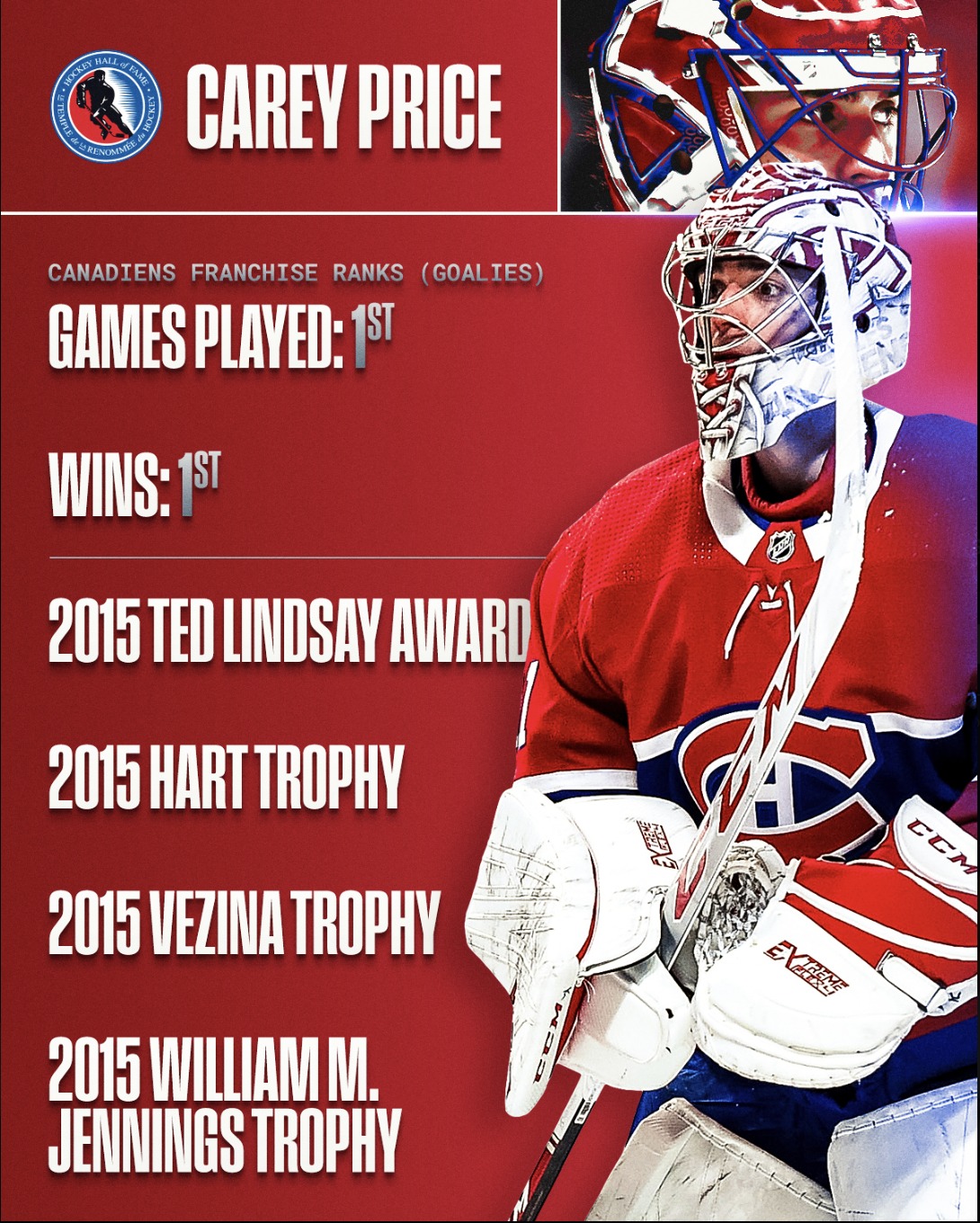
The 2014-15 season is the one that put Price in the Hall of Fame conversation for good. He played 66 games and went 44-16-6 with a 1.96 goals-against average, a .933 save percentage and nine shutouts. He led the NHL in wins, goals-against average and save percentage, and then the trophies started piling up: the Hart Trophy as league MVP, the Vezina Trophy as best goalie, the Ted Lindsay Award as the players’ MVP, and the William M. Jennings Trophy, shared with Corey Crawford. He was also a First Team All-Star.
Four individual awards in one season had been done by only one other Canadien before him. He added the Lou Marsh Award as Canada’s athlete of the year, and the Lionel Conacher Award as the country’s male athlete of the year, that same year.
Proud of his roots: Price and First Nations youth
Price is a member of the Ulkatcho First Nation in Anahim Lake, with Nuxalk and Southern Carrier (Dakelh) roots in his family. His mother, Lynda, was chief of Ulkatcho from 2005 to 2009 and again from 2019 to 2025. His father, Jerry, a former player and goalie coach, learned to fly and bought a plane so his son could play hockey. His grandmother attended residential school, so the history behind the headlines is part of his own family story.
Price has never been shy about it. When he accepted the Vezina at the 2015 NHL Awards in Las Vegas, right after the Hart, he used the biggest stage of his career to tell First Nations youth to take pride in their heritage and be leaders in their communities. The recognition followed: the Jean Beliveau Trophy for his charity and community work, the Indspire Award in sports in 2016, and in 2024 an honorary Doctor of Laws from the University of Northern British Columbia and induction into the BC Hockey Hall of Fame. He is also the national ambassador of Breakfast Club of Canada for First Nations, Metis and Inuit communities, he helped open two breakfast programs in Anahim Lake, and the Carey and Angela Price Foundation supports youth and youth sports in the region.
He also showed up when it mattered. In June 2021, before Game 2 of the second round in Winnipeg, Price went to a rally at St. Mary’s Cathedral to support residential school survivors, days after the discovery of the remains of 215 children at the Kamloops Indian Residential School. The photo of him fist-bumping survivor Gerry Shingoose was seen across the country. For a lot of Indigenous kids who dream of playing hockey, Carey Price is the proof that a player from a small community, a long way from the big cities, can make it to the top and stay true to who he is.
Gold for Canada: Sochi and the World Cup
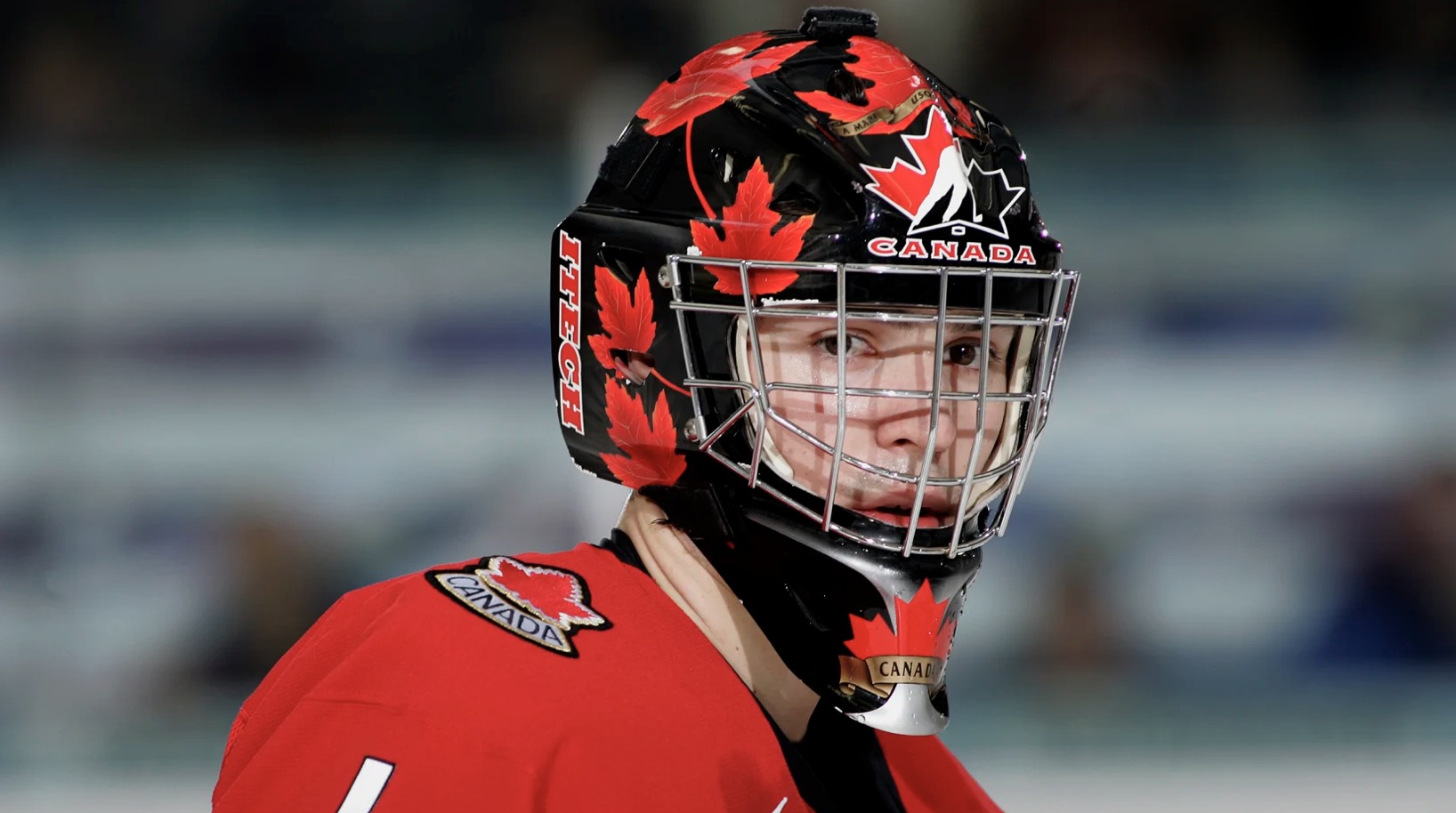
Price never wore a Canadian sweater without winning something. At the 2014 Sochi Olympics he was the starter on the gold-medal team: five games, five wins, two shutouts and a 0.59 goals-against average, and he was named the tournament’s best goaltender. In the 2016 World Cup of Hockey he won all five of his starts again with a 1.40 average, and Canada took the championship.
Knees, contracts and the Plante record
The years after 2015 were harder. He played only 12 games in 2015-16 because of a knee injury, going 10-2, and the Canadiens missed the playoffs without him. That is the clearest proof of how much that team depended on him. He came back in 2016-17 with 37 wins, a 2.23 average, and a nomination as a Vezina finalist. In July 2017 he signed an eight-year, $84 million extension.
The bad years were real. In 2017-18 he won only 16 of 49 games with a 3.11 goals-against average. But he kept going, won 35 games in 2018-19, and on March 12, 2019, he passed the legendary Jacques Plante for the most wins in Canadiens history. In the 2020 playoffs bubble he gave Montreal a 1.78 goals-against average and two shutouts in 10 games.
2021: one last run to the Stanley Cup Final
Nobody gave the 2021 Canadiens a chance. Price played only 25 games in the shortened regular season, and the team then started the playoffs down 3-1 to the Toronto Maple Leafs. Montreal won three straight, including an overtime win in Game 5, to take the series in seven. They swept Winnipeg in the second round, then beat Vegas in six games, Artturi Lehkonen’s overtime goal in Game 6 sending Montreal to the Final, with Price standing tall behind them.
Entering the Final, Price was 12-5 in the playoffs with a .934 save percentage and a 2.02 goals-against average. An NHL.com staff vote had him as the MVP of the playoffs, with 11 of 13 first-place votes. Tampa Bay was too deep and won the Final in five games, but Price’s playoff run was the best of a modern Canadiens goalie: 22 games, 13 wins, and a 2.28 average.
The hardest fight, and the last game
That run came at a price. His knee was already a major problem during the playoffs, and he had surgery on a torn meniscus in July 2021. On October 7, 2021, he entered the NHL and NHLPA player assistance program. A month later, on November 9, Price posted a statement saying he had entered a residential treatment facility for substance use, and admitted he was working through years of neglecting his own mental health. In an October 2022 interview with The Athletic, Price went further. He said he had been drinking a lot and that he used alcohol as a crutch because he sometimes feels socially awkward. He talked about living under the microscope, with the media attention and the social media noise, and about how everything piled up after the Final: the loss, the surgery, and the feeling that his career was close to the end. He said he was not a happy person and was not being the father he wanted to be.
Now think about where he played. Goalie in Montreal is the most scrutinized job in hockey, with every save and every goal dissected in two languages, and Price carried that for 15 years behind a stone face. That is why this took so much courage. He said he could have handled it privately and nobody would ever have known, but he wanted to show that it is OK to ask for help. He also spoke about substance abuse in First Nations communities, where he has lost friends and family. The NHL recognized his fight: he won the 2022 Bill Masterton Memorial Trophy, given for perseverance, sportsmanship and dedication to hockey.
He made his comeback on April 15, 2022, with only five games left in the season. He lost his first four starts, and then, in his last game on April 29, 2022, he stopped 37 shots in a 10-2 win. That was the final game of his career, against the Florida Panthers at the Bell Centre, and afterward he gave his jersey to a young fan. The knee never came back. When the surgeon cleaned up the torn meniscus in New York, he found that the cartilage on the end of the thigh bone had worn off completely, leaving the joint almost bone on bone. Specialists in Pittsburgh offered a cartilage transplant, but there was no guarantee it would work, the rehab would have cost him a full season, and it could have hurt the outdoor life he loves, so Price said no. In September 2025, in the last year of his contract, he was sent to San Jose in a pure salary-cap move that brought back prospect Gannon Laroque. This past July he held a retirement party in Wyoming with about 100 people who helped him along the way.
The goalie every other goalie wanted to be
When people ask me why Price was the best, I point to three things. First, size and positioning: at 6-foot-3 he took up the net without having to move much, and he was always square to the shooter. Second, his calm. Price never panicked, never chased, and his rebound control meant the first shot was usually the last shot. Third, his skating and puck handling. When an opponent ripped the puck around the boards behind the Canadiens’ net, Price stopped it with his stick, settled it down and made the first pass out of the zone himself. He did it hundreds of times, so often that the Bell Centre crowd stopped noticing, but goalies around the league noticed every time.
Ask the goalies who grew up on him and you hear the same story. Jet Greaves, Stuart Skinner and Akira Schmid all call Price their idol, and they learned the position by watching his highlights on YouTube, because he was part of the first generation of players whose saves went viral. Greaves decided to become a goalie after watching Price win the 2007 World Junior gold-medal game against the Americans in a shootout. Schmid remembers January 6, 2011, when Price stopped Chris Kunitz and the Penguins’ shooters in a shootout and crossed his arms in celebration. Samuel Montembeault, who later became his teammate, says that for a generation of Quebec goalies, the lesson from every goalie coach was to copy Carey Price.
He did all of this in the toughest market in hockey. In 2010 the fans booed him after his first preseason game and he told them to chill out. Then Jaroslav Halak’s playoff run that spring reminded him that nothing would be handed to him. Montreal traded Halak, gave Price the crease, and in 2010-11 he played 72 games with 38 wins, eight shutouts and a 2.35 goals-against average. On many nights the Canadiens did not deserve the points they got, but with number 31 behind them they always had a chance. He was a quiet, stoic kid from Anahim Lake who became the face of the most famous franchise in hockey, and he never changed.
Carey Price by the numbers
| GP | W | L | OTL | SO | GAA | SV% | |
|---|---|---|---|---|---|---|---|
| NHL regular season | 712 | 361 | 261 | 79 | 49 | 2.51 | .917 |
| NHL playoffs (92 GP) | 92 | 43 | 45 | — | 8 | 2.39 | .919 |
| Best season, 2014-15 | 66 | 44 | 16 | 6 | 9 | 1.96 | .933 |
| 2021 playoffs | 22 | 13 | 9 | — | 1 | 2.28 | — |
The Canadiens’ own records tell the rest of the story. Price’s 361 wins are the most by any goalie in franchise history, 47 more than Jacques Plante. His 712 games played and 700 starts also lead Plante, his 19,304 saves and 21,059 shots against lead Patrick Roy, and his 49 shutouts rank third behind George Hainsworth (75) and Plante (58). He played in seven NHL All-Star Games. And he wore number 31 for the entire 15 years.
In his own words: the call and the family
Price told NHL.com that the Hall of Fame has not hit him yet and probably will not until he sits on that stage in November. When Hall chair Mike Gartner and selection committee chair Ron Francis phoned him on June 22, he was driving to Kamloops because his grandmother had broken her leg, and his mind was somewhere else. He said that when you are playing, you are so focused on the task that you do not see your place in the game, and he never imagined an end to it. If he could do it again, he would, and he wishes he had soaked it in a little more. He also said he spent half his life in Montreal, that the city will always be a big part of his life, and that for a kid from Anahim Lake, the road to a 15-year NHL career was a very long one.
The Canadiens’ dressing room clearly shaped him. Price said that during his years there, Patrick Roy’s portrait was looking over his shoulder every day, and in his last seasons he sat under a gallery of Hall of Famers that included George Hainsworth, who arrived in Montreal 100 years ago to replace the late Georges Vezina. His own portrait will now be added with the legends in the Bell Centre dressing room and at the team’s training rink.
Away from the rink, he is exactly who you would expect. He lives in Kelowna, British Columbia, with his wife Angela and their three children, Liv, Millie and Lincoln, and a perfect day for him is on a horse or on a tractor with a wrench. When the miniature Vezina arrived with the net damaged, he did not ask for a replacement. He removed the felt from the bottom and bolted the net back on with a screwdriver. On Tuesday, the whole family will be with him at center ice in Montreal, and he says a future as a goalie consultant for the next generation of Canadiens is something he might consider when the time is right.
A big night in Toronto: the Class of 2026
Price will not walk into the Hall alone. The Class of 2026 has six members, and the night in Toronto will have a lot of star power. Patrice Bergeron, elected on his first ballot, spent his whole career with the Bruins, won the Stanley Cup in 2011, two Olympic golds and a record six Selke Trophies as the league’s best defensive forward. Pekka Rinne, the Finnish goalie of the Nashville Predators, won 369 games in 15 seasons and the Vezina Trophy in 2017-18. Keith Tkachuk played 1,201 games and scored 538 goals, and he led the NHL with 52 in 1996-97. Cindy Curley, a pioneer of the U.S. women’s team, scored 11 goals in five games at the first Women’s World Championship in 1990. Brian Burke joins as a builder after a career as a general manager that included the 2007 Stanley Cup in Anaheim.
Two goalies in the same class, one a Canadien and one a Predator, is a special moment for the position. And for Habs fans, the Hall of Fame already has Georges Vezina, George Hainsworth, Bill Durnan, Jacques Plante, Gump Worsley, Ken Dryden and Patrick Roy. On Monday night, Carey Price joins them. On Tuesday, the Bell Centre will get to say what it has wanted to say since April 2022: thank you, number 31.
Sources: Hockey Hall of Fame (Class of 2026 profile and announcement), NHL.com, Indspire, University of Northern British Columbia, Daily Hive, APTN, CBC, CTV Montreal, Radio-Canada, TSN, Sports Illustrated, The Hockey News, The Hockey Writers, Wikipedia.
Get the Habs week in your inbox
Free weekly newsletter from HABSHQ.
Leave a Reply