
Alexander Zharovsky has 23 points through 28 games this season, and his plus-10 rating is the number that jumps out. For a player Montreal moved up to grab at 34th overall in the 2025 draft, that is the first real checkpoint of his development: not whether he can produce in the KHL, which he already proved last season, but whether he can produce consistently as a go-to piece for Salavat Yulaev Ufa rather than a feel-good rookie story.
The early answer from the stat sheet is yes. Zharovsky is averaging 0.82 points per game this season, up from 0.71 as a rookie, while playing fewer minutes per night than he did a year ago. That is the kind of efficiency gain player development staff want to see: more production per shift, not more production because the shifts got longer.
The Numbers Through 28 Games
Zharovsky sits at 8 goals and 15 assists for 23 points in 28 games, shooting 12.3 percent on 65 shots and averaging 14 minutes 27 seconds of ice time a night. The plus-10 is the headline number: it means Salavat Yulaev has been a better team with him on the ice than off it, by a wide margin, in a league where most 19-year-olds are lucky to break even.
The shot volume tells part of the story. Sixty-five shots in 28 games works out to better than two a night, a real release for a teenager in a league full of grown men.
Compared to his own rookie season, the shift is clear. He is scoring more per game on less ice time, which usually means a team trusts a player’s reads enough that it does not need to manage his minutes as carefully. What the coaching staff in Ufa will want to see the rest of the way is whether that plus-10 holds up against tougher opponents down the stretch, or whether it is partly a product of an easier first-half schedule.
What the Rookie Season Proved
Context matters here, because last season is why Zharovsky is a name Habs fans already know. In 2025-26, his first full KHL season, he put up 16 goals and 26 assists for 42 points in 59 games, a total no player his age had ever reached in a KHL regular season (the previous best was 36 points), and it earned him the league’s Rookie of the Year award.
That season came with a plus-7 rating and 15 minutes 6 seconds a night, both strong marks for an 18-year-old breaking into a professional men’s league. The record itself matters less than what it signaled: in his first season after the draft, Zharovsky was not just keeping up with grown pros, he was outproducing most of them.
The why is simple enough from the outside: a left-shot winger with an NHL-ready shot and the hockey sense to get to soft ice, playing on a team that trusted him with real minutes from day one. Compared to most European prospects at that age, a scoring-record rookie season in a league as deep as the KHL is rare, and it already makes Montreal’s decision to trade up for him in 2025 look smart.
Where He’s Taking a Step Forward
The clearest sign of growth this season is on-ice impact. Zharovsky’s plus-10 in 28 games works out to roughly plus-0.36 a game, a significant jump from last year’s plus-7 across 59 games, or about plus-0.12 a game. His scoring rate has climbed too, from 0.71 points a game to 0.82.
That combination, more points per game and a far better on-ice differential, on fewer minutes a night, says the coaching staff trusts his reads more than it worries about his stamina across a full shift. It is the profile of a player getting more dangerous in shorter bursts rather than simply accumulating more ice time and more counting stats.
This is the version of Zharovsky Montreal’s development staff wants to see before he ever sets foot in an NHL training camp. A plus-10 forward averaging under 15 minutes a night in a top European men’s league, who is also getting more efficient offensively, is not a product of sheltered deployment. It is a player the coaching staff believes can swing a game in less ice time than most of his linemates.
Where the Habs Still Want to See More
The numbers that should get a second look are on the defensive side. Zharovsky has 1 blocked shot and 12 takeaways through 28 games, compared to 24 blocks and 24 takeaways across 59 games a year ago. Even adjusted for games played, that is a real drop in the plays that show up away from the puck: his blocks-per-game rate has fallen from about 0.41 to 0.04, and his pass-interception numbers, 4 this season versus 30 last season, have fallen even further, from roughly 0.51 to 0.14 a game.
The why matters more than the raw numbers. A drop that steep usually means one of two things: either a change in how the team is using him, pushing him further up the lineup and off the puck less often in his own zone, or a step back in the detail work away from the puck that doesn’t show up in the counting stats most fans look at first.
Hits are the one defensive-engagement number moving the other way, up from about a quarter of a hit a game last season to closer to half a hit a game now, which suggests he is still physically involved. But blocks and takeaways are the plays a coach actually asks a young winger to clean up, and right now those numbers are trending the wrong way. What has to change, if Montreal’s player development staff is doing its job, is a conversation with Ufa’s coaching staff about whether that drop is deployment or habits. A plus-10 winger who is also getting better defensively would be the complete package; right now Zharovsky is one of those two things, and the Canadiens will want both before he is penciled into an NHL lineup.
Zharovsky vs. Demidov: Same League, Different Draft Paths
Montreal’s two highest-profile KHL graduates invite the obvious comparison, and the numbers from each player’s first full KHL season after the draft line up closer than the gap in where they were picked would suggest.
| Player | Season After Draft | GP | G | A | PTS | PPG | Avg TOI | Drafted |
|---|---|---|---|---|---|---|---|---|
| Ivan Demidov | 2024-25 | 65 | 19 | 30 | 49 | 0.75 | 13:45 | 5th overall, 2024 |
| Alexander Zharovsky | 2025-26 | 59 | 16 | 26 | 42 | 0.71 | 15:06 | 34th overall, 2025 |
Demidov was taken fifth overall in 2024 off a dominant MHL season, then posted 49 points in 65 KHL games the following year and added five points in six playoff games with SKA. Zharovsky went 34th overall in 2025, after Montreal traded up to get him, and answered with 42 points in 59 games, the KHL’s Rookie of the Year award and the league’s under-19 scoring record.
The gap in draft position came from what each player did before the draft. Demidov’s 60 points in 30 MHL games, two points a game, made him one of the most dominant junior scorers of his class, while Zharovsky’s 50 points in 45 MHL games put him a tier below. Once both reached the KHL, the gap nearly closed: 0.71 points per game for Zharovsky in his first season after the draft, against 0.75 for Demidov. That is the strongest argument that Montreal found real value at 34th overall.
The HABSHQ Projection Card
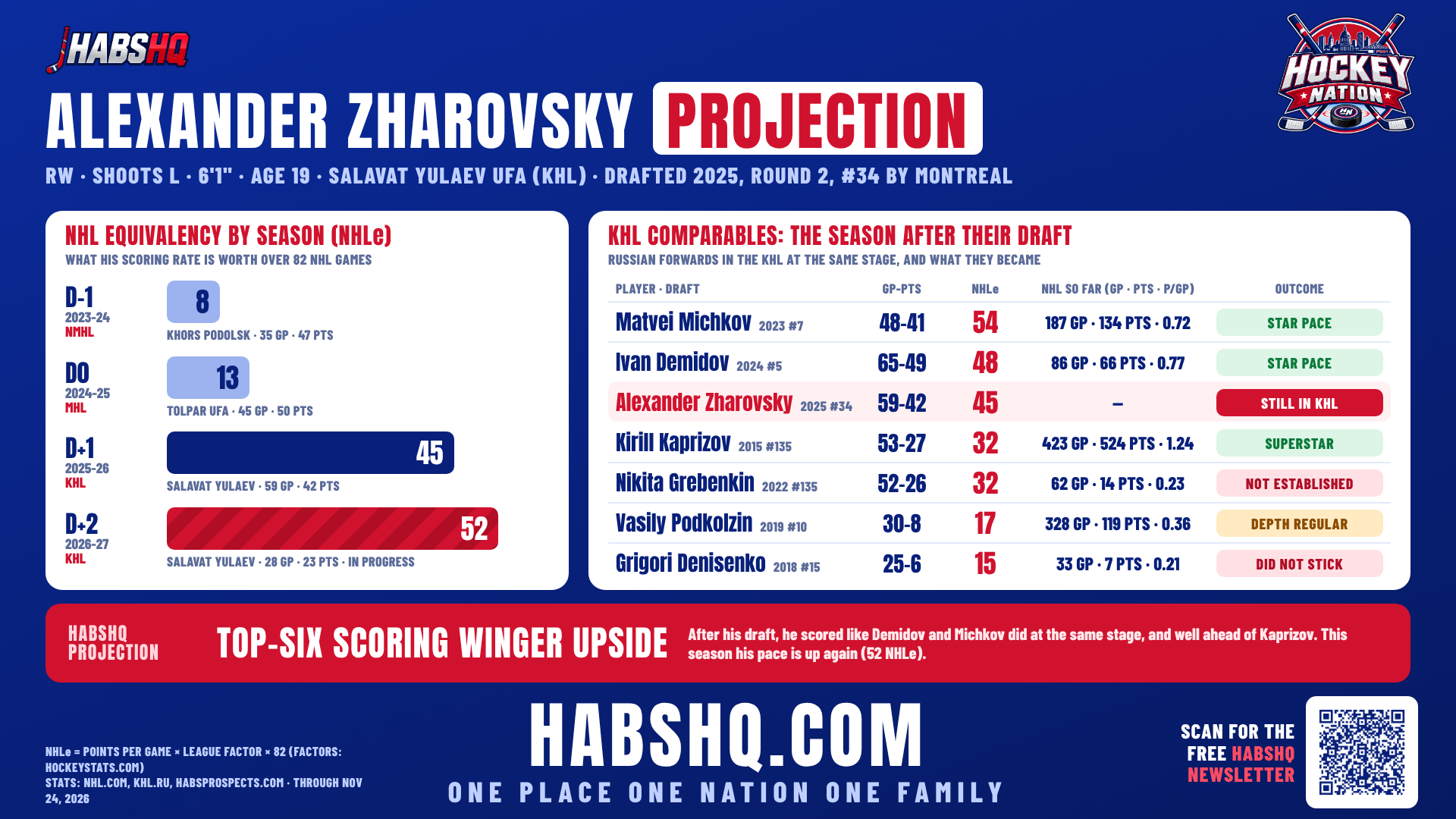
To put his numbers in context, we built a projection card that converts every season of Zharovsky’s career into NHL equivalency, or NHLe: what his scoring rate would be worth over 82 NHL games, using standard league conversion factors. It is not a prediction of his NHL point total. It is a way to compare scoring across very different leagues on one scale.
The jump is clear. His two junior seasons translate to 8 and 13, because the junior leagues he played in convert at a low rate. His first KHL season after the draft translates to 45, and this season he is on a 52 pace. A teenager whose number climbs once he faces men, instead of dropping, is the profile scouts look for.
The comparables are Russian forwards in their first KHL season after their draft, and what they became. Zharovsky’s 45 sits just behind Matvei Michkov (54) and Ivan Demidov (48), and well ahead of Kirill Kaprizov at the same stage (32). Michkov and Demidov have both scored better than 0.7 points per game in the NHL, and Kaprizov became one of the best wingers in the world.
The card also shows the players who did not work out, because a good KHL season guarantees nothing. Vasily Podkolzin (17) became a depth forward, and Grigori Denisenko (15) played 33 NHL games. The difference is that Zharovsky’s number sits with the top group, not the bottom one. The HABSHQ projection: top-six scoring winger upside, with the defensive details above still to clean up.
Contract, Draft Slot and What Comes Next
Zharovsky, born February 22, 2007, stands 6-foot-1 and 179 pounds, and is signed to a two-way contract with Salavat Yulaev through May 31, 2027. That timeline matters: his KHL deal ends after this season, so the earliest he could come to North America is 2027-28, and the rest of this season is his chance to keep building on both sides of the puck.
Montreal traded up to select him 34th overall in the 2025 draft, and his first two KHL seasons have backed that call. The team’s bet is straightforward: let him keep playing real minutes against men in a top European league, and worry about North American conversion once his KHL deal runs out.
For now, the file on Zharovsky reads like a player trending the right way offensively, plus-10 and climbing in points per game, with a defensive-engagement dip the coaching staff in Ufa, and eventually Montreal’s development staff, will want to see corrected before he is handed a bigger role. The rest of this KHL season will go a long way toward showing which version of this player shows up in a Canadiens jersey.
Sources: KHL.ru official statistics and KHL youngster report; NHL.com player statistics; HockeyStats.com NHLe factors.
Get the HABSHQ Newsletter in Your Inbox
Every Monday, the HABSHQ newsletter brings you the full Canadiens, Rocket, Lions and prospects report, our takes, the stats of the week and the preview of the week ahead, straight to your inbox. It is free.

Get the Habs week in your inbox
Free weekly newsletter from HABSHQ.
More from HABSHQ


Watch the analysis
Coach Frenchy breaks down every Canadiens game live on the Hockey Nation Live Show, with the lines, the numbers and the plays that mattered.
Watch on YouTubeAbout Coach Frenchy
Coach Frenchy (Pierre) hosts the Hockey Nation Live Show, the daily live Canadiens and NHL commentary show on YouTube. HABSHQ is where he brings the lines, the numbers and the prospects together in one place.
Leave a Reply