
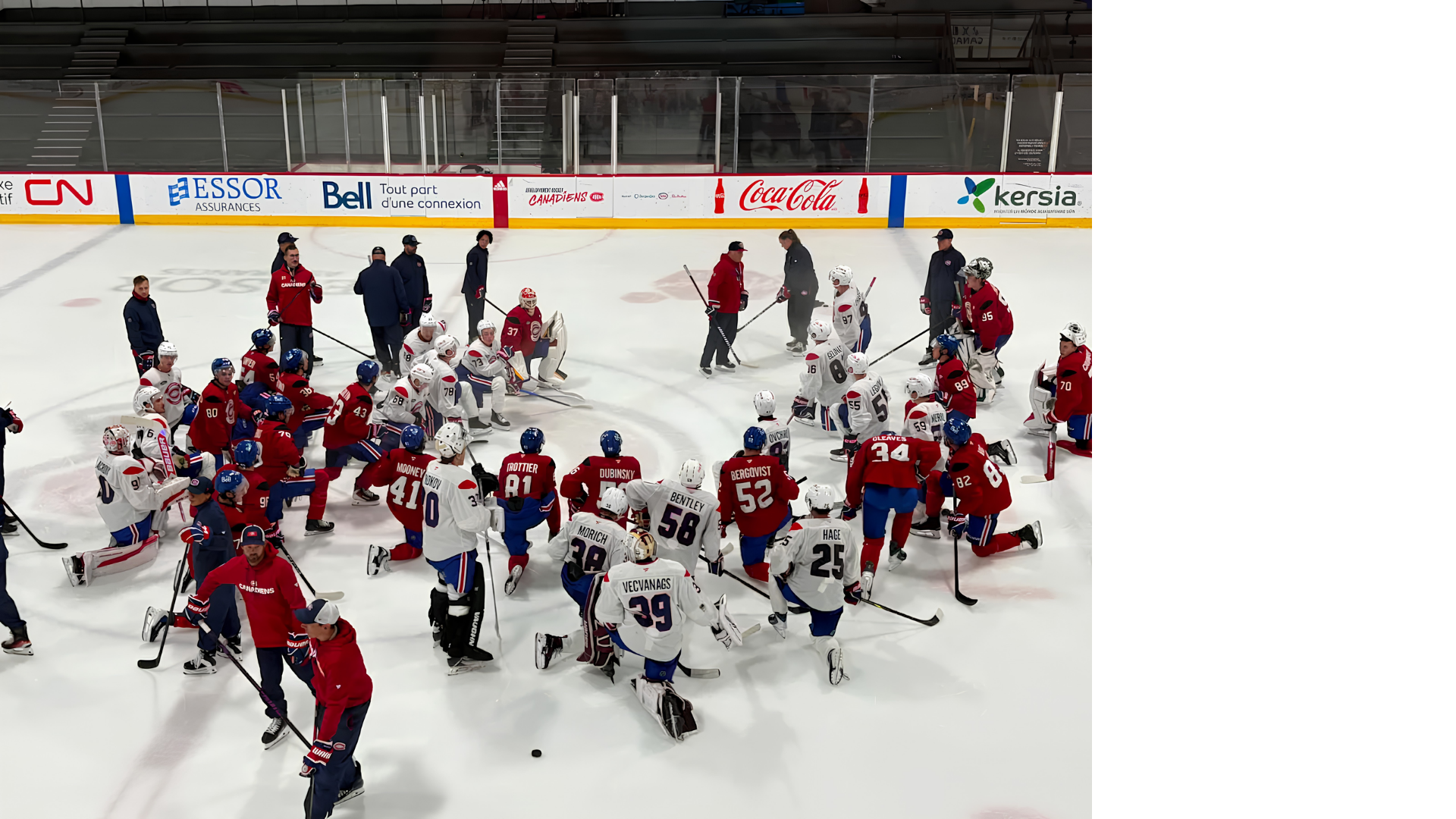
Heading into training camp, the Montreal Canadiens have an enviable problem: real offensive depth. With the top nine taking shape and the core locked in, the conversation naturally shifts to the bottom of the roster. Specifically, the battle for the 13th forward spot.
In the modern NHL, the extra skater is one of the most misunderstood roles on the roster. It is not an award handed out to your highest-ceiling prospect for having a flashy preseason. Carrying an extra forward is about utility, roster management, ego management, and, above all, developmental preservation.
The Canadiens’ development philosophy suggests that if a young player is not going to receive meaningful NHL minutes, the AHL can provide a better environment for his development. That creates an important question for Martin St. Louis and Kent Hughes: Is it better to have a talented young player sitting in the press box, or an experienced depth player who can step into the lineup immediately?
The ideal 13th forward is a low-maintenance pro who can sit in the press box for two weeks, stay in peak physical condition, and step onto the ice on short notice to deliver eight to ten hard-working, error-free minutes.
But there is another element that could have a major influence on this decision: waiver status and roster flexibility.
If a player can be sent to Laval without being exposed to the waiver process, Montreal has more freedom to prioritize development. If another player has already reached the point where roster management becomes more complicated, keeping him in Montreal could become the safer organizational decision.
With that philosophy in mind, several very different candidates are pushing for the job.
The 2025–26 Baseline: How the Candidates Performed
| Candidate | 2025–26 Primary Team | GP | G | A | PTS | PIM | NHL Experience | Profile |
|---|---|---|---|---|---|---|---|---|
| Brett Berard | Hartford / NYR | 41 AHL | 6 | 16 | 22 | 53 | 13 NHL GP | NHL-tested energy winger |
| Florian Xhekaj | Laval | 64 | 17 | 12 | 29 | 182 | 5 NHL GP | Physical, heavy forward |
| Lucas Condotta | Laval | 70 | 8 | 10 | 18 | 94 | NHL experience | Veteran insurance |
| Owen Beck | Laval | 58 | 13 | 20 | 33 | 28 | 28 NHL GP | Two-way center |
| Sasha Pastujov | San Diego | 71 | 21 | 36 | 57 | 26 | Limited NHL experience | Offensive wildcard |
| Jared Davidson | Laval | 53 | 16 | 9 | 25 | 59 | 10 NHL GP | High-motor winger |
The Canadiens’ current 2026–27 roster already includes Beck and Berard, among others, while Montreal’s official records confirm the 2025–26 numbers for several of these candidates. (NHL)
The Plug-and-Play Pro: Brett Berard
Acquired from the New York Rangers in exchange for defenseman William Trudeau, Brett Berard fits much of the modern 13th-forward blueprint.
Berard is an undersized, relentless sparkplug who plays with energy well beyond his stature. He already has NHL experience and understands the pace, structure, and physical demands of the league. That gives him an advantage over players who would be making their first serious attempt to establish themselves in Montreal.
Berard’s calling card is his motor. He attacks opposing defensemen on the forecheck, disrupts breakouts, and creates turnovers in the dirty areas of the ice. If St. Louis needs a fast-skating energy winger against a high-tempo opponent, Berard can slide onto the fourth line without requiring a long adjustment period.
But there is an important question.
Is Berard really the player Montreal wants sitting in the press box?
He is no longer simply a prospect waiting for his first opportunity. Montreal acquired him because the organization sees NHL potential in his game. If he has an exceptional training camp, the conversation could quickly move beyond the 13th-forward role.
Berard therefore represents something different from Condotta. Condotta is the insurance policy. Berard could be trying to prove that he deserves to become part of the regular lineup.
The Muscle & Deterrent: Florian Xhekaj
If the Canadiens want size, intimidation, and raw physical presence traveling with the team, Florian Xhekaj is an obvious candidate.
After a strong rookie campaign in Laval in 2024–25, Xhekaj took another step in 2025–26, finishing with 29 points and 182 penalty minutes in 64 games. He also received his first NHL opportunities, giving the Canadiens a glimpse of what his physical style could look like at the highest level. (NHL)
Xhekaj is particularly interesting because of the exemption situation.
If Montreal can send him back to Laval without exposing him to waivers, the organization has an important advantage: they don’t have to force the decision too early.
That could make Xhekaj one of the easiest players to keep developing outside Montreal if he doesn’t win a regular job.
But what happens if he dominates training camp?
That’s where things become complicated.
If Xhekaj shows that he can provide physicality while also contributing offensively, the Canadiens may have a difficult decision. Do they send a young, physical player back to Laval simply because there is no regular NHL spot available? Or do they find a way to keep him around because his unique skill set could be valuable against certain opponents?
The dilemma for management is simple:
Is Florian Xhekaj better served playing major minutes in Laval, or becoming Montreal’s physical insurance policy?
The Ultimate Veteran Insurance: Lucas Condotta
Every NHL coaching staff loves having a player like Lucas Condotta.
The Laval captain represents the definition of a professional depth player. He can be trusted to step into the lineup, follow a system, compete along the boards and provide the coaching staff with a dependable option when injuries strike.
Condotta will never light up an NHL highlight reel, but that isn’t the reason you carry a player like him.
His value is predictability.
He can sit in the press box, stay ready, and then suddenly find himself playing because someone is injured or because the coaching staff wants a different style of fourth-line game.
That’s exactly what you want from a 13th forward.
There is another advantage: Montreal does not need to protect his development in the same way it does with younger prospects. If Condotta plays eight minutes one night and doesn’t play the next three games, the organization isn’t worried about whether his long-term development is being compromised.
That makes him the safest option.
But is safe the same thing as best?
That’s where the debate begins.
If Montreal believes it has a legitimate playoff team, carrying a dependable veteran like Condotta could make sense.
If Montreal wants to maximize the development of its younger forwards, however, Condotta’s presence could also mean a more talented player starts the season in Laval.
The High-End Dilemma: Owen Beck
Selected 33rd overall in the 2022 NHL Draft, Owen Beck represents one of the most interesting decisions in this entire group.
Beck’s hockey IQ, defensive maturity and two-way game make him different from many of the other candidates. He finished 2025–26 with 33 points in 58 games in Laval and has already accumulated significant NHL experience. Montreal’s official records list him with 28 NHL games entering the end of the 2025–26 season. (NHL)
The real question isn’t whether Beck can play in the NHL.
It’s whether he should be the 13th forward.
And that could be a mistake.
Beck’s long-term value is much greater if he becomes an everyday NHL center rather than a player who watches games from the press box.
If he isn’t going to receive consistent minutes in Montreal, sending him to Laval to play major minutes in all situations could be much more beneficial.
And because Beck falls into the exemption group for this roster discussion, Montreal has another layer of flexibility.
That could ultimately work against him.
The Canadiens don’t necessarily have to keep him in Montreal simply because he is NHL-ready. They can use Laval as a development tool without facing the same roster-management concern they might have with another player.
Beck may therefore be one of the best players in this competition — and still not win the job.
That’s what makes this decision so fascinating.
The Wildcard: Sasha Pastujov
Sasha Pastujov might be the player capable of completely changing the conversation.
Montreal acquired Pastujov from Anaheim during the offseason after he produced 57 points in 71 AHL games with San Diego. His 21 goals and 36 assists immediately give the Canadiens another offensive option in their prospect pool. (NHL)
The question isn’t whether Pastujov can score at the AHL level.
The question is whether he can translate that offense into an NHL opportunity.
Unlike a traditional 13th forward, Pastujov isn’t necessarily the type of player you want sitting in the press box for long stretches. If his offensive game explodes during training camp, the Canadiens may have to ask themselves whether they are looking at a potential everyday NHL winger rather than an extra forward.
That’s what makes him a true dark horse.
If Pastujov has a dominant preseason, he could force Montreal to reconsider the entire depth chart.
And that is exactly what a prospect should do in training camp.
Don’t simply win the 13th-forward job.
Make the Canadiens wonder why you’re not already in the top 12.
Jared Davidson: The Gallagher Comparison
Jared Davidson is another player who could make the decision difficult.
His game is built around effort, competitiveness and a willingness to go into uncomfortable areas of the ice. The Brendan Gallagher comparison is understandable because of his motor and willingness to battle around the net.
Davidson also received NHL experience last season, giving him a taste of what Montreal expects at the highest level.
But like Beck, Davidson faces an important development question.
If he isn’t going to play regularly in Montreal, would it really benefit him to spend most nights watching from the press box?
Probably not.
And because Davidson is part of the exempt group for this roster discussion, Montreal has more flexibility with his development.
That could actually make his path more difficult.
He might need to be better than the veterans, not simply equal to them, to convince the Canadiens that keeping him in Montreal is worth sacrificing regular AHL minutes.
That’s a tough standard — but it’s also the reality of a team with increasing depth.
The Waiver & Exemption Factor Could Decide Everything
This might be the most important part of the entire debate.
Fans often look at the 13th-forward competition and ask:
“Who is the best player?”
Kent Hughes may be asking a completely different question:
“Who gives us the best combination of NHL readiness, development, roster flexibility and risk?”
Those are not the same thing.
Beck, Davidson and Florian Xhekaj have the advantage of exemption in this roster discussion. That gives Montreal the ability to send them to Laval and continue their development without having to treat the decision exactly the same way as a player who carries greater roster-management risk.
That changes the calculation.
Imagine two players have nearly identical training camps.
One can be sent to Laval without creating a roster problem.
The other becomes more complicated to move.
Which one does management keep?
The answer may not be the player with the higher upside.
This is why the 13th-forward battle could ultimately be decided away from the ice.
Contracts, waiver status, development needs, injuries and roster flexibility could all influence the decision.
And if one of the younger players absolutely dominates training camp, all of those calculations could become irrelevant.
That’s the beauty of training camp.
The Final Verdict
When the puck drops on opening night, I expect the Canadiens to prioritize development and roster flexibility rather than simply choosing the six most talented forwards for the final depth positions.
That makes Brett Berard and Lucas Condotta the two players I currently see as the strongest candidates for the traditional 13th-forward role.
Berard brings NHL experience, speed, forechecking pressure and the potential to become more than a spare forward.
Condotta brings something completely different: reliability.
He is the player you can trust to sit for several games and then step into the lineup without asking the organization to sacrifice the development of a young prospect.
But there is a second group that could completely change the equation.
Owen Beck, Florian Xhekaj and Jared Davidson are exempt in this roster discussion, giving Montreal more flexibility to continue their development in Laval.
And then there is Sasha Pastujov, the wildcard who could force his way into the conversation with a dominant training camp.
So perhaps the real battle isn’t simply:
“Who will be the Canadiens’ 13th forward?”
Maybe the better question is:
“Which player gives Kent Hughes the best combination of immediate NHL insurance, long-term development and roster flexibility?”
That makes this much more than a competition for one press-box seat.
It is a decision between development, security, flexibility and upside.
And if one of these young players forces the Canadiens’ hand during training camp, the player currently projected to be the 13th forward could suddenly find himself outside the lineup altogether.
Who would you choose?
Would you take the safe veteran in Lucas Condotta?
The NHL-tested speed of Brett Berard?
The physical presence of Florian Xhekaj?
The two-way game of Owen Beck?
The offensive upside of Sasha Pastujov?
Or the relentless style of Jared Davidson?
The Canadiens may have only one extra forward spot — but they have several very different ways to fill it.
Get the Habs week in your inbox
Free weekly newsletter from HABSHQ.
Leave a Reply