
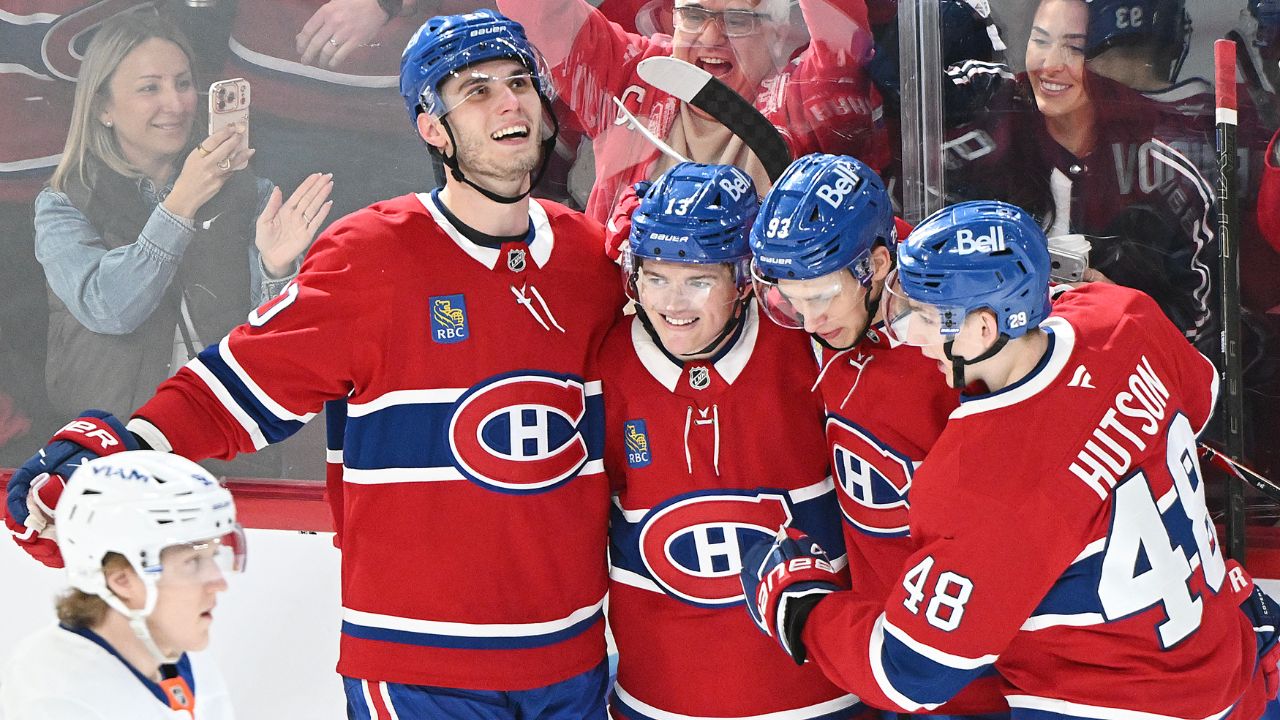
The Athletic just dropped its 2026-27 NHL Player Tiers — the latest edition of a project built by senior writers Harman Dayal, Thomas Drance, Sean Gentille, Shayna Goldman, and Dom Luszczyszyn. They sort the 150 best players in hockey into five tiers, from Tier 1 (MVP/Cornerstone) down to Tier 5 (Support), each broken into A/B/C sub-groups for finer separation. The process starts with a projected “Net Rating” — a model that combines a player’s production with his play-driving ability, adjusted for usage, to estimate his impact on his team’s goal differential for the coming season. An elite player usually lands around +10 or higher, a solid top-of-lineup player is closer to +5, and 0 is league average. From there, the five writers and a panel of more than 20 league insiders — scouts, execs, coaches, former players — argue it out and lock in the final order.
Seven Canadiens made the list this year, and two of them landed in the Franchise tier — a rarity across the whole league. Here’s where every one of them landed, projected 2026-27 numbers included, and where we think the ranking got it right — and where it didn’t.
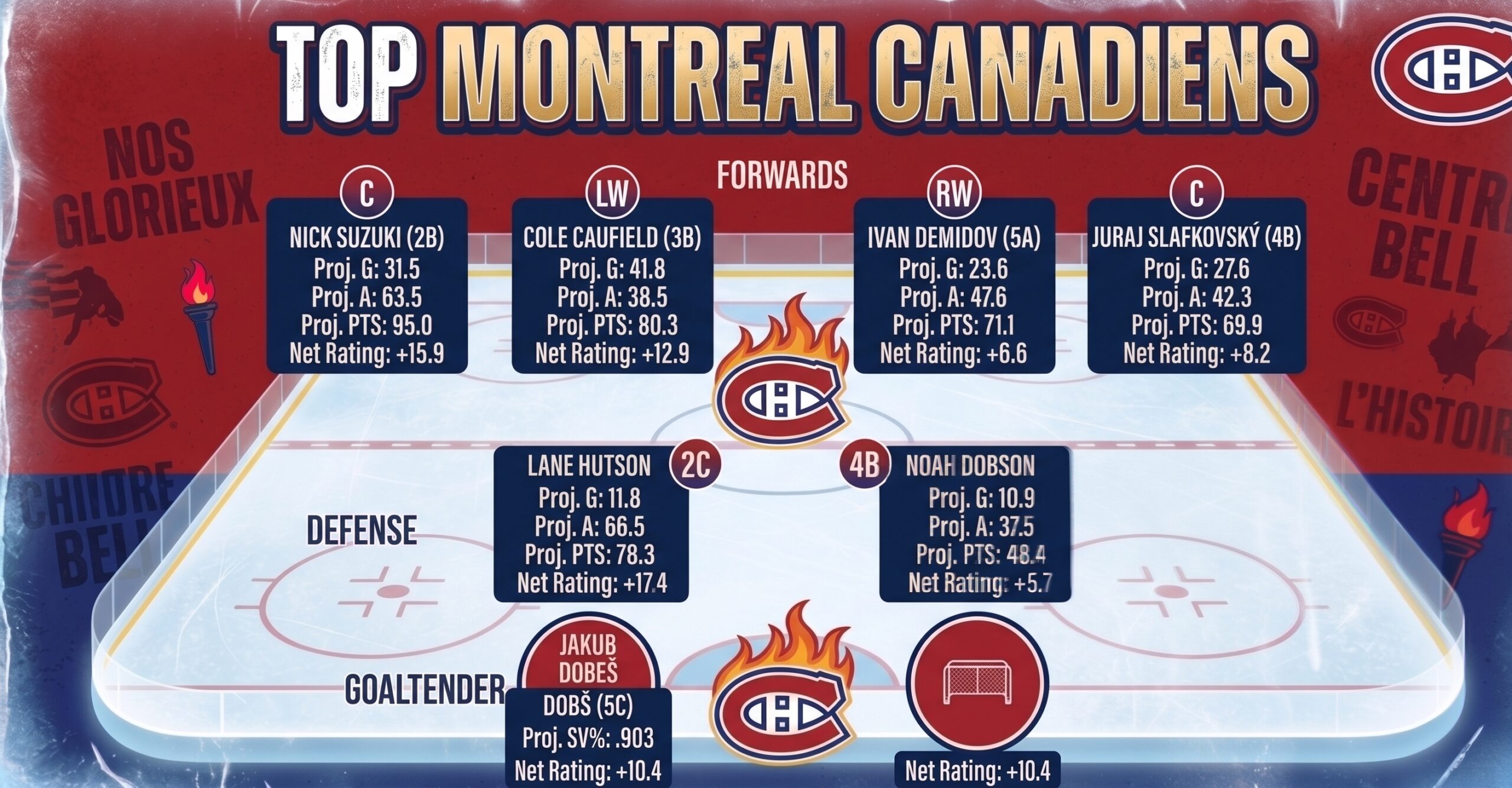
WHERE EVERY HABS PLAYER LANDED
Nick Suzuki — Tier 2B (Franchise)
The least controversial spot on this whole list. Suzuki just won the Selke Trophy as the league’s best defensive forward, and The Athletic’s own model actually had his Net Rating trailing only Connor McDavid and Macklin Celebrini last season — better than every other player in the sport. One coach called him “a nightmare” to play against, and meant it as a compliment. Several panelists said they’d take him over Jack Hughes. A complete two-way center, and it’s not close.
Lane Hutson — Tier 2C (Franchise)
The one that looks like a surprise on paper and isn’t one at all if you’ve actually watched him play. Montreal took him 62nd overall in 2022, after a long line of teams passed on him over his size. Since he stepped into the lineup, the Canadiens haven’t missed the playoffs — and Hutson is a huge reason why. The vision, the hockey IQ, the skating, the sheer determination to prove every team that passed on him wrong — it’s changed how this offense operates. The Athletic’s own model actually projects Hutson’s Net Rating (+17.4) to come in higher than Suzuki’s next season, and their evaluators floated real Norris Trophy upside if his defensive game keeps catching up to Quinn Hughes’ career arc, the comp they used for him.
Cole Caufield — Tier 3B (All-Star)
Coming off a 51-goal season and this year’s Lady Byng winner, Caufield’s placement isn’t really in dispute. The knock, per The Athletic’s own scouts, is that he can struggle to drive play on his own against elite competition — fair enough. Worth noting, too: his playoffs didn’t look like his regular season. The shots weren’t finding the same lanes, the space he lived in all year got a lot harder to find, and the finishing touch that made him a 51-goal scorer went quiet at points. That wasn’t just a Caufield problem, though — his whole line struggled to generate the same way once the games got tighter in the postseason. Nobody’s arguing he isn’t one of the purest shooters alive.
Juraj Slafkovský — Tier 4B (Star)
A 30-goal, 73-point breakout season, a strong Olympics, and a Tier 4 slot that one of The Athletic’s own scouts admitted might be too conservative. What actually changed this year is that Slafkovský finally figured out what he can do with his body. He’s stronger, more mature, and protects the puck far better than he used to — driving the play himself on the carry instead of just being a beneficiary of it. The real turning point came when he dropped to the second line alongside Demidov: that stretch is where his season transformed. He carried that new confidence back up to the top line, and after the Olympic break, that duo became one of the most dangerous combinations on the team. We’re on board with where he landed. The arrow is pointing straight up.
Noah Dobson — Tier 4B (Star)
Tied with Slafkovský in the exact same sub-tier — and this is where we start to disagree. The Athletic’s own writeup on Dobson is lukewarm at best: he fell out of Tier 3 last year after his production dropped from 70 points (2023-24) to 39 (2024-25) with the Islanders, and “with the Canadiens, Dobson’s production hovered in the same space,” while his expected goal share dropped from 54 percent to 47 percent — worse than Montreal’s team average. Their own words: “That made arguing him back up the list a tough sell. Nobody on our panel made the attempt.” His actual 2025-26 line with Montreal: 47 points in 80 games, still well off his 70-point peak. He also played through a hand injury suffered in Montreal’s third-to-last regular season game that needed a procedure — he missed the start of the playoffs, and managed just one assist over 13 playoff games afterward. He’s a good, mobile, first-pairing defenseman with real vision and a big shot — when it’s on target. But this isn’t a Norris-track player, and the numbers back that up: of all seven Habs on this list, Dobson’s own projected Net Rating for next season (+5.7) is the lowest — even below Demidov’s rookie projection.
Ivan Demidov — Tier 5A (Support)
Sixty-two points as a 20-year-old NHL rookie earned him the very top spot in Tier 5 — the highest sub-tier of the lowest group on a 150-player board. What that ranking doesn’t fully capture: Demidov led every rookie in the NHL in scoring this past season, ahead of even Calder Trophy winner Matthew Schaefer, and finished runner-up for the Calder himself. The Athletic’s own evaluators called his tier placement a fair grade for a debut season, while also predicting he could rocket up their list before long. One veteran evaluator put his ceiling at “50-goal upside.” This is where we disagree the most.
Jakub Dobeš — Tier 5C (Support)
Montreal’s goaltending was a rollercoaster to start last season — Samuel Montembeault was unplayable, Jacob Fowler was unproven — and Dobeš had his own share of shaky nights early. Then everything changed after the Olympic break: 14 goals saved above expected in just 16 games, and an impressive run through three rounds of playoff hockey. As one former player put it, “he wasn’t the guy until he was.” A fair grade for a 25-year-old who’s still building a track record, with real room to climb.
OUR TAKE: DEMIDOV DESERVES MORE
A ranking like this is built to capture where a player is right now, not where he’s going — and where Ivan Demidov is going is the whole point. A 20-year-old just put up 62 points in his rookie season, in a league where most 20-year-olds are still fighting for a regular shift. The panel put him at the very top of the lowest tier on the board, which is really just another way of saying he’s standing on the doorstep of the next one up. And that’s before you factor in a player who’s still adjusting to North American ice, still growing into his frame, still just scratching the surface of what he showed at every level before he ever put on a Habs sweater.
We think Demidov becomes the best player on this team within the next three seasons. Not just part of the Tier 3 conversation — the best player, full stop, on a roster that already has a Selke winner, a Lady Byng winner, and a defenseman half the league wishes it hadn’t passed on. That’s not a knock on any of them. It’s what makes his ceiling so dangerous for the rest of the NHL: Montreal isn’t hoping one star carries a rebuild. It already has four players this very list just validated. If Demidov gets to where we think he’s going, that’s not one more good player. That’s the difference between a good team and a team built to win a Stanley Cup.
OUR TAKE: DOBSON IS RANKED TOO HIGH
Here’s the flip side. Tying Dobson with Slafkovský at 4B gives him credit he hasn’t earned yet — and The Athletic’s own reporting basically admits it. This is a player whose production has gone in one direction for two straight seasons (70 to 39 to 47), whose expected goal share dropped after the trade to Montreal, and whose role has changed with the Canadiens — he’s no longer a true PP1 option the way he was on Long Island. He’s a legitimately good, mobile, first-pairing defenseman with excellent vision and a heavy shot. But that shot misses the target more often than it should, and a hand injury that needed a procedure limited what he could give this team when it mattered most in the playoffs. Great defenseman? Yes. A Tier 4B “Star” on the level of a 30-goal, 73-point breakout season from Slafkovský? Not yet — and the numbers agree with us: his own projected Net Rating for 2026-27 is the lowest of any Hab on this list. One tier below Slafkovský is the honest call.
THE FUTURE OF MONTREAL
The gap between a really good team and a genuine contender usually comes down to one thing: does the roster have a player capable of taking over a night, a series, a run, when everything else is even. Suzuki gives this team a weapon at both ends of the ice. Hutson gives it a game-breaker from the back end. Caufield gives it a finisher. Slafkovský gives it size and a shot that keeps climbing. Dobson gives it stability on the blue line, even if the ceiling isn’t what some think. Dobeš gives it a goaltender who’s already shown he can rise to the moment. What none of them are — not yet, and maybe not ever — is the kind of singular, bend-the-game talent Demidov’s tools suggest he could become. If he gets there, this stops being a team with a great young core and starts being a team built the way Cup winners actually get built. The Athletic got five out of seven right, in our book. The other two are the two that matter most for where this franchise is actually headed.
Leave a Reply